The Unique Burial of Fāṭimah bint Asad

Updated: 1 hour ago
Fāṭimah bt. Asad (AS) was the 11th convert to Islam and the first female to pledge allegiance to Rasūlullāh (ﷺ) when it was ordained. Despite being the mother of Imām ʿAlī (AS), she also mothered Rasūlullāh (ﷺ) to the extent that he regarded her as his second mother.
She passed away in the 4th year after the Hijrah, at approximately 60 years of age, and was buried in the cemetery of al-Baqīʿ in Madīnah. Due to the Prophet's immense love for her, it was very difficult for him to cope with her loss.
In this article, we will examine one of this noble lady’s unique virtues, which is that the Prophet (ﷺ) buried her in a manner unlike any of other companion.
The Prophet’s Tawassul through Himself
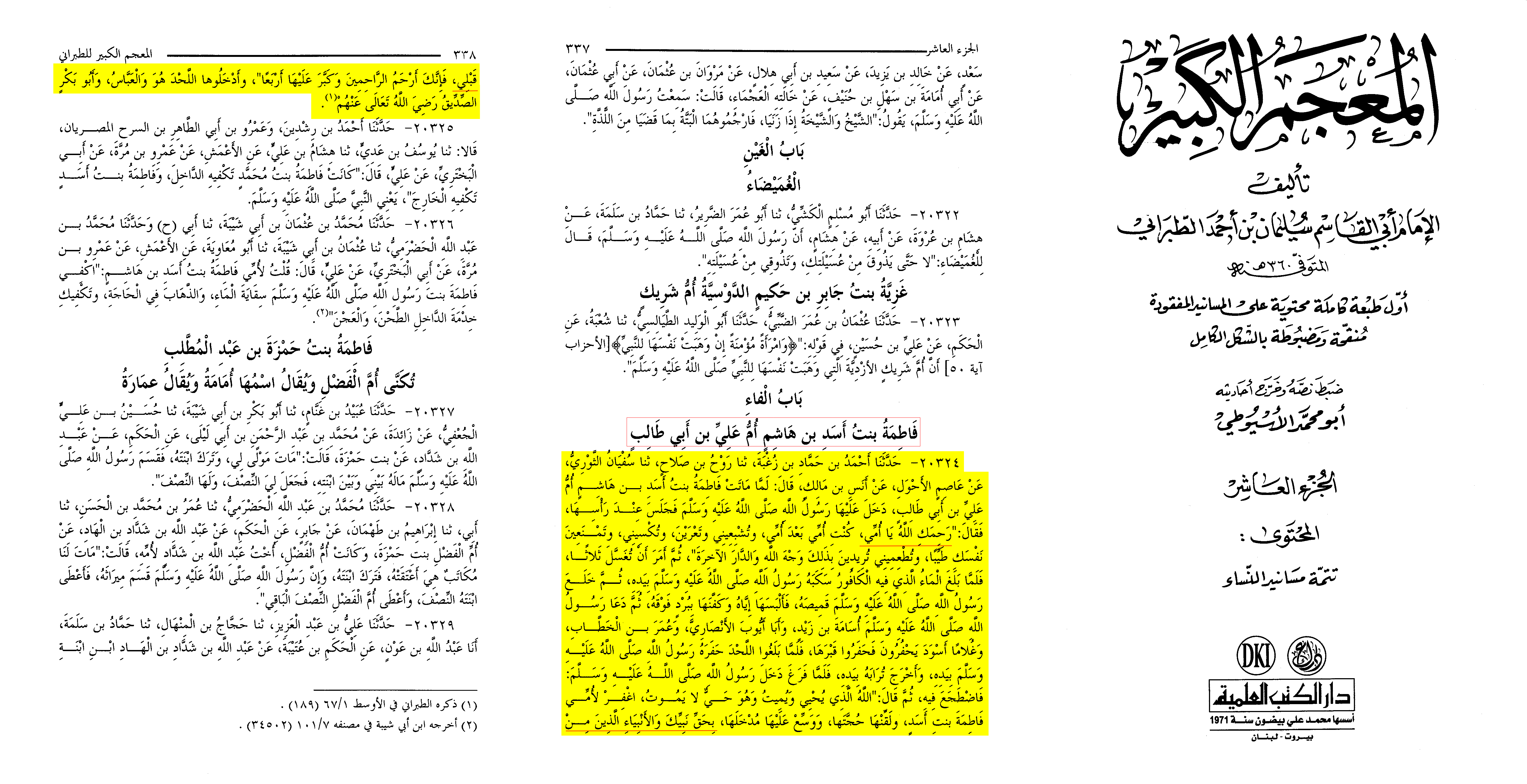
The following tradition serves as one of the clearest evidence for the permissibility of tawassul through the dead. It was recorded by al-Ṭabarānī in his al-Muʿjam al-Kabīr, Vol. 10, pg. 337 - 338, Hadith # 20324:
Aḥmad b. Ḥammād b. Zughbah narrated to us, he said: Rūḥ b. Ṣalāḥ narrated to us, he said: Sufyān al-Thawrī narrated to us, from ʿĀṣim al-Aḥwal, from Anas b. Mālik, who said:
When Fāṭimah bt. Asad b. Hāshim, the mother of ʿAlī b. Abī Ṭālib, died, the Messenger of Allah (ﷺ) entered upon her and sat at her head and said: "May Allah have mercy on you, O my mother! You were my mother after my mother. You would satisfy my hunger while you yourself went hungry, you would clothe me while you yourself remained unclothed, you would deny yourself good things and feed me, seeking the Face of Allah and the Hereafter."
Then he ordered that she be washed three times, and when it reached the water mixed with camphor, the Messenger of Allah ﷺ poured it with his own hand. Then the Messenger of Allah (ﷺ) removed his shirt and clothed her in it, and shrouded her with a cloak over it.
Then the Messenger of Allah (ﷺ) called Usāmah b. Zayd, Abū Ayyūb al-Anṣārī, ʿUmar b. al-Khaṭṭāb, and a black servant to dig; so they dug her grave. When they reached the bottom of the chamber, the Messenger of Allah (ﷺ) dug it with his own hand and removed its soil with his own hand.
When he finished, the Messenger of Allah (ﷺ) entered it and lay down in it, then said: "Allah is the One who gives life and causes death, and He is Living and does not die. Forgive my mother Fāṭimah bt. Asad, teach her her proof, and expand for her her entrance, by the right of Your Prophet and the prophets before me. Indeed, You are the Most Merciful of the merciful."
The same report was recorded in Ḥilyat al-Awliyāʾ Vol. 2, pg. 401 - 402 by Abū al-Nuʿaym al-Iṣbahānī, where the editor declares it as a reliable (Hasan) report.
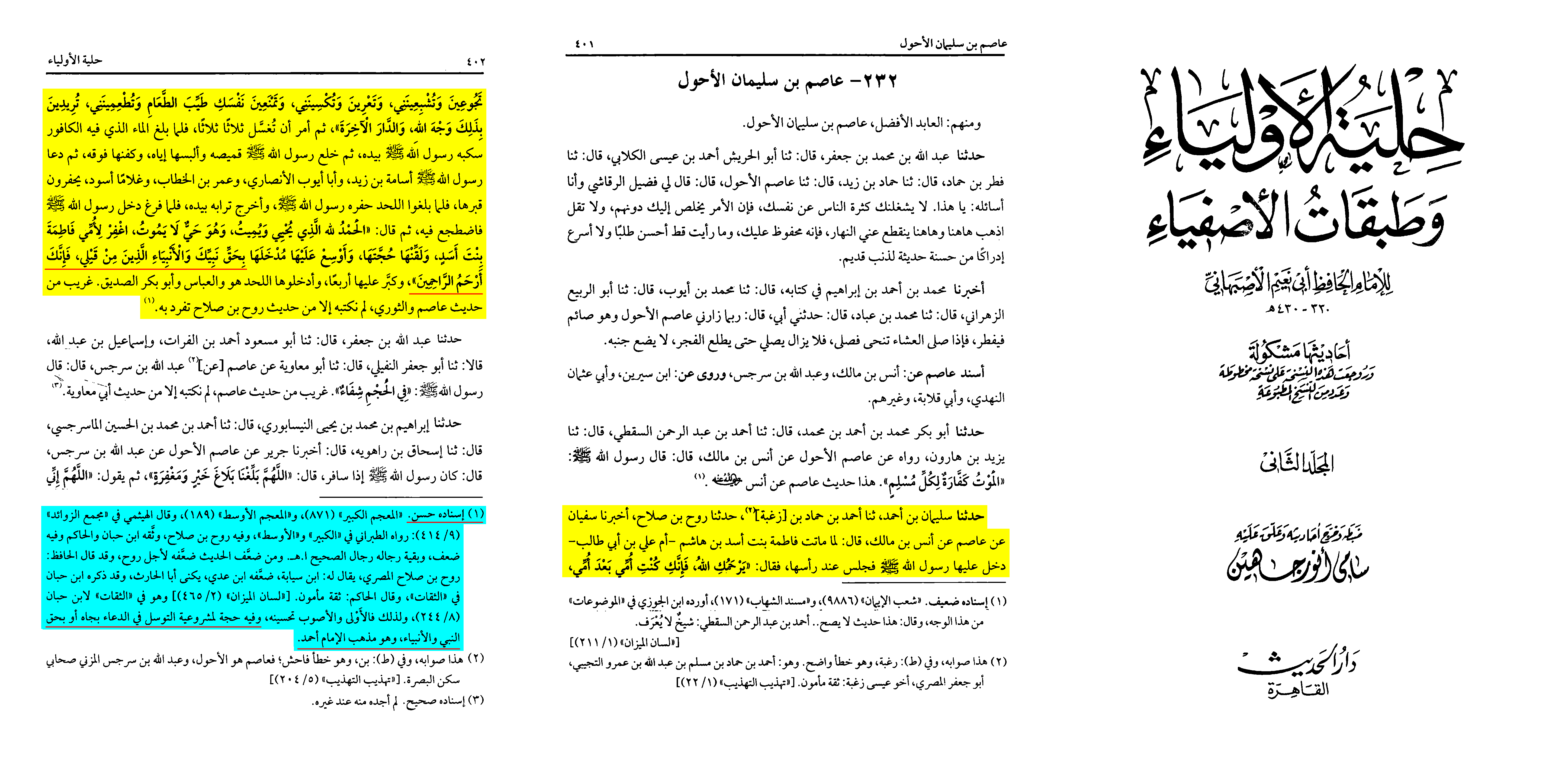
In this report, the Prophet approaches Lady Fāṭimah bt. Asad (AS) after she had passed away, calls out to her, and speaks to her. This is a practice that is frequently observed throughout the Prophet's life in his interactions with those who had passed away.
During the burial process, the Prophet ensured she is shrouded with his own shirt and cloak, because of its blessed nature due to belonging to the Prophet (ﷺ). He then entered upon her grave while praying for her by virtue of all of the Prophets of God.
This tradition is very clear in its meaning, it shows the permissibility of: Calling to the dead, seeking blessings from the things the Prophet touched and owned (tabarruk), and interceded through all the Prophets of God.
Credibility of Rūḥ b. Ṣalāḥ
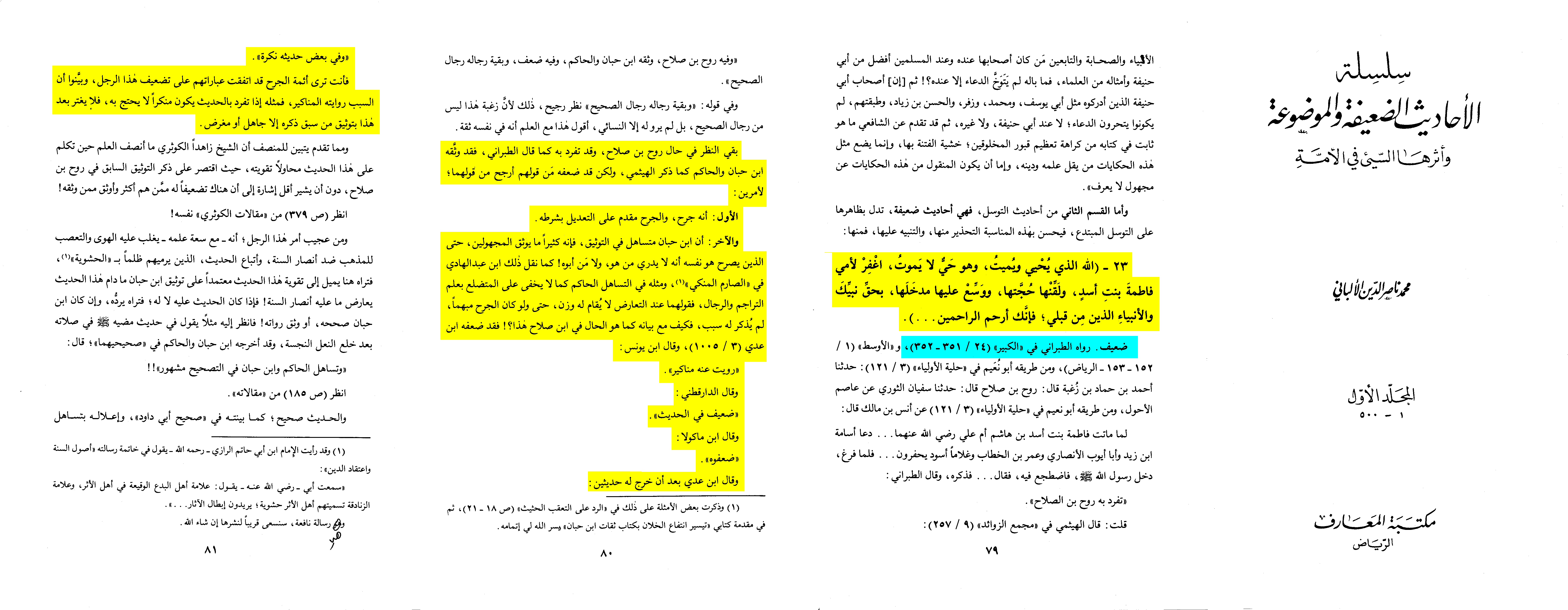
Nāṣir al-Dīn al-Albānī rejected this report due to the presence of Rūḥ b. Ṣalāḥ, such that he said the following in Silsilat al-Aḥādīth al-Ḍāʿīfah Vol. 1, pg. 81:
It remains to examine the status of Rūḥ b. Ṣalāḥ, for he alone narrated this report, as al-Ṭabarānī stated. Ibn Ḥibbān and al-Ḥākim declared him trustworthy, as al-Haythamī mentioned. However, those who criticised him are given greater weight than those two, for two reasons:
First, this is a case of disparagement (jarḥ), and—when its conditions are met—it takes precedence over praise (taʿdīl).
Second, Ibn Ḥibbān is known for being lenient (mūtasahil) in declaring narrators trustworthy. He frequently authenticated unknown narrators, even individuals about whom he himself explicitly said that he did not know who they were or who their fathers were.
Al-Ḥākim is similarly lenient in this regard, as is well known to those well versed in the this science.
Therefore, when their taʿdīl conflicts with jarḥ, their opinion carries little weight—even if the jarḥ is somewhat general and its reason is not stated. So how much more so when the reason is explicitly explained, as is the case with this Ibn Ṣalāḥ?
Ibn ʿAdī declared him weak. After citing two of his narrations, Ibn ʿAdī commented: "Some of his hadith contain objectionable material."
Ibn Yūnus said: "Munkar narrations were narrated from him."
Al-Dāraquṭnī said: "He is weak in hadith."
Ibn Mākūlā said: "They declared him weak."
So you see that the Imāms of criticism have agreed in their expressions on weakening this man, and they have explained that the reason is his narration of odd reports. So when one like him narrates a hadith alone, it is rejected and not used as evidence. Therefore, do not be deceived after this by the authentication of the one previously mentioned except by an ignorant person or one with ulterior motives.
Al-Albānī has a habit of pretending that his opponent is biased and ignorant while he manifests these qualities in every word he writes.
First: When scholars contradict each other in evaluating a narrator's reliability, two principles are applied to reconcile these differences: first, clear expressions (jarḥ or taʿdīl mufassạr), such as "he is unreliable because he admitted to lying" are prioritized over vague statements (jarḥ or taʿdīl mujmal) like simply declaring "he is unreliable".
However, when both disparagement (jarḥ) and praise (taʿdīl) are equally vague, precedence is given to the praise. The reason for this was explained to us by Ibn Ṣalāḥ al-Shaharūzī in Maʿrifat ʿUlūm al-Hadith, pg. 217:
"Taʿdīl is accepted without mention of its cause according to the correct majority opinion, because its causes are too vast that makes it difficult to mention…".
"However, Jarḥ is not accepted unless it is elaborate and explains the cause, because people differ as to what is jarḥ and what isn't."
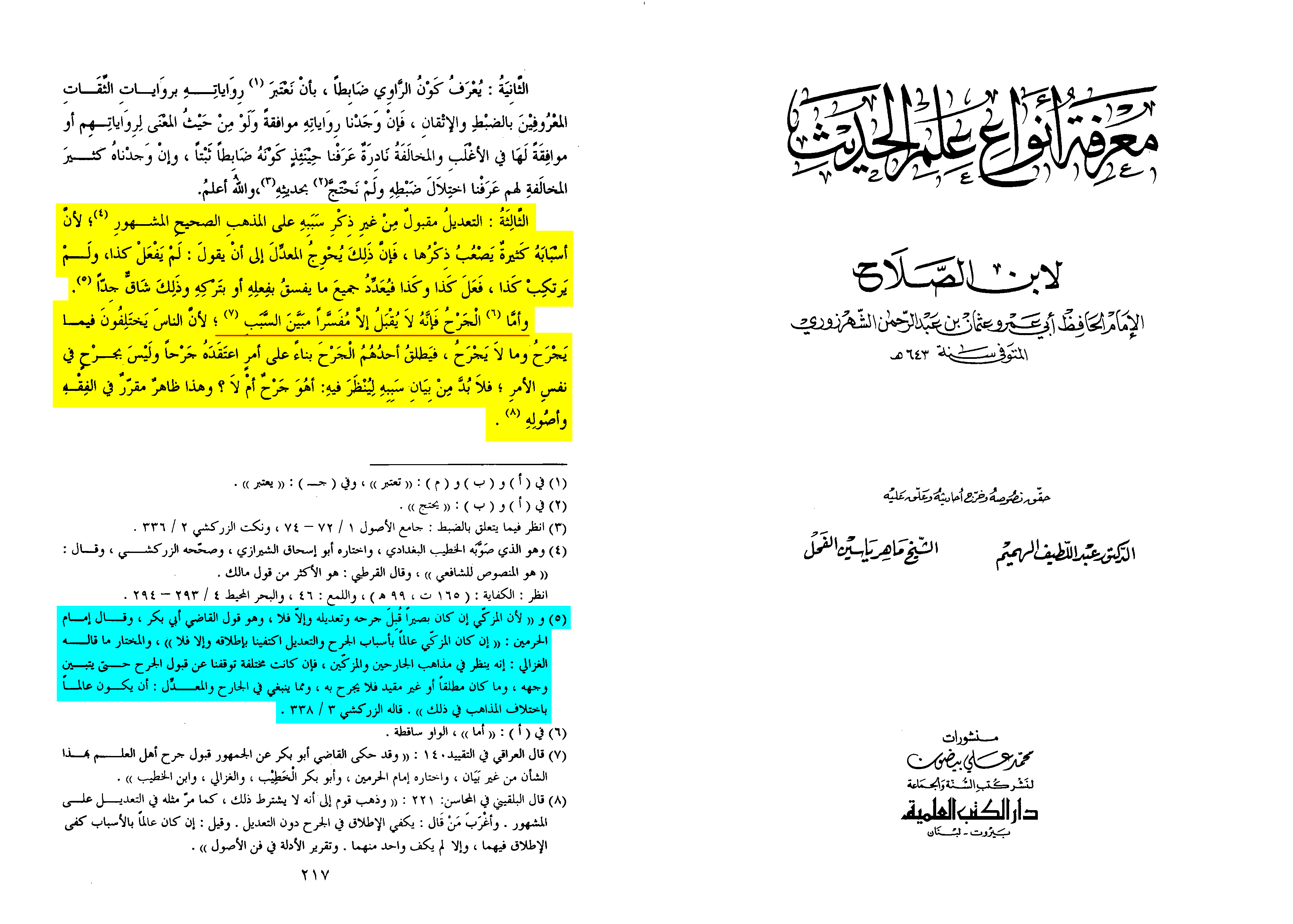
Thus, the explanation for this matter lies in the obvious perception that praise requires no elaboration, as it may be too obvious or vast to explain in a single statement. Disparagement, however, is not so self-evident, and so requires a clear reason to be accepted.
For this reason, Muḥammad b. Nasr al-Marwazī, says in Tahdhīb al-Tahdhīb Vol. 4, pg. 555:
"Every man whose integrity has been established—the criticism of anyone against him is not accepted until it is made clear against him with a matter that admits no explanation other than disparagement."
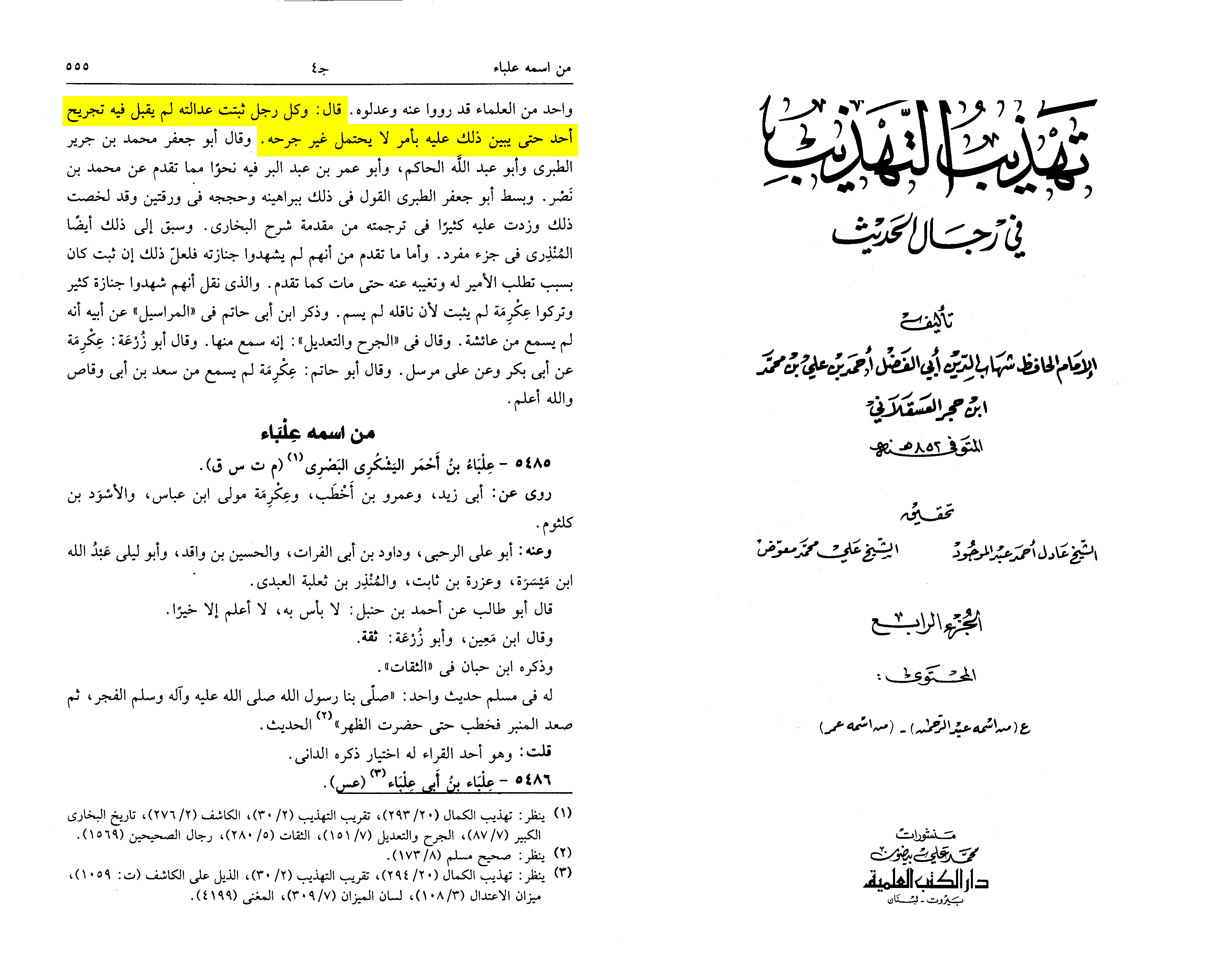
Second: Al-Albani claims the praise of Ibn Hibban for Rūḥ b. Ṣalāḥ is insufficient because he was lenient, however, this seemingly contradicts what most scholars comment about Ibn Hibban’s methodology. He was actually known for his strictness in Hadith evaluation.
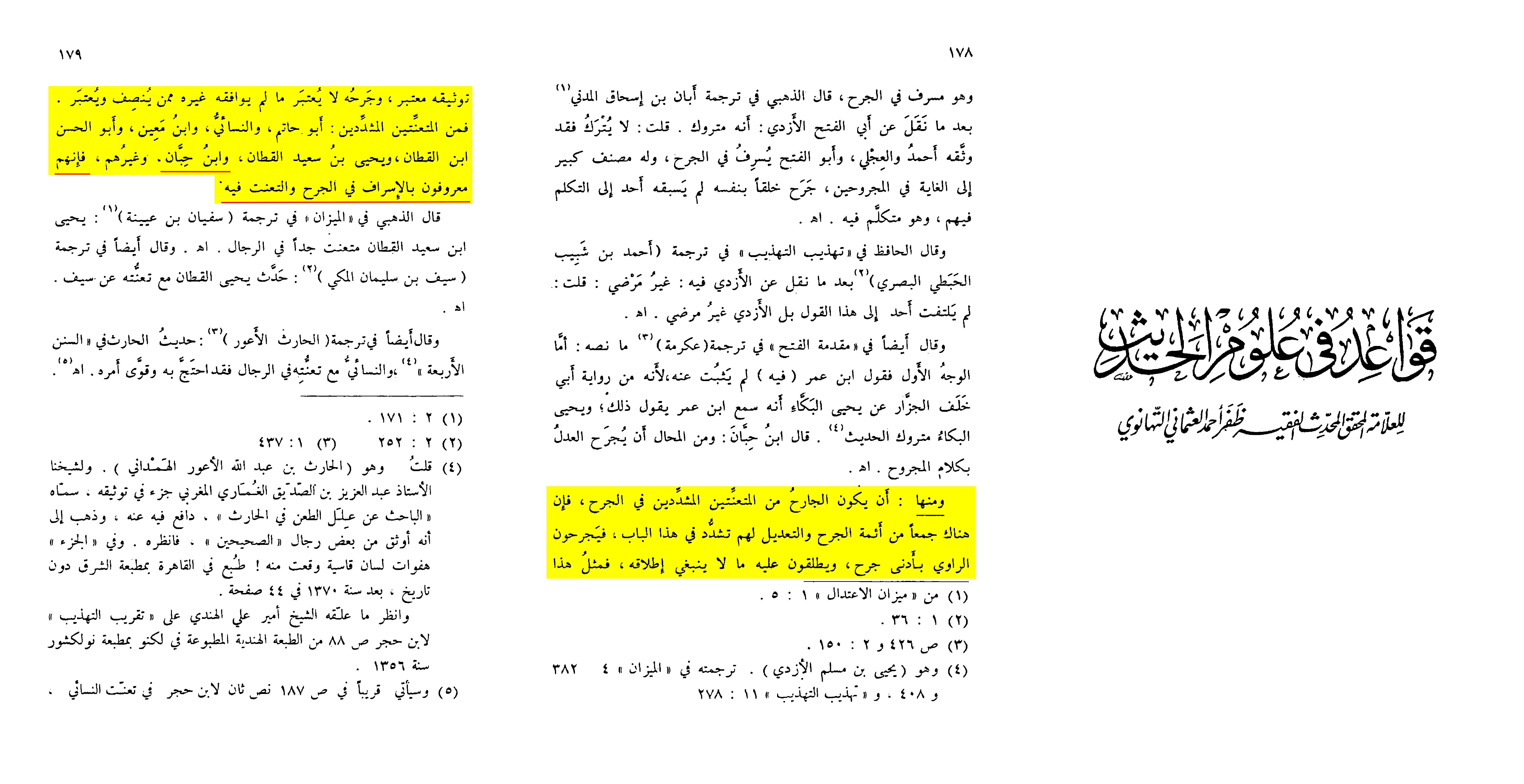
Just consider what ʿAllāmah al-Tahānawī says in al-Qawāʿid Fī ʿUlūm al-Hadith, pg. 178 - 179:
There is a group of the leading scholars of al-jarḥ wa al-taʿdīl who are known for being particularly severe in this field. They may criticize a narrator for the slightest flaw and apply descriptions to him that should not ordinarily be applied.
In such cases, their taʿdīl is considered reliable, but their jarḥ is not accepted unless it is supported by another critic who is fair and balanced in his judgement.
Among those regarded as overly strict and severe are: Abū Ḥātim al-Rāzī, al-Nasāʾī, b. Maʿīn, Abū al-Ḥasan b. al-Qaṭṭān, Yaḥyā b. Saʿīd al-Qaṭṭān, Ibn Ḥibbān, and others, for they are known for excessive strictness and severity in narrator criticism.
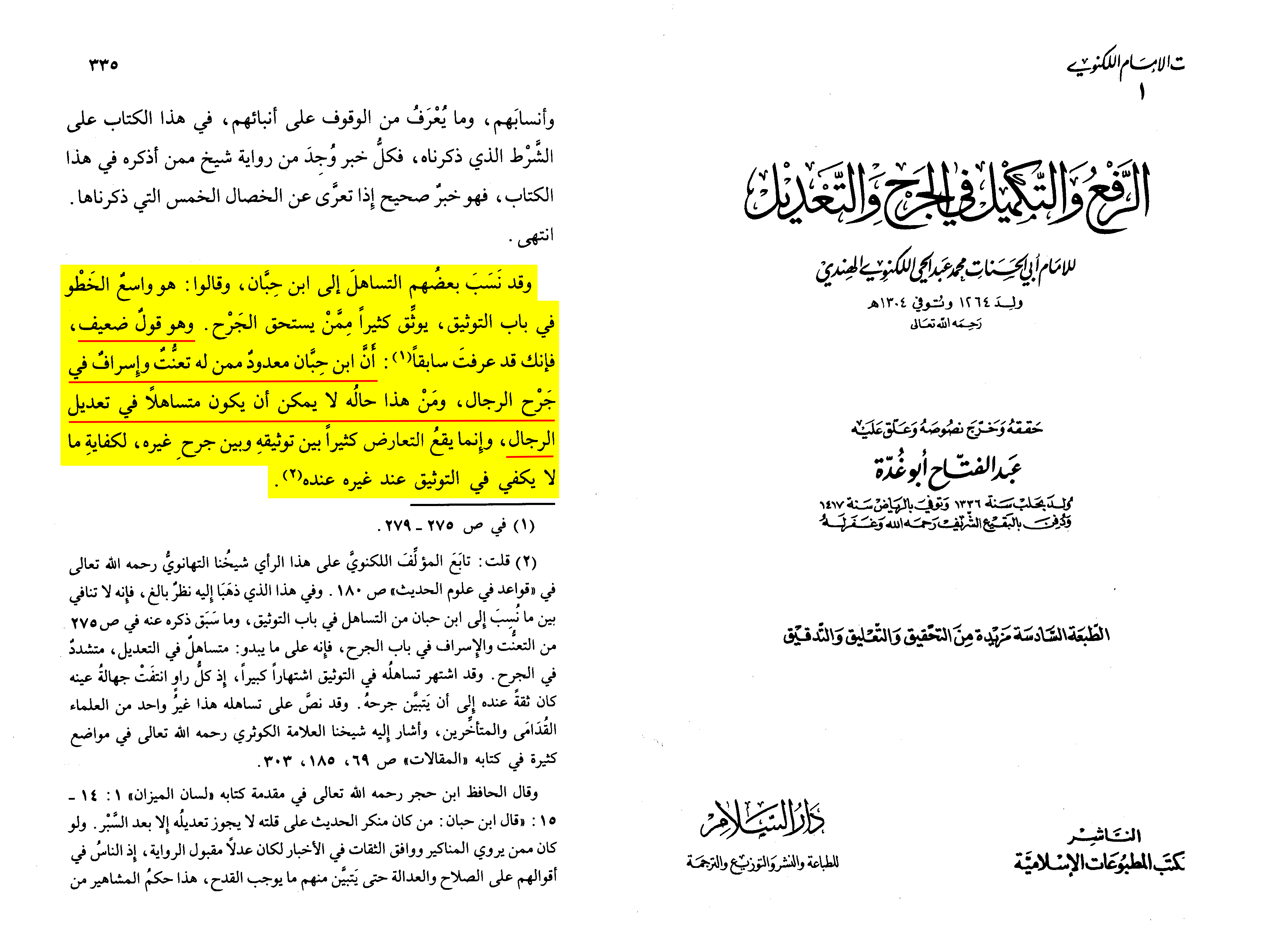
For this reason, his student ʿAllāmah al-Laknawī, says in al-Rāfiʿ wal-Takmīl Fī Jarḥ wal-Taʿdīl, pg. 335:
Some scholars have attributed leniency (tasāḥul) to Ibn Ḥibbān, claiming that he was overly broad in the field of narrator certification (tawthīq), declaring trustworthy many narrators who actually deserve criticism.
This is a weak claim, for as you have already seen earlier, Ibn Ḥibbān is counted among those known for being strict and excessive in criticizing narrators (jarḥ al-rijāl). Someone with such a characteristic cannot reasonably be described as lenient in accrediting narrators.
Rather, the frequent disagreement between Ibn Ḥibbān's praises and the criticism of other scholars arises because he considered certain standards sufficient for declaring a narrator trustworthy, whereas other critics did not regard those same standards as sufficient for tawthīq.
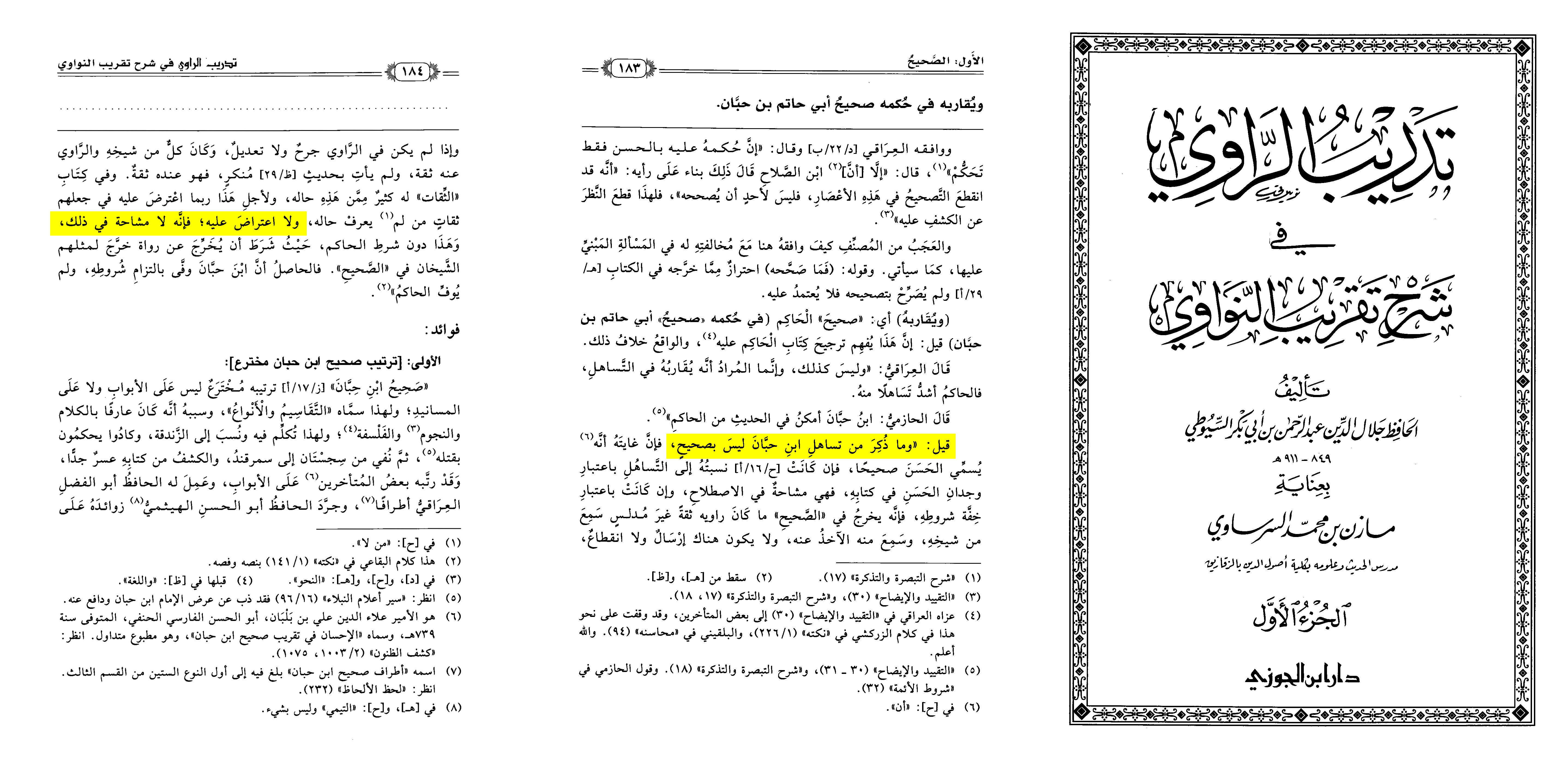
Thus, al-Suyūṭī concludes in Tartīb al-Rāwī Vol. 1, pg. 183 that Ibn Hibban is not a mutasāhil and that there is no [valid] objection against his methodology.
Al-Dhahabī likewise considers his book, Kitāb al-Thiqāt, as amongst the primary sources of ʿilm al-Rijāl in his al-Munqidh, pg. 79.
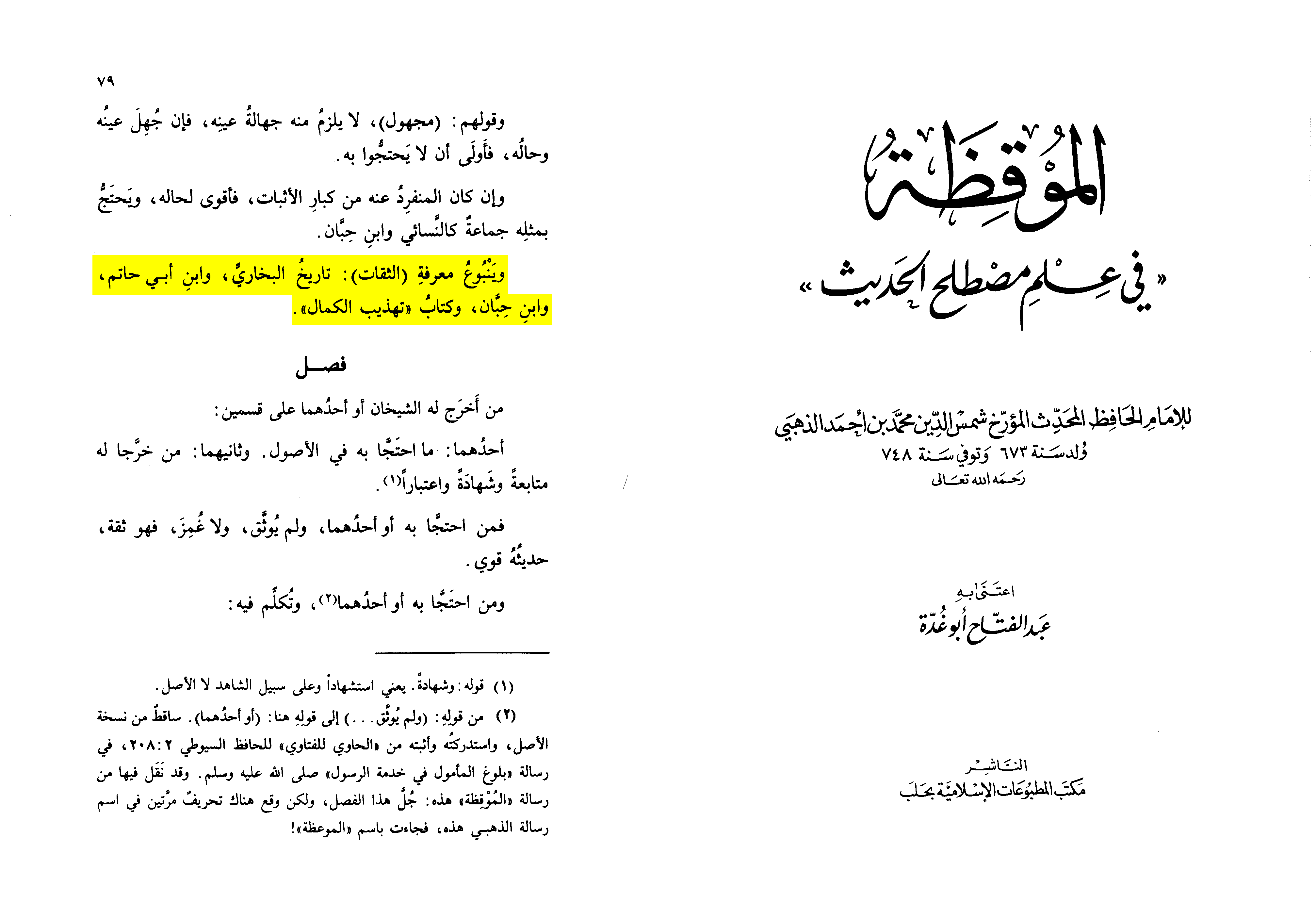
So to say "Ibn Hibban is quick to authenticate others" seemingly contradicts what scholars say about him, which is that he is very strict when it comes to criticising narrators and that his authentication is relied upon.
Third: Al-Albānī then quotes Ibn ʿAdī, who says the following in al-Kāmil Fī al-Ḍuʿafāʾ Vol. 4, pg. 63:
Rūḥ b. Ṣalāḥ, Ibn Siyabah, I think he is Egyptian, weak. His kunyah is Abu al-Harith… And Ruh b. Siyabah has hadiths that are not numerous.. And in some of his hadith there are oddities.
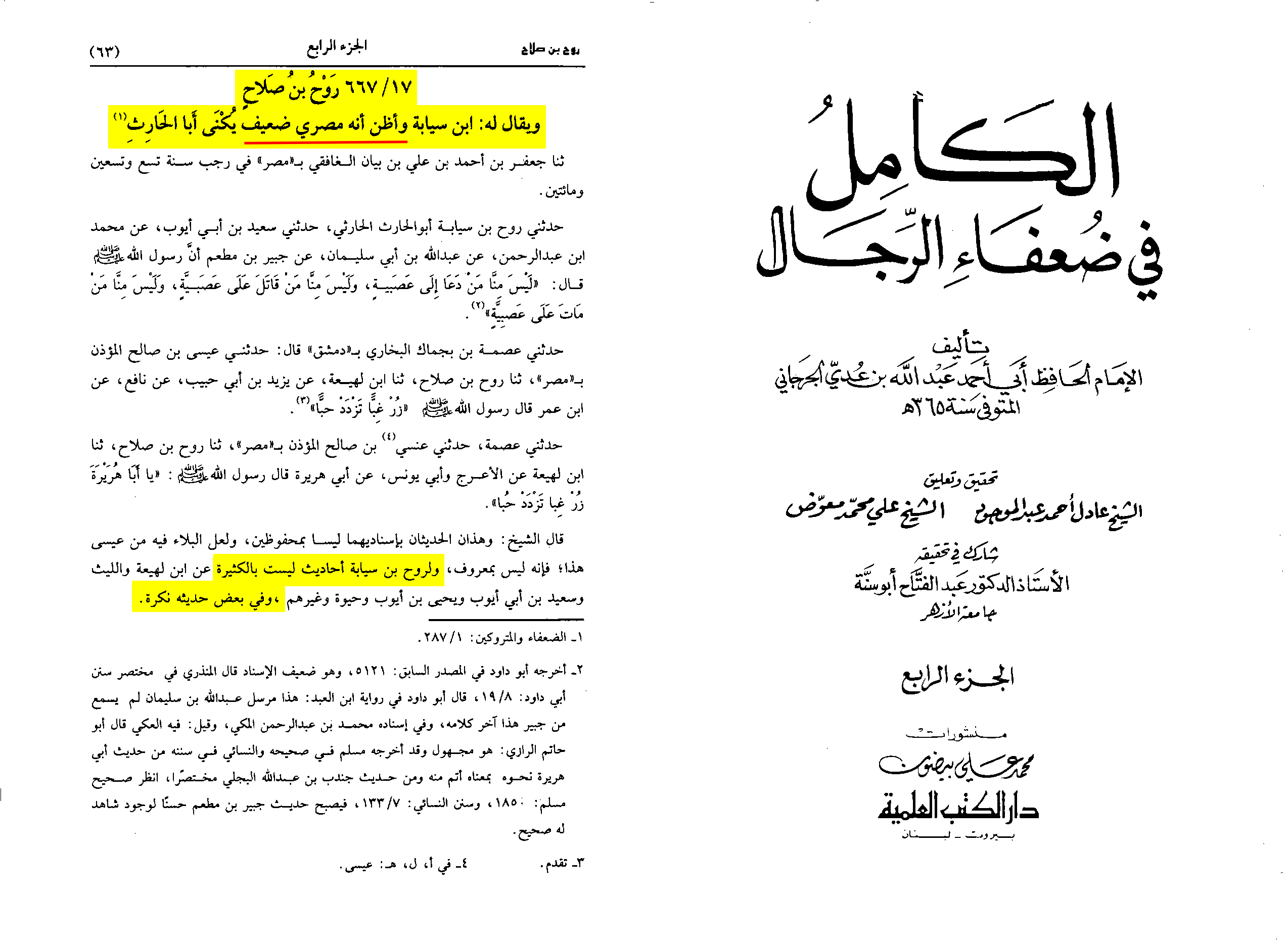
In this case, Ibn ʿAdī is not even aware of the biography or who Rūḥ is, and yet he is quick to weaken him without explaining why. He claims there are oddities in his reports, yet fails to present any evidence to illustrate this. This is not a weakening we can rely on, and nor is there evidence presented for his claim.
Fourth: As for Ibn Yūnus' statement, the fact that he says Rūḥ narrates manākīr (odd reports) does not imply that Rūḥ himself is a weak narrator. This is because narrating manākīr can simply mean narrating reports that are unfamiliar or not widely known. Linguistically, munkar comes from the root نَكِرَ, meaning “to be unrecognized”.
This was explained to us by al-Rāfiʿ wal-Takmīl Fī Jarḥ wal-Taʿdīl, pg. 200:
Do not assume from their statement, “This is a munkar hadith,” that its narrator is not trustworthy, for they often used munkar simply to refer to a report narrated uniquely by one person (tafarroud).
Later scholars, however, adopted the technical definition that a munkar hadith is one narrated by a weak narrator in contradiction to a trustworthy narrator…
Likewise, do not assume from their statements, “So-and-so narrated manākīr,” or “This hadith of his is munkar,” or similar expressions, that the narrator is weak.
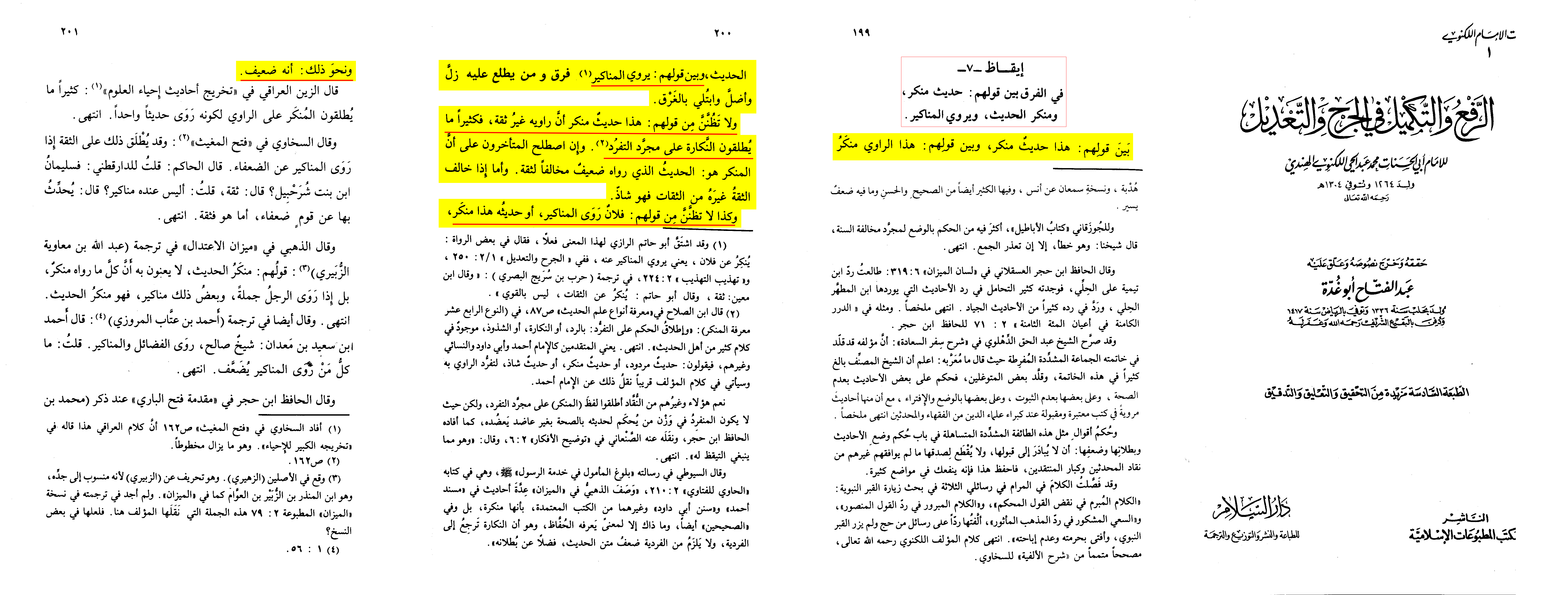
This definition was adopted by al-Jirjani as evident in numerous occasions, such as in al-Kāmil Fī Ḍuʿafāʾ Vol. 2, pg. 247 where he says under another narrator:
The case of ʿUthmān b. ʿAbd al-Raḥmān is that there is no issue in him, as Abū ʿArūbah said. However, he narrates unusual reports from unknown narrators, and those unusual reports originate from the unknown narrators, not from him.
Among the people of al-Jazīrah, he is like Baqiyyah among the people of al-Shām. Baqiyyah also narrates unusual reports from unknown narrators, yet he himself is trustworthy, reliable, and truthful. Whatever oddity (inkār) appears in his hadith comes only from those from whom he narrates.
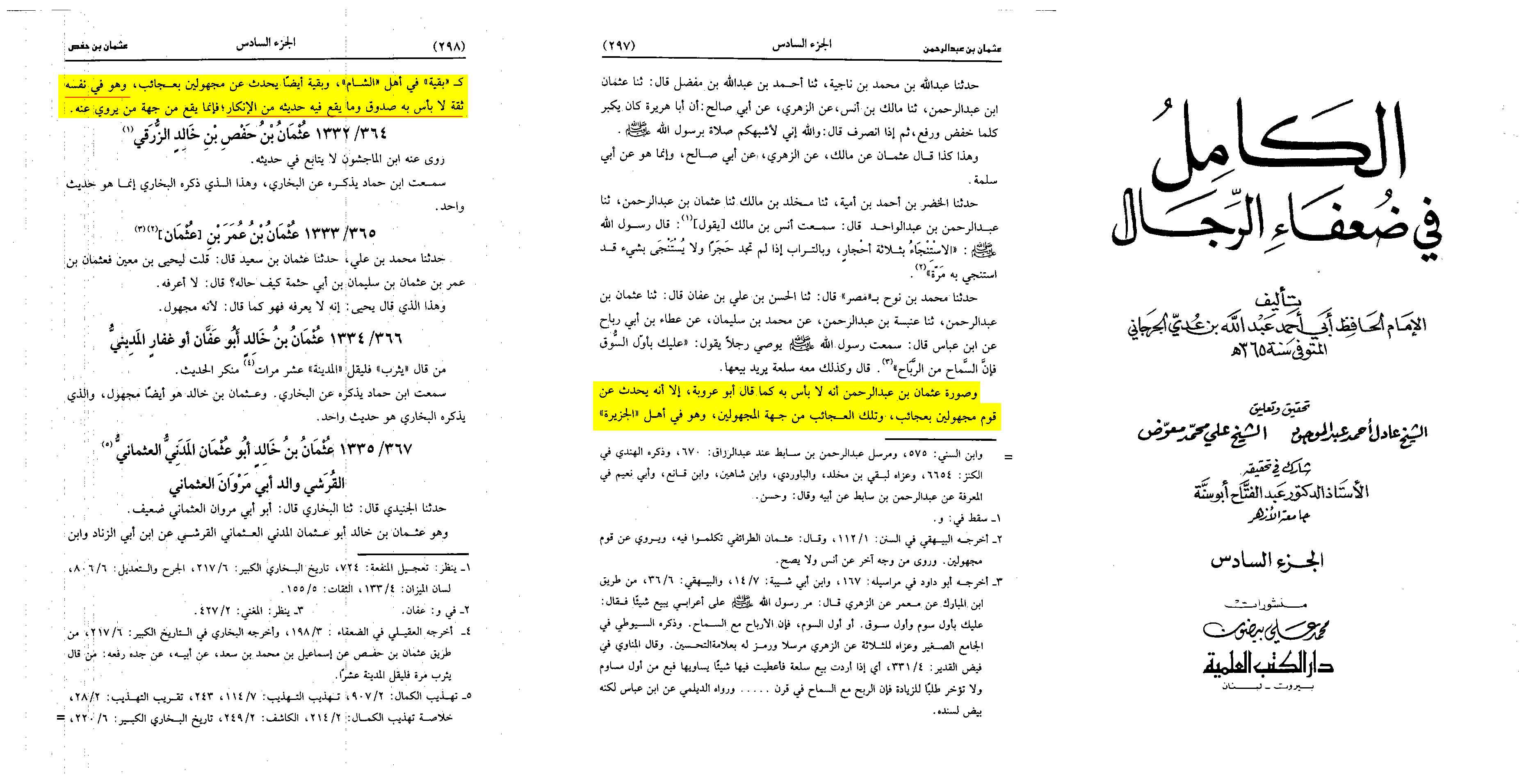
So oddity appearing in one’s narrations, does not justify a person’s weakness, as the oddity may not be the fault of them, or it may not be an issue at all.
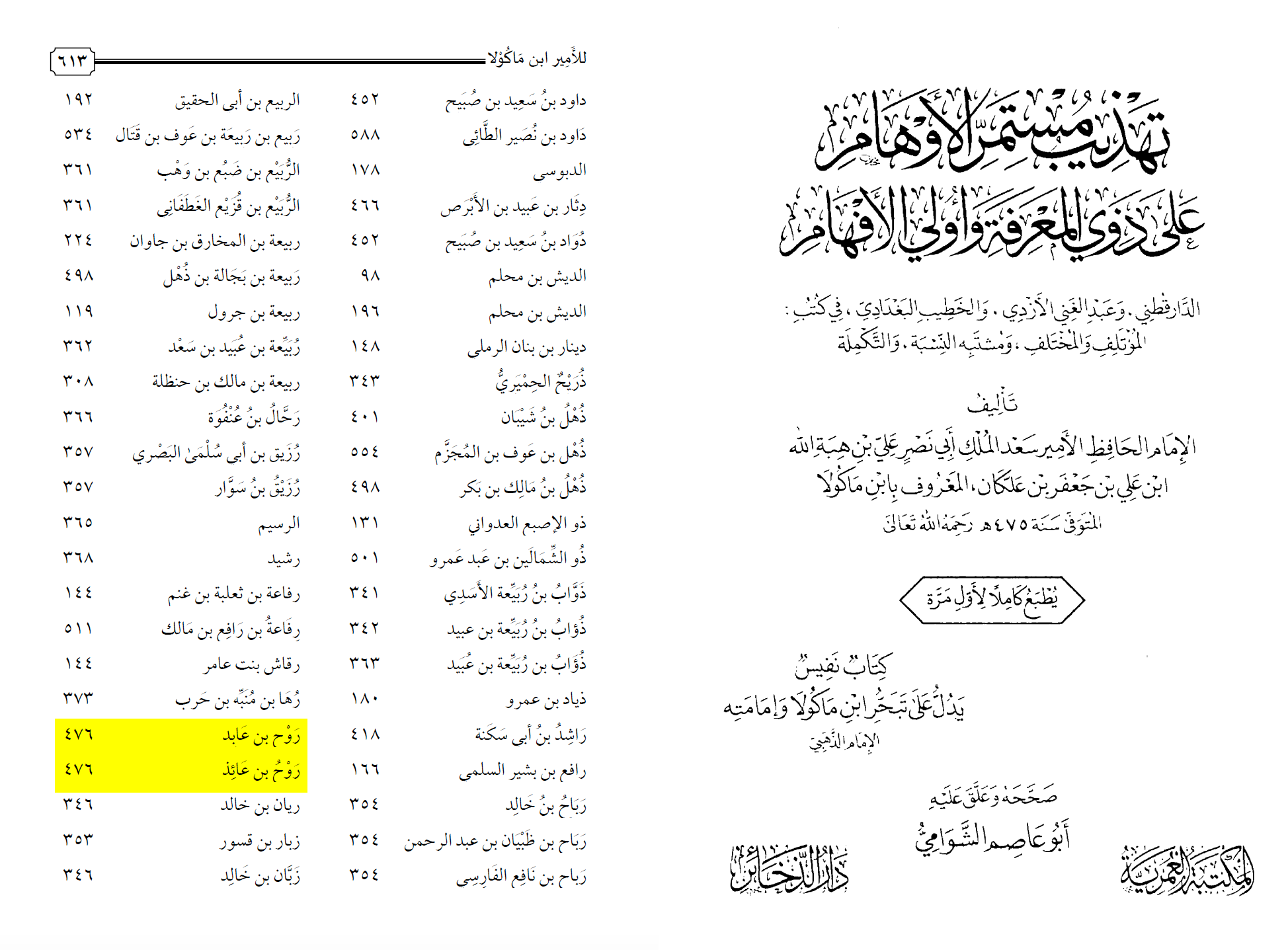
Fifth: As for Ibn Mākula's statement that some scholars weakened him, I could not find anyone with an entry named Rūḥ in his Kitāb al-Ikmāl, and the only entries with the name of Rūḥ in his Tahdhīb, pg. 613 did not include Rūḥ b. Ṣalāḥ. It is not quoted which scholars or their reasonings either by Al-Albani, so it cannot be depended on as he is a late scholar.
Sixth: As for al-Daraqutnī's weakening, then this is also insufficient evidence because al-Daraqutnī does not necessarily categorise ʿweak' as someone who is unreliable, but may use it in different ways. For instance, he says in Suʾālāt al-Barqānī, pg. 121 under the biography of Qābūs b. Abī Ẓabyān:
Al-Daraqutnī says: "He is weak, but he is not to be abandoned."
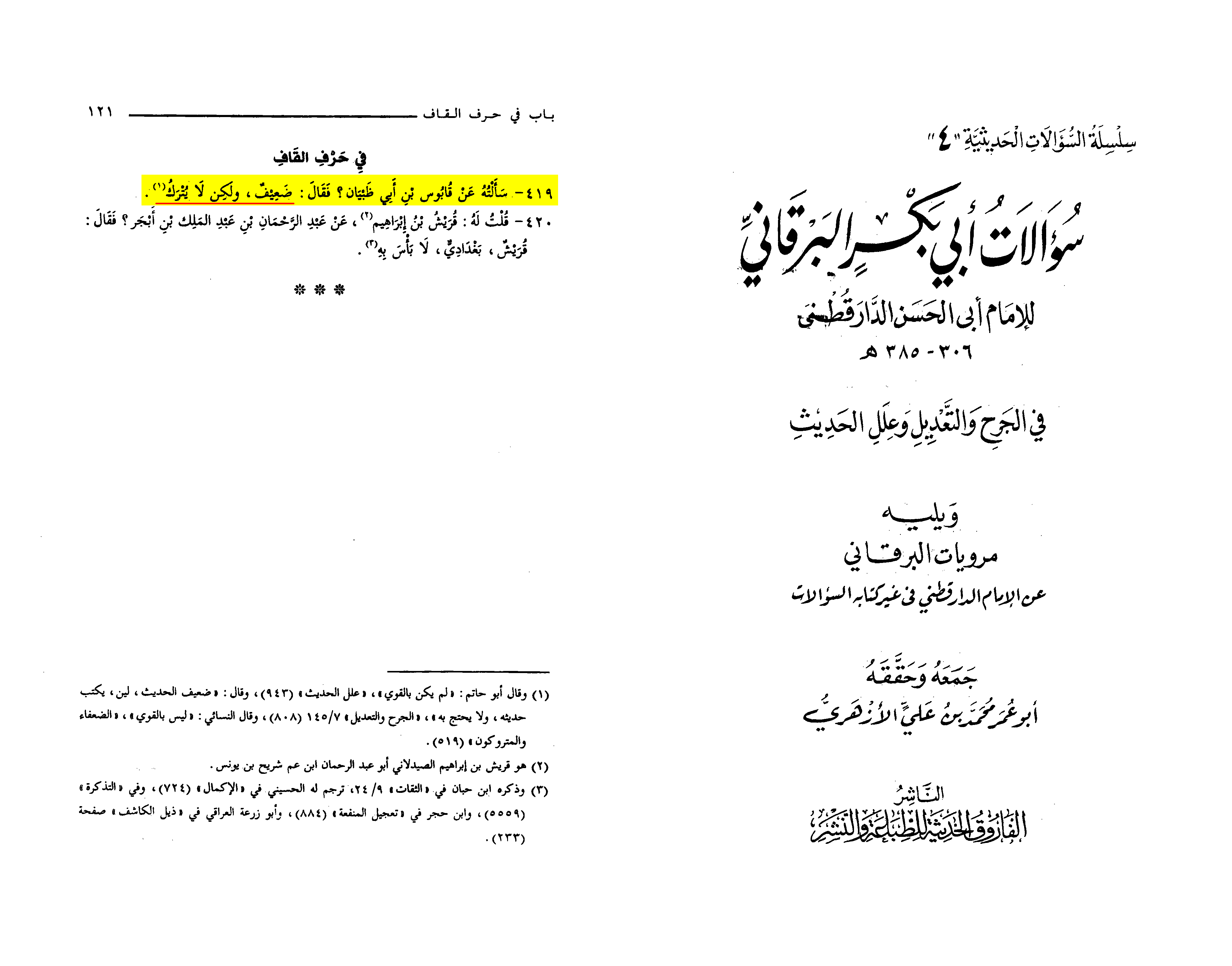
Despite being weak, he still accepts his narrations to be used. This is because it may be intended to refer to slight weakness, or weakness in relation to a different narrator.
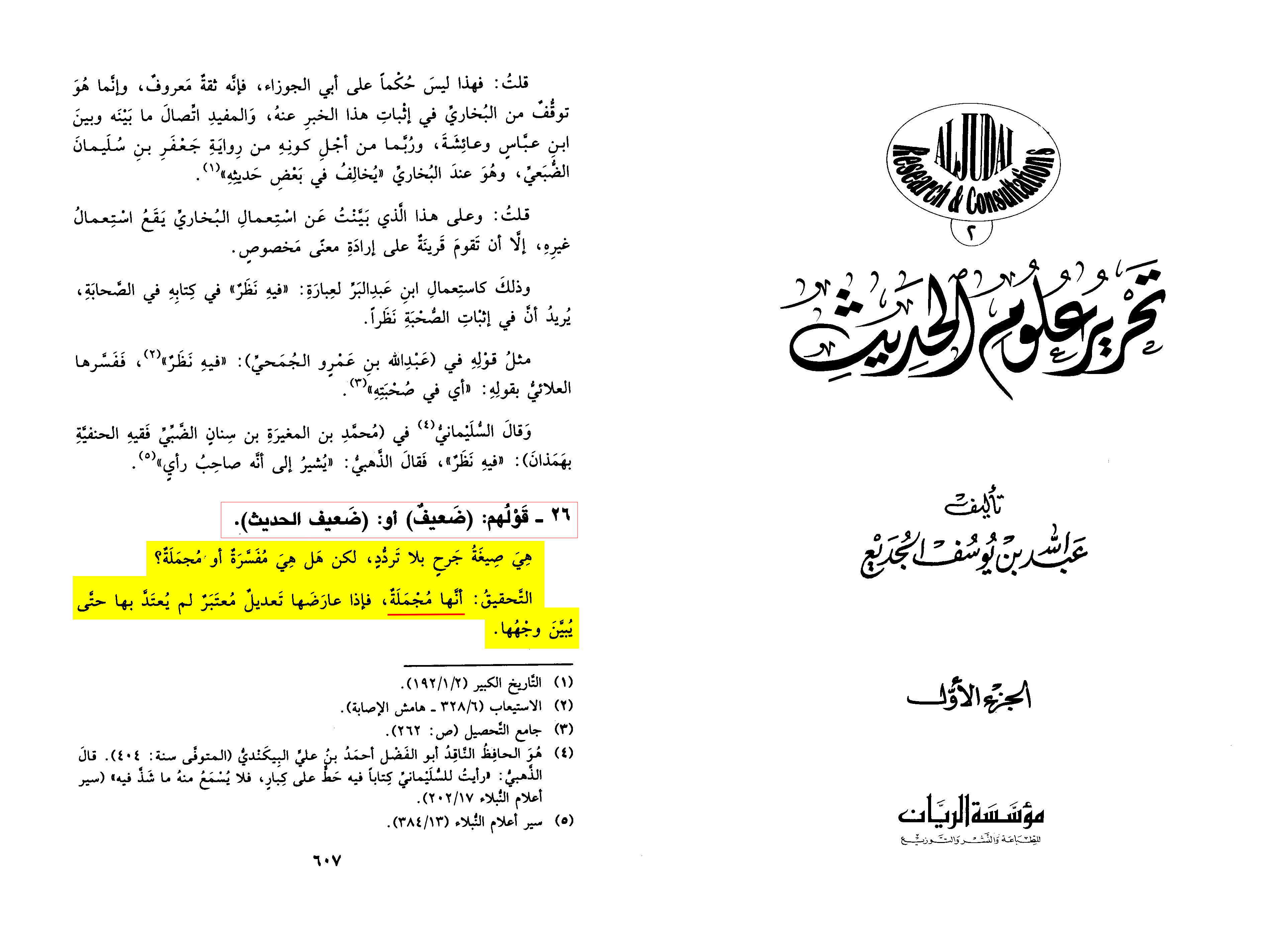
For this reason, Dr. ʿAbdullāh Judāy' declares these statements to be jarh mujmal in Tahrir ʿUlūm al-Hadith, pg. 707:
[Chapter: When a scholar says: ‘He is weak’]
It is a form of criticism without doubt, but is it elaborate (mufassạrah) or unclear (mujmalah)?
The research shows that it is unclear. So if specified praise opposes it, it is not relied upon until its meaning is clarified.
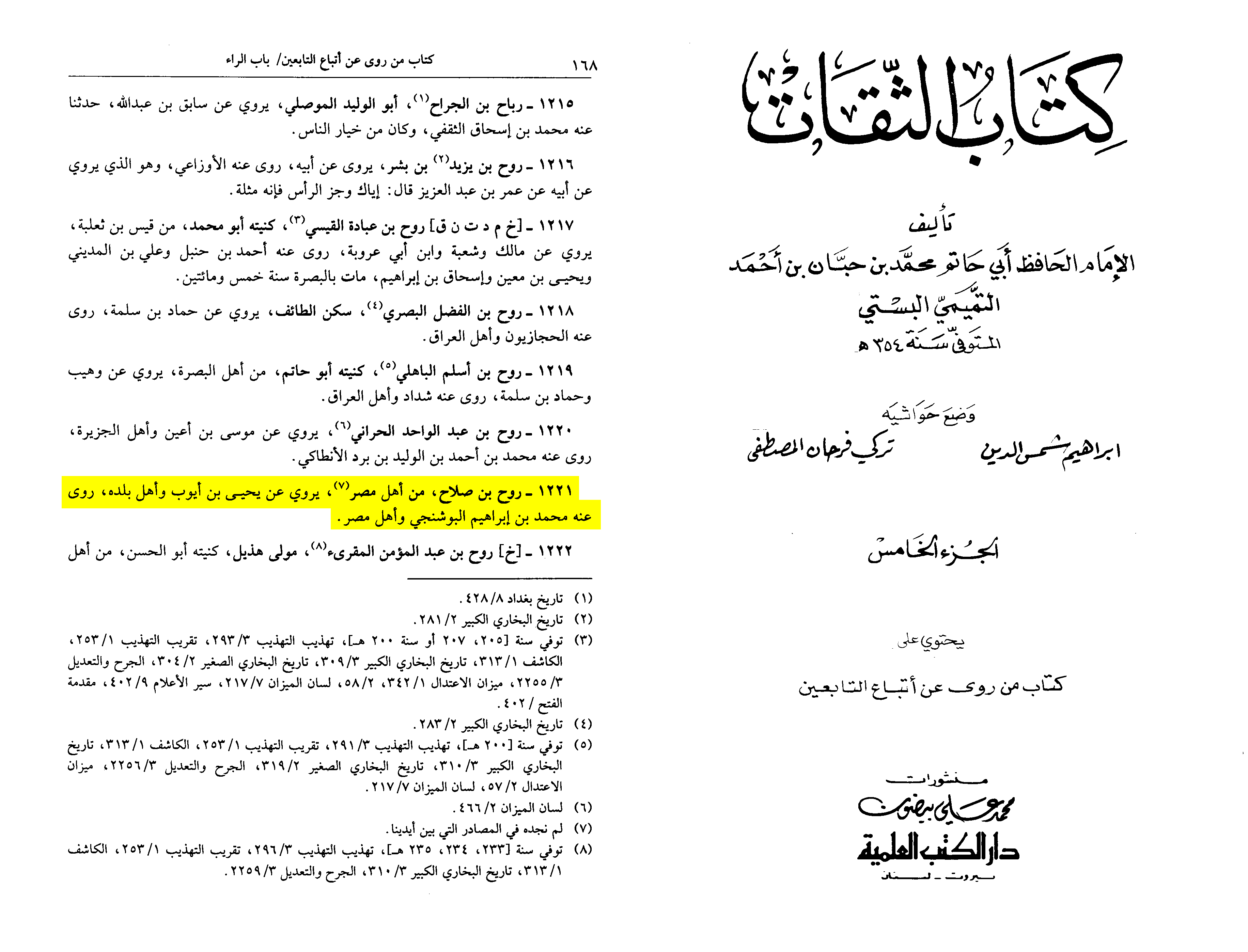
In contrast to this, we find Rūḥ b. Ṣalāḥ upheld words of praise from other scholars. For example, Ibn Hibban records him in his Kitāb al-Thiqāt Vol. 5, pg. 168, who as we mentioned was very critical of narrators. If he was indeed weak, Ibn Hibban would've known this.
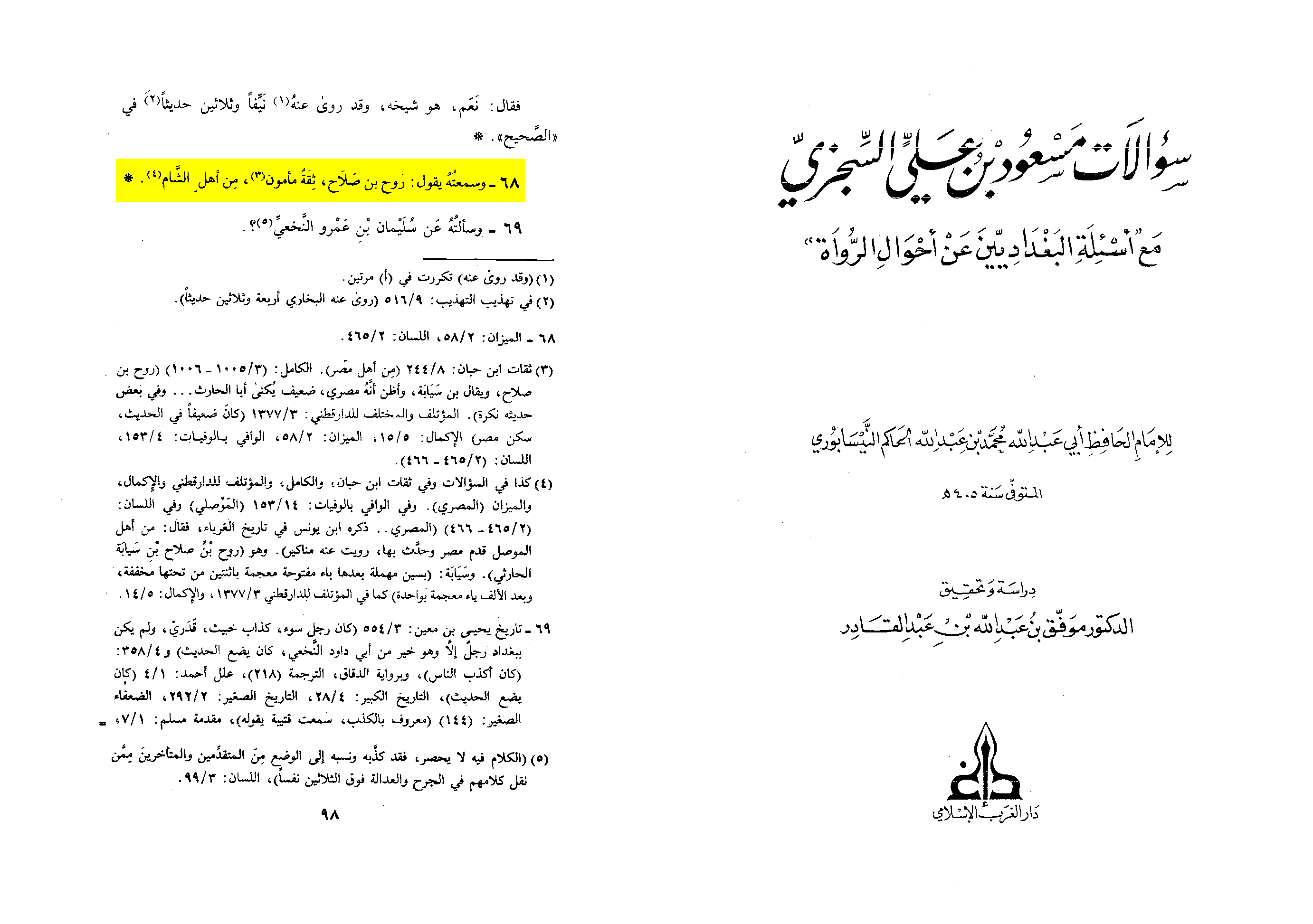
Additionally, al-Ḥākim al-Nayshāpūrī records that he is "upright and trustworthy" in Suʾālāt Masʿūd, pg. 98.
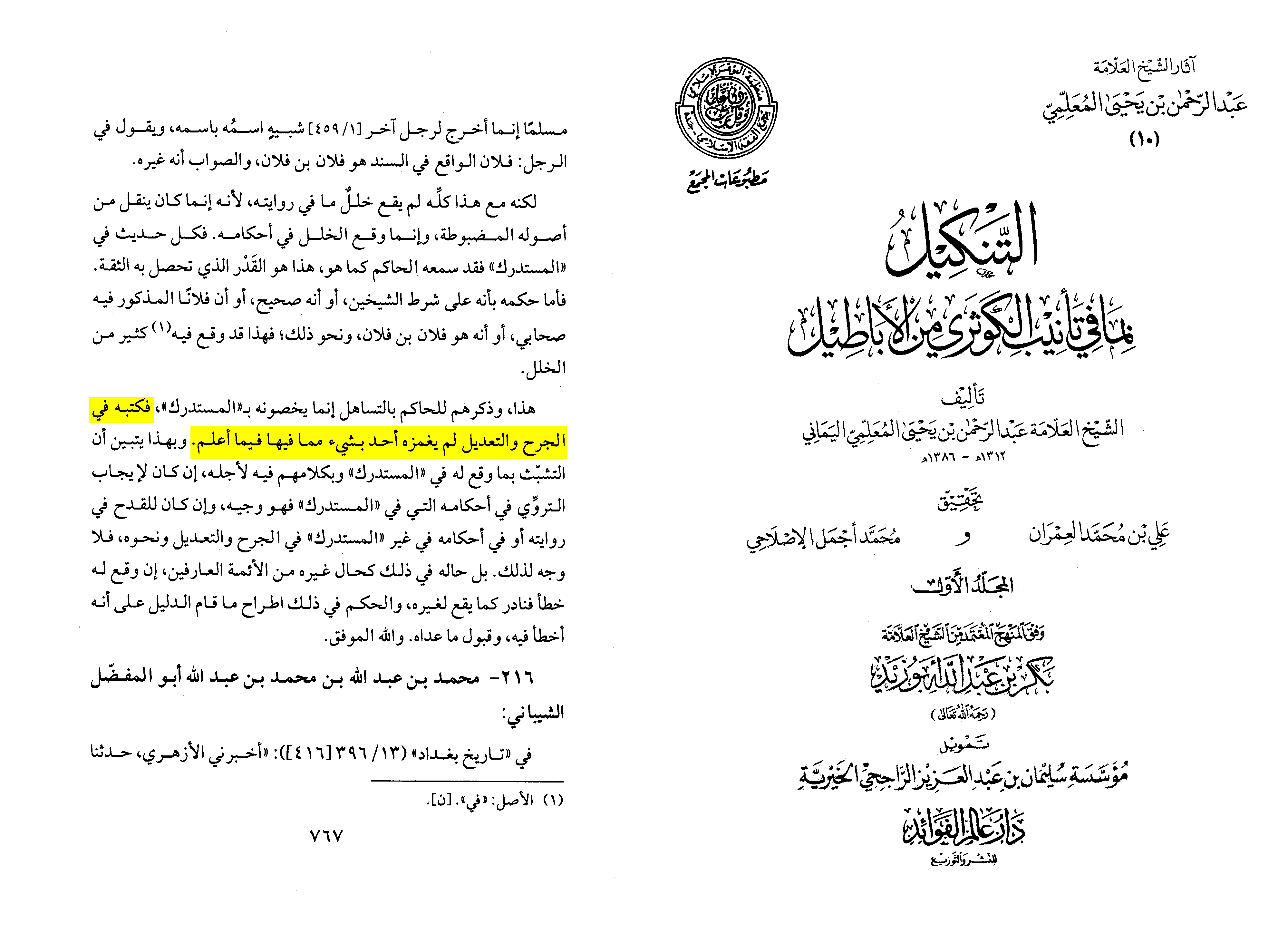
Despite some calling al-Ḥākim a mutasāhil, the majority opinion of scholars is that his authentications are accepted when outside of his Mustadrak. This was explained to us by ʿAllāmah ʿAbd al-Raḥmān al-Muʿālamī in his al-Tankīl Vol. 1, pg. 767:
As for what has been said about al-Ḥākim being lenient, they only apply this criticism to his al-Mustadrak. As far as I know, none of his books on al-jarḥ wa al-taʿdīl have been criticized for leniency in what they contain.
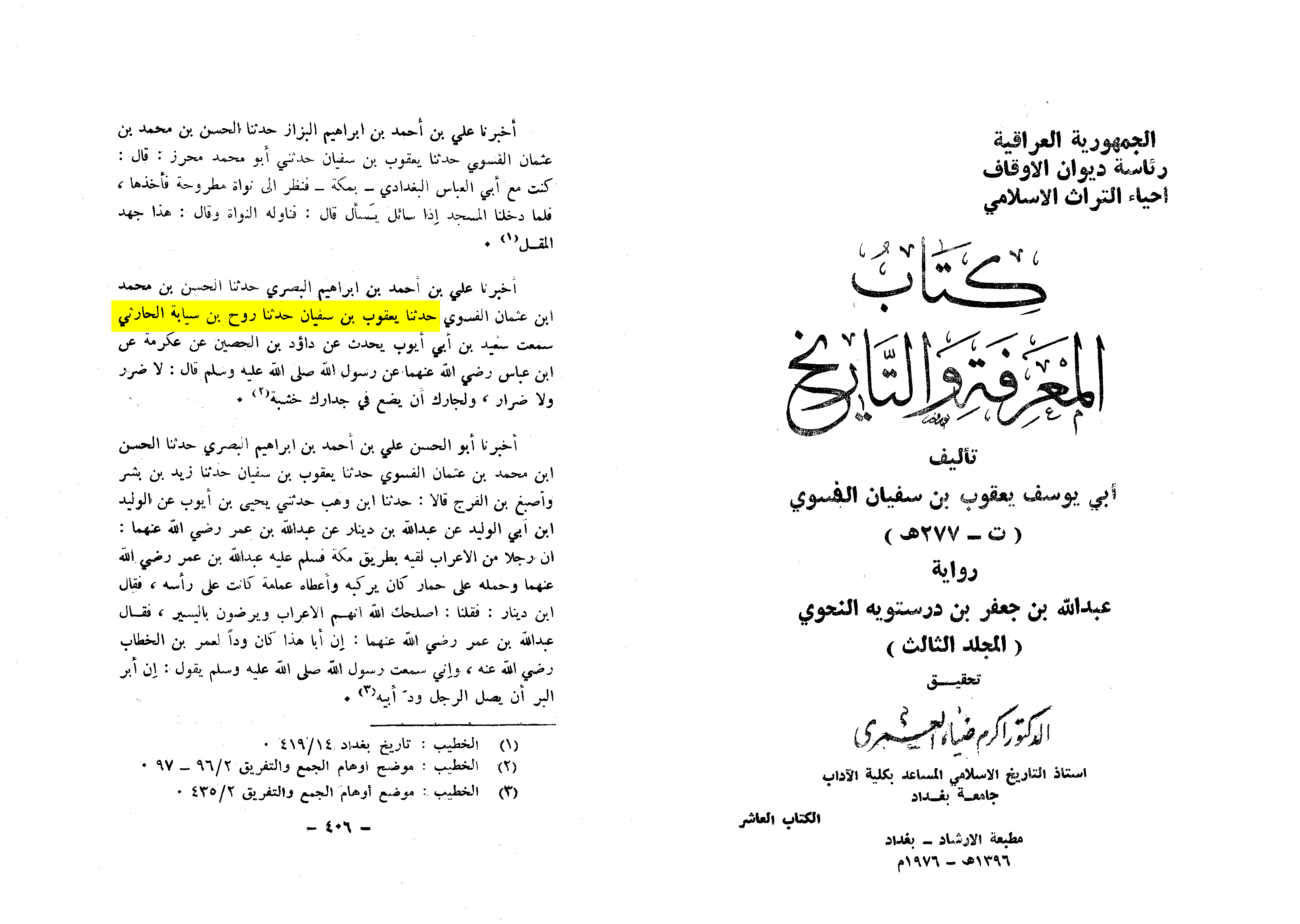
While this could suffice as evidence for his reliability, what seals the deal is another authentication that Al-Albānī was completely ignorant of, and that is the authentication of the grand Hadith scholar, Yaʿqūb b. Sufyān al-Fāsawī. He narrates from Rūḥ b. Ṣalāḥ as his direct mashāyikh in al-Maʿrifah wal-Tārīkh Vol. 3, pg. 406.
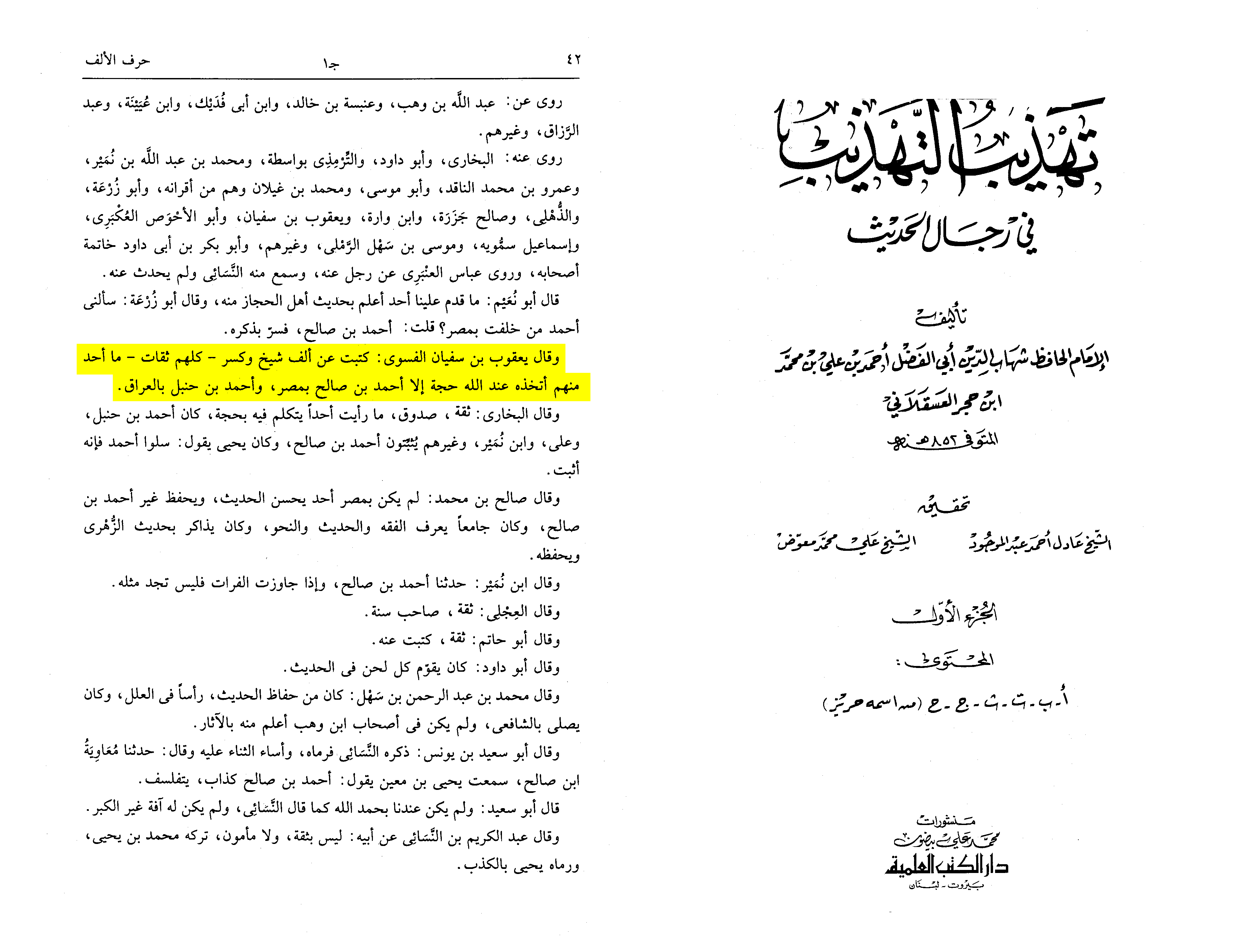
As Ibn Ḥajar mentions in Tahdhīb al-Tahdhīb Vol. 1, pg. 42, everyone who is a direct mashāyikh of al-Fāsawī is thiqah in his eyes.
Thus, the fact that a grand scholar directly met Rūḥ b. Ṣalāḥ, believing him to be reliable, alongside the strict scholar Ibn Hibban and al-Ḥākim authenticating this man, illustrates that we have sufficient evidence for the reliability of this narrator, whose hadiths are at the least Hasan if not Sahīh.
This has all been established by the basis of generally agreed upon rules of ʿilm al-Hadith in the Sunni school of thought.
Corroborating Reports
The report we have mentioned is generally in line with what has been reported in other works about the burial of Fāṭimah bt. Asad (AS). For instance, in a report recorded in Muʿjam al-Awsaṭ Vol. 7, pg. 86 - 87, it reads:
Muḥammad b. al-Bustanbān narrated to us: al-Ḥasan b. Bishr al-Bajālī narrated to us; Saʿdān b. al-Walīd, the Sābārī cloth merchant, narrated to us; from ʿAṭāʾ b. Abī Rabāḥ; from Ibn ʿAbbās, who said:
When Fāṭimah, the mother of ʿAlī b. Abī Ṭālib, died, the Messenger of Allah ﷺ took off his shirt and clothed her in it, and he lay down in her grave with her. When he had finished covering her with earth and leveling the grave, some of the people said, "O Messenger of Allah, we saw you do something that you have not done for anyone else."
He replied, "I clothed her in my shirt so that she may be clothed in the garments of Paradise, and I lay down with her in her grave so that the pressure of the grave may be lightened for her. Indeed, after Abū Ṭālib, she was the person among Allah's creation who showed me the greatest kindness."
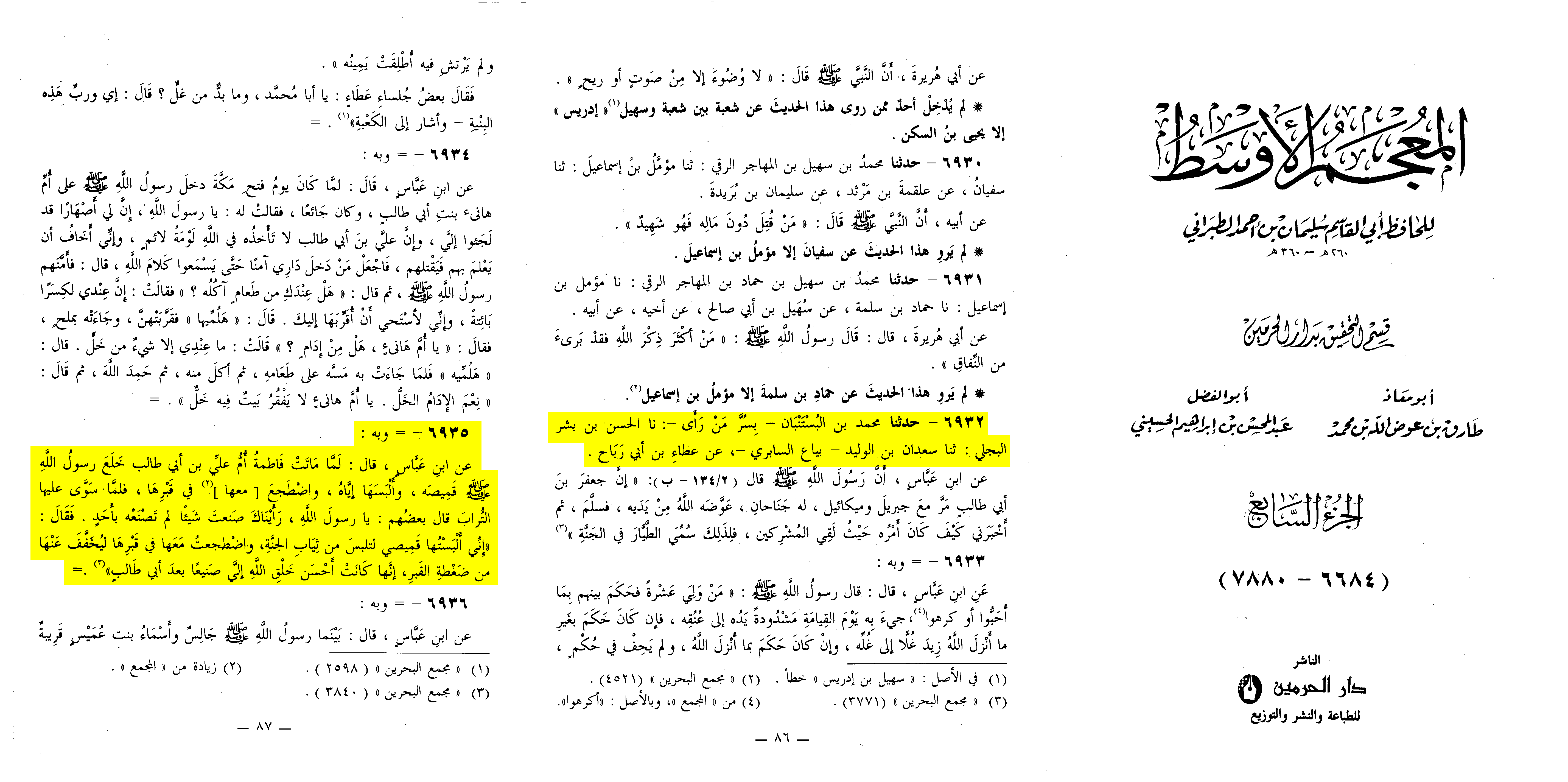
In this report, we find that the Prophet (ﷺ) did the same thing as clothing her with his shirt and sat down in her grave, stating that it would lift the pressure up from her. This is in line with what the report of Rūḥ b. Ṣalāḥ narrated, which is that he clothed her in his own shirt.
The chain of this narration is generally sound, with the exception of Saʿdān b. al-Walīd, whose reliability was not explicitly authenticated. Nevertheless, this report serves as an independent corroboration of the narration transmitted by Rūḥ.
Another such independent corroboration was recorded in Tārīkh Madīnah Vol. 1, pg. 123 - 124 by Ibn Shabbah:
As for Fāṭimah bt. Asad, the mother of ʿAlī b. Abī Ṭālib, ʿAbd al-ʿAzīz narrated from ʿAbd Allāh b. Jaʿfar b. al-Miswar b. Makhramah, from ʿAmr b. Dhibyān, from Muḥammad b. ʿAlī b. Abī Ṭālib, who said:
When Fāṭimah’s condition became critical and the Messenger of Allah ﷺ learned of it, he said, “When she passes away, inform me.” When she died, the Messenger of Allah ﷺ came out and ordered that a grave be prepared for her in the place of the mosque that is today known as the grave of Fāṭimah.
He instructed that a chamber be made for her rather than a trench-style grave. When it was completed, he descended into the chamber, lay down in it, and recited the Qur’an. He then removed his shirt and ordered that she be shrouded in it.
He performed the funeral prayer over her at her grave, pronouncing nine takbīrs, and said, “No one has been spared the pressure of the grave except Fāṭimah bt. Asad.” It was said, “O Messenger of Allah, not even al-Qāsim?” He replied, “Nor Ibrāhīm,” and Ibrāhīm was the younger of his two sons.
ʿUbayd b. Isḥāq al-Faṭṭār narrated to us: al-Qāsim b. Muḥammad b. ʿAbd Allāh b. Muḥammad b. ʿAqīl narrated to us; my father, ʿAbd Allāh b. Muḥammad, narrated to me—that Jābir b. ʿAbd Allāh said:
While we were sitting with the Messenger of Allah ﷺ, a man came and said, "O Messenger of Allah, the mother of ʿAlī, Jaʿfar, and ʿAqīl has died." The Messenger of Allah ﷺ said: "Let us go to my mother."
We stood and went with him, and it was as though birds were perched upon the heads of those with him (out of stillness and solemnity). When we reached the door, he removed his shirt and said: "When you wash her, place this shirt directly against her body beneath her shrouds."
When they brought her body out, the Messenger of Allah ﷺ would at times carry her bier, at times walk ahead of it, and at times walk behind it, until we reached the grave. Then he rolled himself inside the chamber, after which he came out and said: "Place her into it in the name of Allah and upon the name of Allah."
After she had been buried, he stood and said: "May Allah reward you with goodness for being both a mother and a guardian. You were indeed an excellent mother and an excellent guardian to me."
We—or it was said to him—asked: "O Messenger of Allah, you did two things that we have never seen you do before."
He said: "What were they?" We replied: "You removed your shirt, and you rolled yourself about inside the grave."
He said: "As for my shirt, I wished that the Fire would never touch her, if Allah wills. And as for my rolling about inside the chamber, I wished that Allah would make her grave spacious for her."
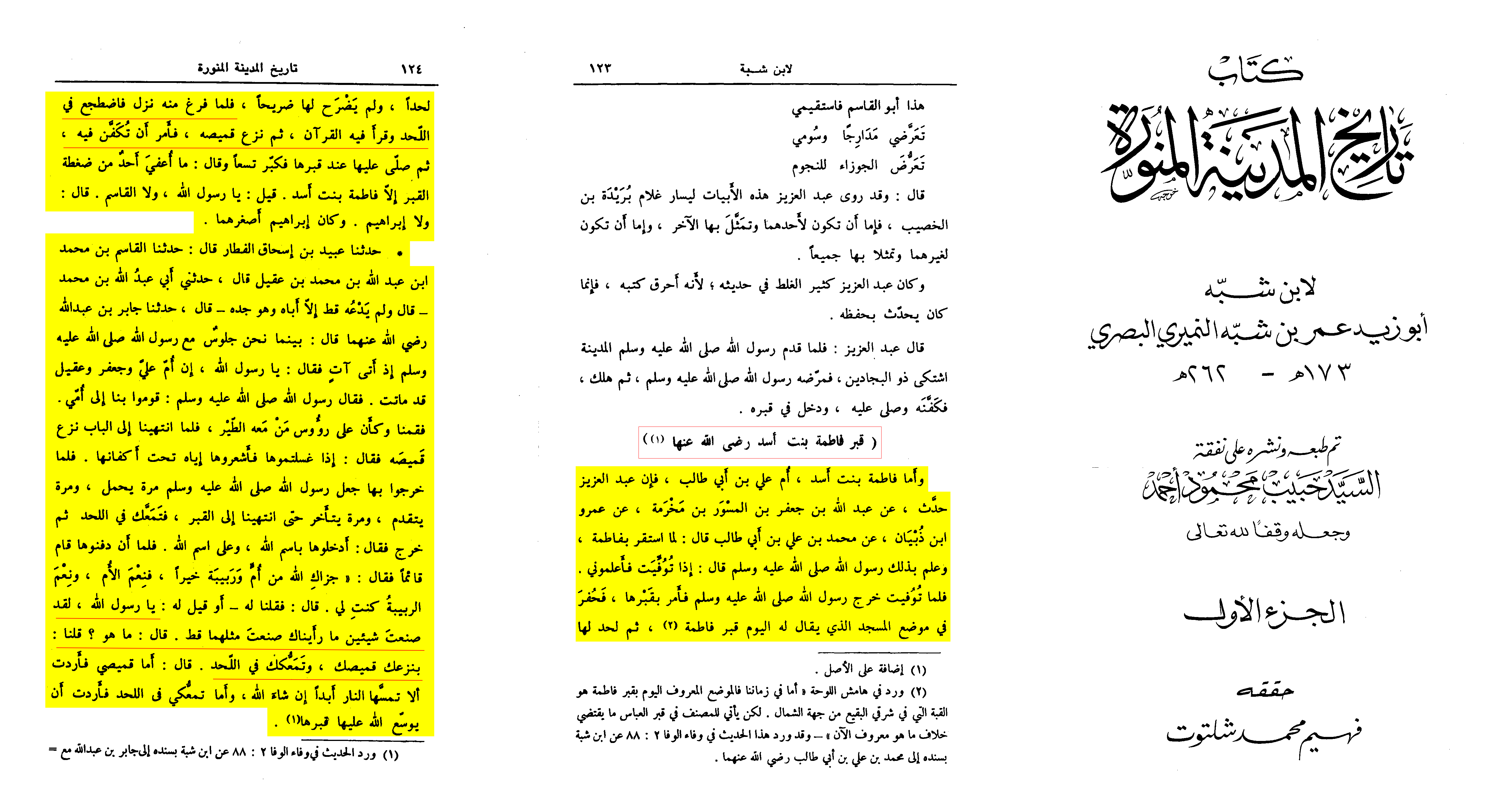
We once again see that the Prophet (ﷺ) would have his shirt wrapped around her, and go into her grave, in order to alleviate her difficulties in her grave. Ibn Shabbah provides us with two independent chains for this matter.
The fact that so much corroboration exists, illustrates that this could not have possibly been fabricated by Rūḥ, and there is no reason to doubt his transmission of the report either.
The same incident has been reported in Shi’a books with extensive details and multiple chains. It was recorded in Usul al-Kafi Vol. 1, Kitab al-Hujjah Chapter 113, Hadith. # 2 and with another chain in Amali al-Saduq Chapter 51, Hadith. # 14.
In fact, we find this matter was so well-known, that even Muʿāwiyah alluded to this Prophetic Sunnah in his own testimony, recorded in Ṭabaqāt Ibn Saʿd, pg. 146 - 148, Hadith # 66:
ʿAlī b. Muḥammad narrated from Sulaymān b. Ayyūb, from al-Awzāʿī; and ʿAlī b. Mujāhid narrated from ʿAbd al-Aʿlā b. Maymūn b. Mihrān, from his father, who said:
Muʿāwiyah said during the illness in which he died, "I was once performing wuḍūʾ for the Messenger of Allah ﷺ when he said to me, 'Shall I clothe you in one of my shirts?' I replied, 'Yes, may my father and mother be sacrificed for you.'
He removed the shirt he was wearing and gave it to me, and I wore it once and then kept it. When I die, place the Messenger of Allah's shirt directly against my skin. I also kept the clippings of the Messenger of Allah's fingernails in a small bottle; when I die, cut them up, grind them into powder, and place them in my eyes, so that perhaps Allah will have mercy on me through them."
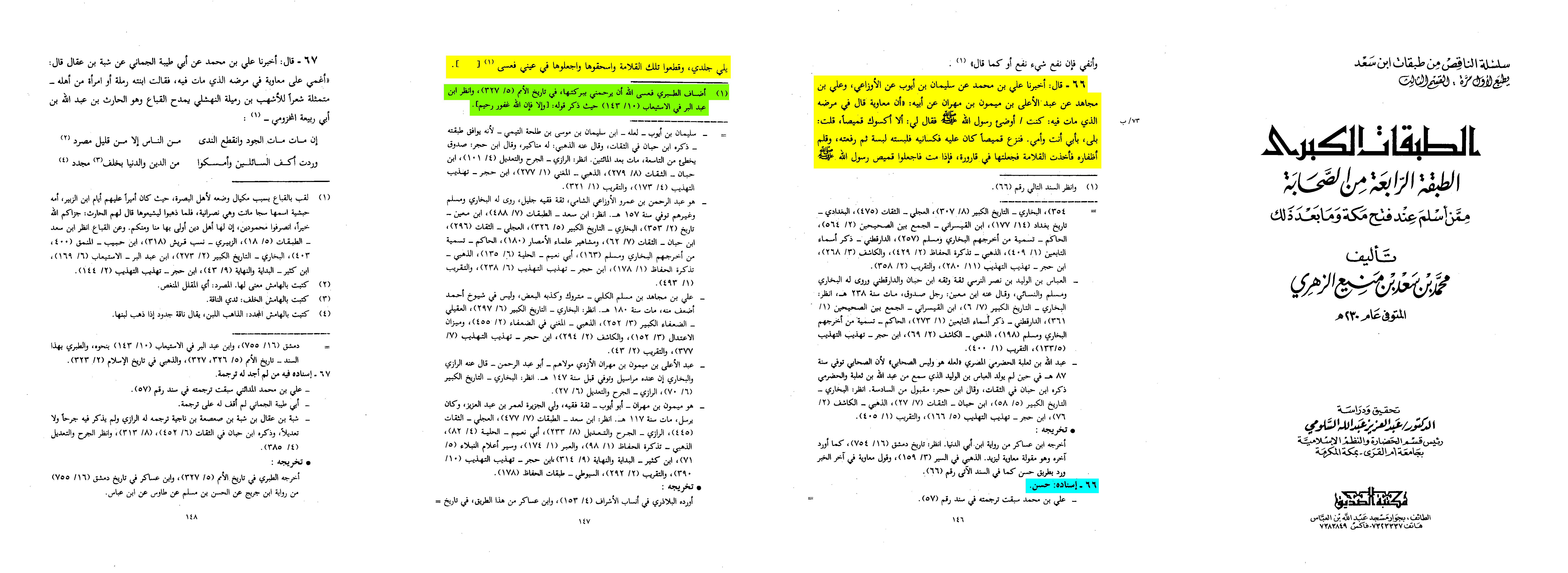
Note: The editor mentions that the chain is reliable, and that there are alternative sources for it.
Conclusion
We conclude from these reports that the Prophet (ﷺ) shrouded Fāṭimah bt. Asad (AS) in his own shirt, just as Prophet Yūsuf (AS) used his shirt for his father, as a means of conveying miracles.
Then, when the bearer of good news came and placed the shirt on to Jacob’s face, his eyesight returned and he said, ‘Did I not tell you that I have knowledge from God that you do not have?’ [Yusuf 12:96]
This is because whatever the Prophets touch carries miraculous blessings by Allah's permission, as they are blessed and holy servants of God. There is nothing in the report to suggest that this blessing effaces upon the Prophet’s passing. Rather, according to historical reports, Muʿāwiyah continued to preserve and seek blessing through prophetic relics, and that the shirt he gave to Fāṭimah bt. Asad would protect her until Judgement day.
This, in turn, supports the permissibility of seeking blessings through the Prophet (ﷺ) and what is connected to him, including his noble grave. Furthermore, the Prophet’s actions and statements in this narration clearly indicate the permissibility of seeking intercession through him. Therefore, we conclude with the permissibility and reccomendation to seek blessings from the Prophet's grave.

Comments