The Tawassul Prayer Taught to Uthmān bin Hunaif

Uthmān b. Hunaif ﵁ was a companion of the Prophet ﷺ and later the governor of Basra during the caliphate of Imām ʿAlī ﵇. In a famous incident he narrated, a blind man came to do tawassul through the Prophet ﷺ.
This incident serves as the most decisive and clearest evidence for the permissibility of tawassul. In this article, we shall cover all its details in full, and refute the objections presented by modern day Salafis.
The Prophet Taught Tawassul Through Himself
We can read in Sunan Ibn Majah 1385:
`Uthmān b. Hunaif narrated that a blind man came to the Prophet ﷺ and said: "Supplicate to Allah to heal me."
He ﷺ said: "If you wish I will supplicate for you, and if you wish, you can be patient, for that is better for you."
He said: "Then supplicate to Him."
He said: "So he ordered him to perform Wuḍūʾ and to make his Wuḍūʾ complete, and to supplicate with this supplication:
'O Allah, I ask You and turn towards You by Your Prophet Muḥammad ﷺ, the Prophet of Mercy. Oh Muḥammad! Indeed, I have turned to my Lord, by means of You, concerning this need of mine, so that it can be resolved, so O Allah so accept his intercession for me.'"
This ḥadīth is one of the most excellent pieces of evidence for the permissibility of tawassul, because it was taught by the Prophet ﷺ directly.
In this story, a blind man came to the Prophet ﷺ requesting prayers to lift his blindness. The Prophet informs him that it is better for him to be patient. This is only because there is more reward in remaining blind than in curing it, as a blind man will avoid the sins of the eyes and be rewarded for his struggles in life.
Despite this, the blind man still requested for the Prophet ﷺ to pray for him to lift his blindness. Now it is not mentioned that the Prophet does actually pray for him, instead he teaches him a prayer where the blind man petitions to Allah through the Prophet, as opposed to just supplicating for the blind man.
This means the blind man is interceding through the Prophet’s essence. This is because the report's wording says:
أَتَوَجَّهُ إِلَيْكَ بِمُحَمَّدٍ
"O God, I face (i.e. approach) you through Muḥammed.”
This is further evidenced by the following phrasing, which says:
تَوَجَّهْتُ بِكَ إِلَى رَبِّي
“Yā Muḥammad, I approached my Lord through you.”
We should note that the version in Jāmiʿ at-Tirmidhī 3578 skips the 'Yā Muḥammad', while most other versions contain it.
The “through you” in these phrases refer to the Prophet as an essence/person. Therefore, it should be permissible for anyone to repeat this prayer because the Prophet’s essence does not change whether he is alive or dead, he still holds the same high status in the eyes of God.
We will come back to the significance of the bāʾ (ب) in this phrase that supports our understanding.
Objection 1: The Prophet has to be alive for this prayer to be enacted
Some Sunnis will attempt to argue that this prayer will not be permitted to be performed unless the Prophet ﷺ is alive. They have no evidence to substantiate this claim, and it is certainly contradicted by the incident itself.
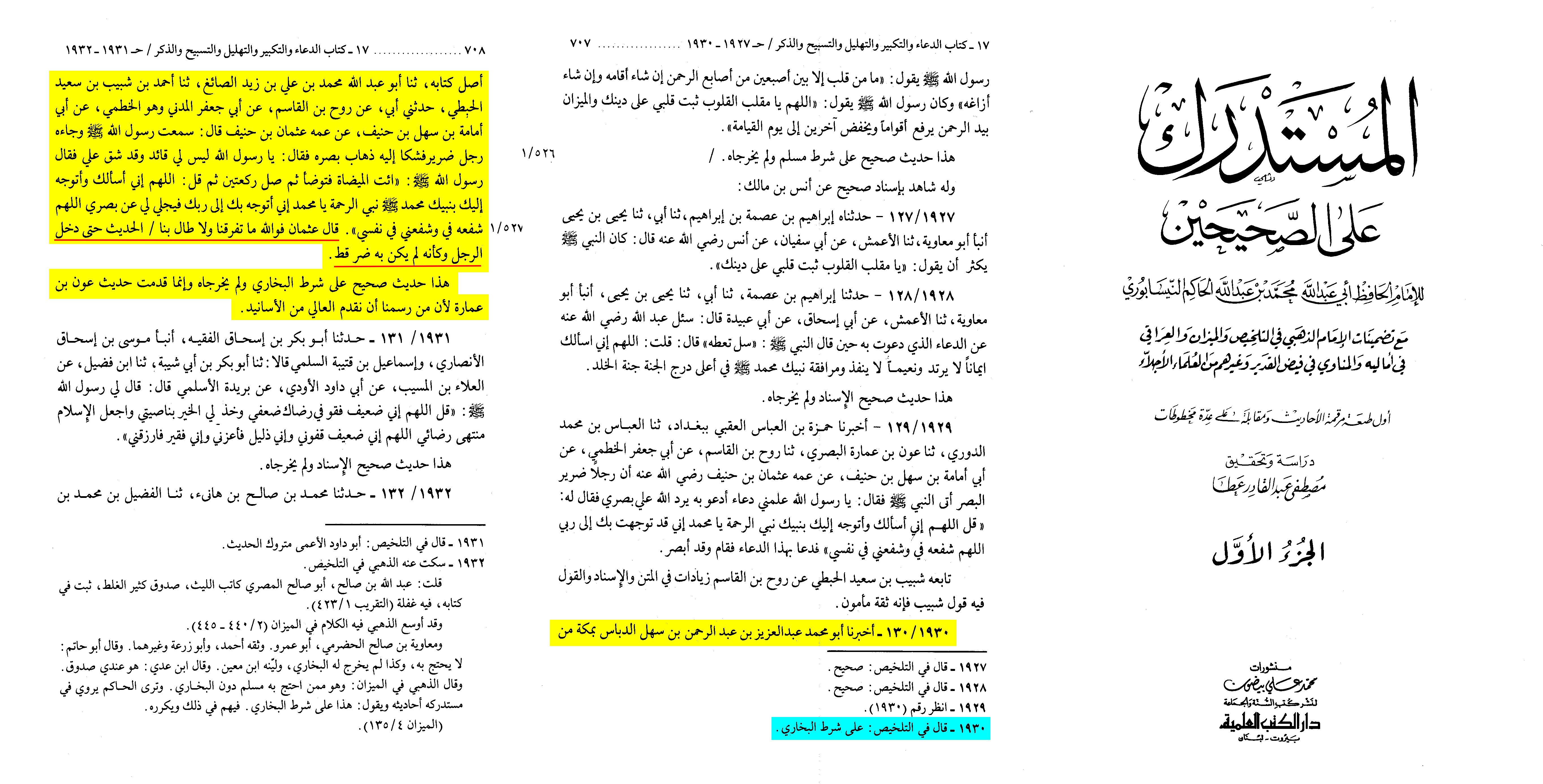
This is because a useful addition in the variant of this same report in al-Hakīm’s al-Mustadrak ʿAlā al-Ṣaḥīḥain, Vol. 1, Pg. 707 - 708, Report #1930 says:
Uthmān said: "By Allah, we (i.e. himself and the Prophet) had not yet parted, nor had our conversation lasted long, before the [blind] man returned, as though he had never suffered any affliction at all."
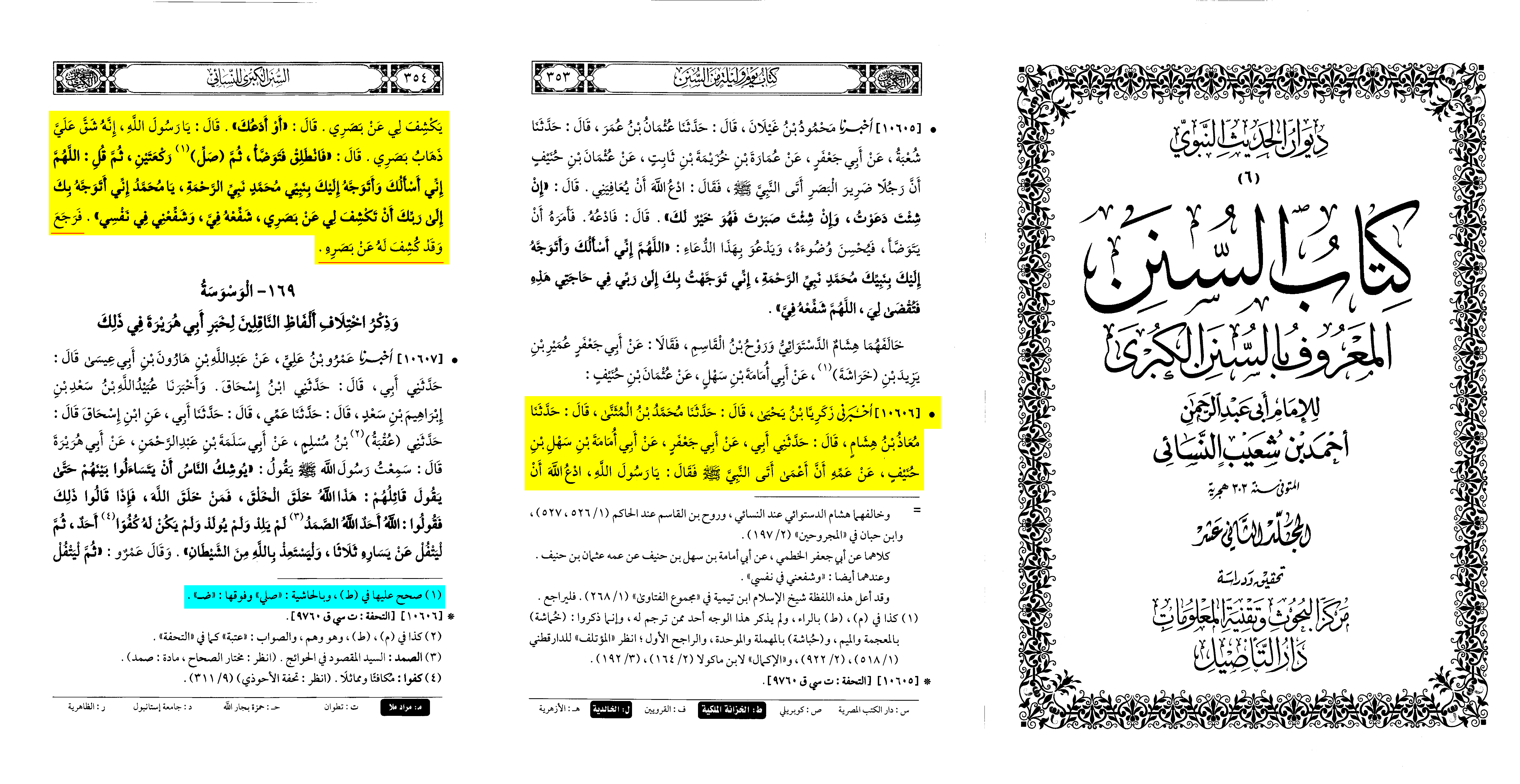
Al-Nasāʾī also reports in al-Sunan al-Kubrā Vol. 12, pg. 353 - 354 similarly:
[Uthmān said:] Then he returned, and his sight had been restored.
It is evident that the blind man did this in the absence of the Prophet, and not in the same room as him, which means he is calling upon the Prophet ﷺ while he is not there to hear him, serving as clear evidence for intercession through someone not immediately present.
This shows that the blind man did this prayer behind closed doors, and neither the Prophet, nor the companions condemned him. This demonstrates the general permissibility of this action.
The fact that later scholars included this tradition in their books of prayers and supplications, such as al-Nasāʾī in his ʿAmal al-Yawm wal-Laylah, pg. 417 - 416, shows they too believed that this report was something that can be acted upon by later generations.
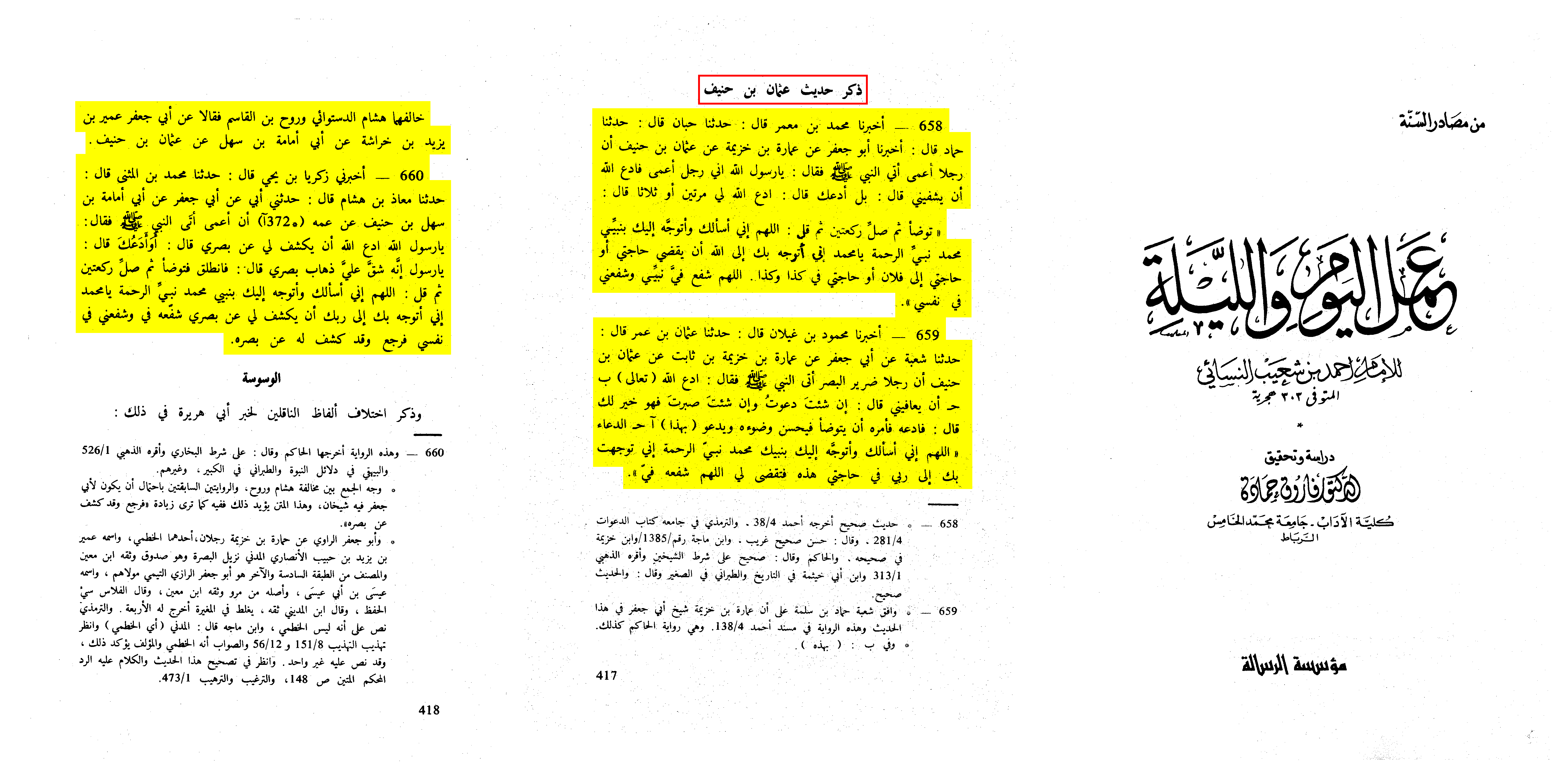
If this action is indeed polytheistic (shĩrk) we welcome our opponents to accuse al-Nasāʾī, al-Hakīm, and their other scholars of this before they point their fingers at us.
Objection 2: “Through you” means “through your prayers”
We mentioned earlier that the Prophet ﷺ taught the blind man to petition to Allah through the essence of the Prophet ﷺ himself, as “through you” means the status and noble essence of the Prophet.
However, Salafis have objected to this point by arguing that “through you” actually means “through your prayers”. Thus, the wording of the report would essentially be:
“O God, I face you through the prayers of Muḥammed.”
Therefore, they would argue: Since the Prophet prayed for the blind man in the report, it follows that he is interceding through the prayers of the Prophet ﷺ. Since the Prophet hasn’t prayed for us, it would not be permissible for us to repeat the same prayer as we can’t intercede through a prayer that was not made for us.
The Salafī standard bearer, Nāṣir al-Dīn al-Albānī, elaborated on this objection alongside others in his Kitāb al-Tawassul, pg. 76 - 83, which we have summarised as following:
First: If the blind man's intention had been to seek intercession through the Prophet's essence then there was no need for him to come to the Prophet and request him to supplicate for him. Rather, he could have remained in his house and supplicated to his Lord, for example, saying: "O Allah, I ask You by the status of Your Prophet and his position with You to heal me and restore my sight." But he did not do so. Why?
Secondly: The Prophet ﷺ promised to supplicate for him, while also advising him about what was better for him. This is reflected in his statement: “If you wish, I will supplicate (to Allah) for you; and if you wish, be patient, for that is better for you.”
Third: The blind man's insistence on supplication, as indicated by his statement "then supplicate," necessitates that the Messenger ﷺ made supplication for him, because the Messenger ﷺ was the best of those who fulfilled their promises.
Fourth: In the supplication that the Messenger of Allah ﷺ taught him, [the blind man] said: "O Allah, accept his intercession for me." This cannot possibly be understood as seeking intercession through the Prophet's essence, his status, or his right. Rather, the meaning is: "O Allah, accept his supplication for me"—that is, accept his supplication that You restore my sight.
Fifth: Among what the Prophet ﷺ taught the blind man to say was: "and accept my intercession for him"... This is the point that refutes their entire argument, because it's logically impossible for a blind man to intercede for the Prophet through the Prophet's status or essence. The only sensible interpretation is that both are making supplications for each other.
Sixth: If the reason for the blind man’s healing had been that he sought tawassul through the Prophet’s rank—as many later scholars understood it—then it would be expected that the same healing would occur for other blind people who seek tawassul through his rank… Yet we do not know, nor do we think anyone knows, of a single person for whom such a cure occurred.
[Conclusion:] Once the noble reader understands the arguments we have presented then it becomes clear that the blind man’s statement in his supplication means: “I seek nearness to You through the supplication of Your Prophet.” In other words, an omitted word (the muḍāf) is understood. We and our opponents agree that an omitted word is understood in such expressions. The disagreement is only over which omitted word should be supplied. They say it is “through the rank of the Prophet” and we say “through the supplication of the Prophet”. One of these two implied meanings must be preferred on the basis of evidence. They have no evidence, while we do.

The response to Al-Albānī is as following:
First: The blind man came to seek a formula on how he should supplicate to God regarding his issue, just as the companions came to the Prophet requesting the formula for how to send the ṣalāwāt upon him, instead of composing one of their own [see our article: “How Ayat al-Salawat Proves Imamah” for further info]. This was a frequent practice of the companions.
Second, Third and Fourth: Al-Albānī devotes his time to proving that it is implied that the Prophet ﷺ supplicated for the man. However, he fails to show how the Prophet supplicating for him defines the supplication the Prophet taught to the blind man. The Prophet may have indeed prayed for him, as can be inferred, yet the supplication he taught the blind man requests intercession through the Prophet’s essence. If it was indeed about his supplication, then the Prophet would’ve clarified that in the prayer he taught to the blind man.
Thus, Al-Albānī does not prove that the wording of the supplication, namely “through Muhammad” بمحمد or “through you” بك implies “through your prayers”. He only proves that the Prophet also prayed for the blind man on top of teaching him this supplication.
Fifth: Despite what al-Albānī claimed, this is by far his weakest point. Firstly, the only variants which contain this phrase, come from confused narrators.
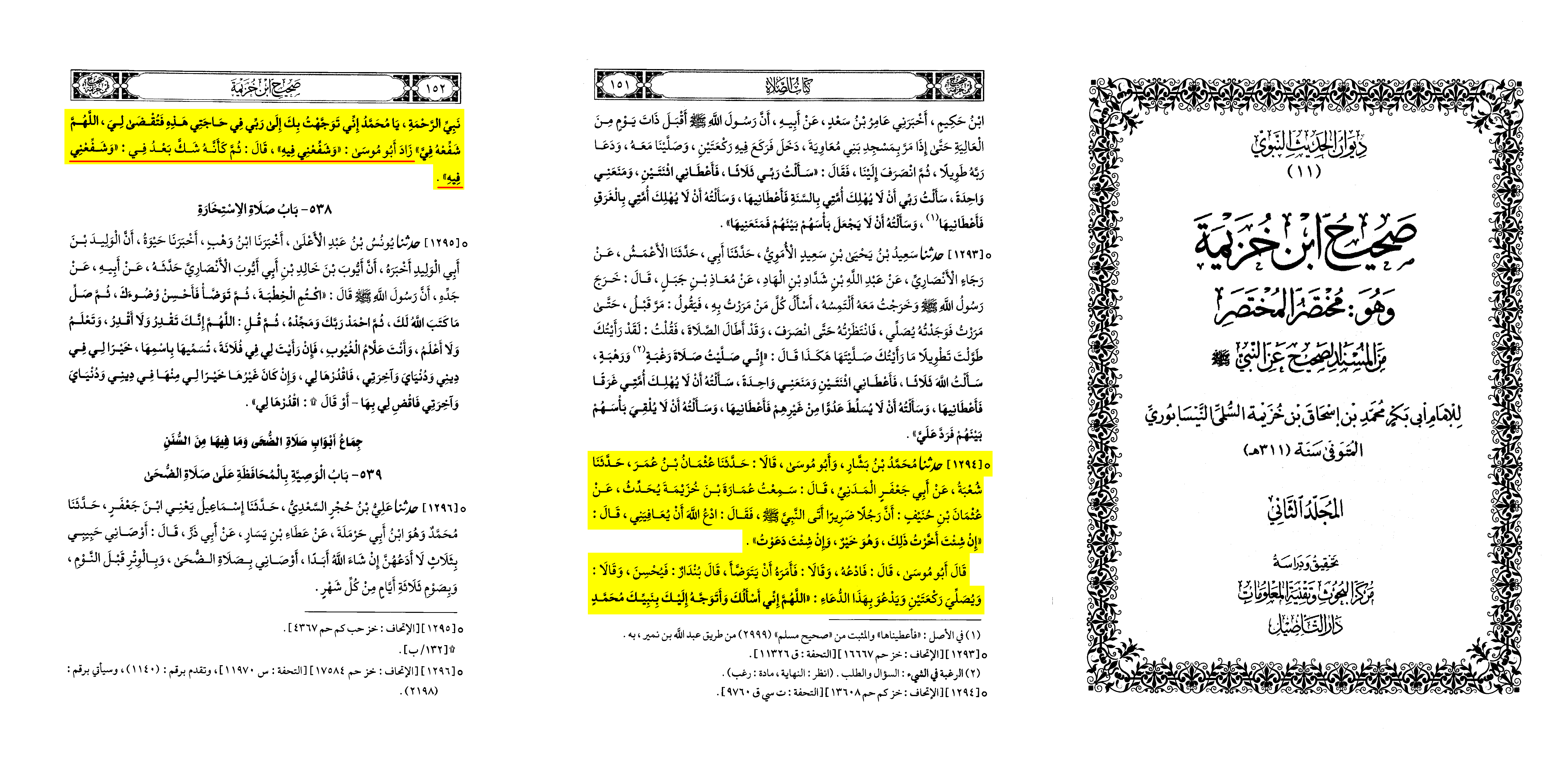
For example in Ṣaḥīḥ Ibn Khuzaymah Vol. 2, pg. 151 - 152 it says:
Abū Mūsā added the phrase: "And accept his intercession for me with him". He (another narrator) said: "It seems that afterward he became uncertain about this phrase."
It was also recorded in Musnad Aḥmad Ibn Ḥanbal Vol. 13, pg. 315, but it also says:
Then he (the narrator, Rūḥ) said: "I think that it contains the words: 'Accept his intercession for me.'"
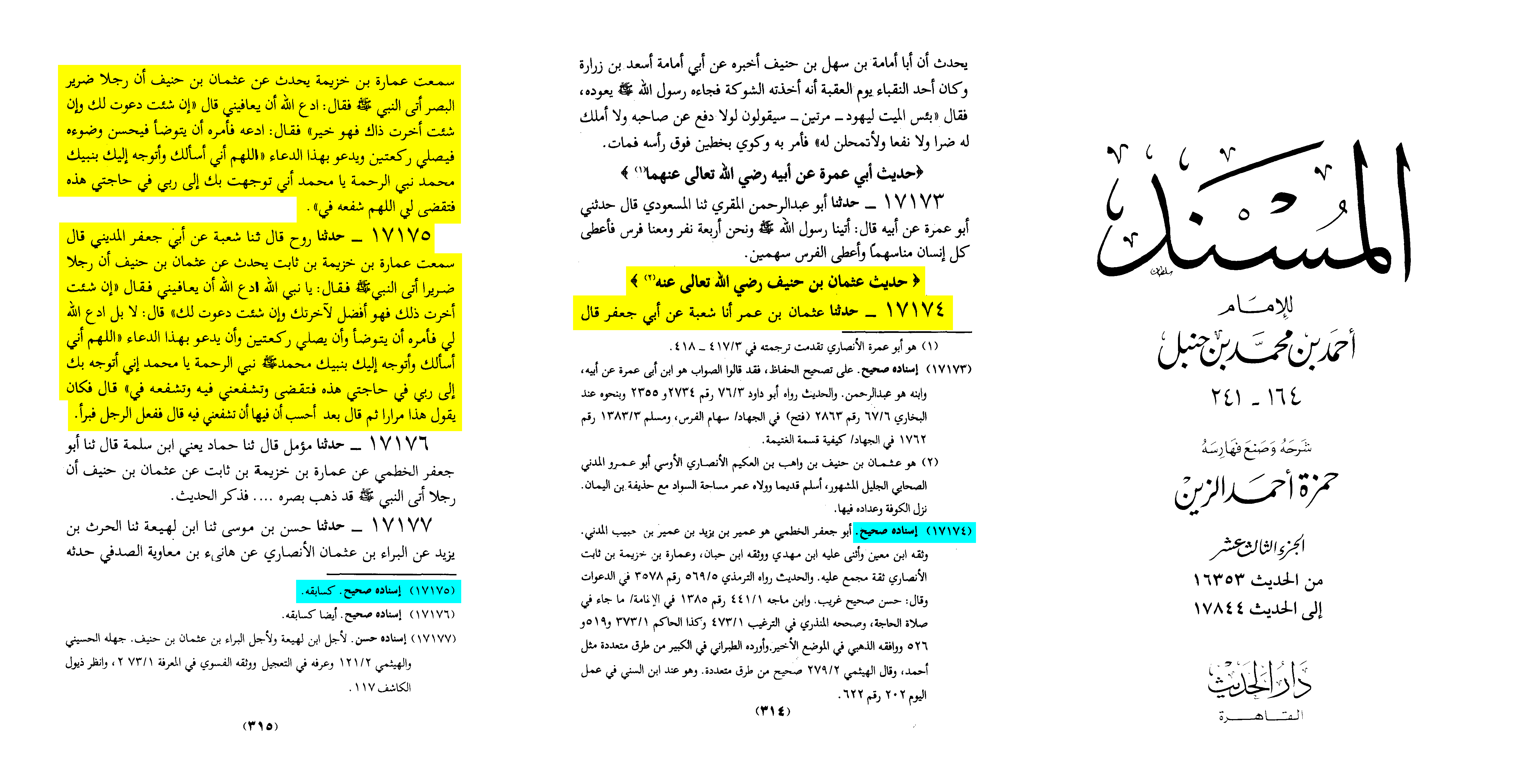
The narration before, without Rūḥ, did not contain this phrase and was also authentic. How then could they depend on this speculation and dismiss all the other variants that negate this?
Secondly, most other variants end off after "and accept his intercession for me", which we have discussed in point two, and and some exceptional ones add:
وَشَفِّعْنِي فِي نَفْسِي
"And accept my intercession for myself"
In this phrase the blind man is interceding through his deeds, and hence requesting God to accept his intercession (i.e. his supplication, which is a deed) for himself.
Sixth: He claims that such miracles did not occur after the Prophet’s death. However, such a statement is pure ignorance and a degree of disbelief, because the miracles of the Prophet ﷺ continue to occur after his death through his intercession.
This was stated by the esteemed scholar of Ahlus Sunnah, Ibn Ṣalāḥ al-Shahrazūrī, in his Fatawa wa-Masa’il Vol. 2, pg. 210:
Indeed, some scholars undertook to investigate the miracles of the Prophet comprehensively and collected a thousand miracles from them, yet we considered this insufficient, since there are many times more than that which cannot be counted.
They are not limited to those that occurred during his lifetime. Rather, they have continued to appear after him throughout the succession of generations.
This is because the miracles granted to the saints among his community, and the responses granted to those who perform tawassul through him in their needs, and the relief they receive after their tawassul through him in times of hardship, are decisive proofs for his prophethood and radiant miracles belonging to him. No one can count them and no limit can encompass them.

Many miracles have been reported until today about the relief people have received by performing tawassul through the Prophet ﷺ, Al-Albānī's denial of this fact is due to his own bias.
One such example is what was mentioned by Ibn Abī al-Dunyā in his Mujāb al-Duʿāʾ and quoted by Ibn Taymiyyah in Majmu’a al-Fatawa Vol. 1, pg. 263 - 264:
There are also accounts concerning certain people who saw in a dream that they were told, ‘Supplicate with such-and-such.’ Such a thing cannot be used as evidence, according to the agreement of the scholars. Some of these accounts have been mentioned by compilers of supplications, and a report from one of the Salaf has also been narrated concerning this, such as what Ibn Abī al-Dunyā narrated in his book Mujāb al-Duʿāʾ.
He said:” Abū Hāshim narrated to us: I heard Kathīr b. Muḥammad b. Kathīr b. Rifāʿah say:
A man came to ʿAbd al-Malik b. Saʿīd b. Abḥar. He examined his abdomen and said: "You have an illness that cannot be cured." The man asked, “What is it?". He replied, “Al-dubaylah” (a severe internal abscess or tumour).
The man then turned away and said: “Allah, Allah, Allah is my Lord; I associate nothing with Him. O Allah, I turn to You through Your Prophet Muḥammad, the Prophet of mercy, may Allah bless him and grant him peace. O Muḥammad, I turn through you to your Lord and my Lord, that He may have mercy on me regarding what has afflicted me.“
He said: Then he examined his abdomen again and said, “You have been cured. There is no illness in you.”
I [Ibn Taymiyyah] say: This supplication and others like it have been narrated as having been used by the early Muslims (al-Salaf). It has also been transmitted from Aḥmad b. Ḥanbal, in al-Marwadhī’s Manāsik, that he permitted seeking tawassul through the Prophet ﷺ in supplication, while others prohibited it.
If those who practice tawassul intend tawassul through faith in him, love for him, loyalty to him, and obedience to him, then there is no disagreement between the two groups. But if they intend tawassul through his very essence (dhātihi), then that is the point of disagreement. Whatever they disputed about should be referred back to Allah and the Messenger.
Merely because a supplication achieves the desired result does not prove that it is permissible in the Sharīʿah… For many people call upon things besides Allah—such as the stars and other created beings—and they obtain whatever they seek… Therefore, obtaining one's objective through certain means does not entail that those means are permissible, even if the objective itself is permissible.

Ibn Taymiyyah admits that the usage of this duʿāʾ, which was taught by ʿUthmān b. Ḥunayf, was famous amongst the Salaf and that many people, including this man, were granted miraculous answers to their prayers. He only argues that the fact that these prayers were answered does not necessarily mean that performing them is permissible. In any case, this constitutes a firm refutation of al-Albānī’s argument.
Conclusion: Al-Albānī argues that both interpretations are advocating for an implied omitted meaning (muḍāf); however this is incorrect and a result of his poor grammatical skills. In Arabic, the preposition bāʾ (ب) carries 14 distinct meanings, which are shaped by the context of the sentence.
Consider the example from Sūrat al-Qaṣaṣ (28:17):
قَالَ رَبِّ بِمَآ أَنۡعَمۡتَ عَلَىَّ فَلَنۡ أَكُونَ ظَهِيرًا لِّلۡمُجۡرِمِينَ
He [Mūsā] said, "My Lord, for the favour You have bestowed upon me, I will never be an assistant to the criminals."
The bāʾ in this verse can be interpreted as either bāʾ al-qasamiyyah (the bāʾ of oath-taking, which would read as “I swear by the favour…”) or bāʾ al-sababbiyyah (the bāʾ of causality, which would read as “Because of the favour…”). Figuring out which bāʾ is applicable will depend on the context of the sentence.
Now, among the various functions of this preposition is bāʾ al-istiʿānah (the bāʾ of seeking assistance). It was explained to us by Ibn al-ʿUthaymīn in his Sharh al-ʾAlfiyyah:
The preposition bāʾ (ب) can denote the means of seeking assistance. Istiʿānah refers to requesting aid or support, and thus the bāʾ is attached to the source from which help is sought.
For example, in "I seek help from Allāh" (astaʿīnu bi-Allāh), the bāʾ functions as bāʾ al-istiʿānah, indicating that assistance is sought from Allāh.
The bāʾ al-istiʿānah, by its grammatical function, designates its object as the means through which assistance is sought.
Thus, if the bā’ in the dua “through Muhammad” denotes assistance, it would mean that Muhammad as a person (i.e. essence) would be the means by which God is being approached. This would be the apparent (ẓāhir) of the statement and not an addition.
In contrast, his use of adding “prayers” would be an addition that is not indicated by the text. No other category of bāʾ would make sense in this sentence as well, neither grammatically nor contextually, and no category of bāʾ implies the word ‘prayers’.
This concludes our discussion on this report as being legitimate evidence for the permissibility of seeking intercession through the Prophet’s ﷺ essence outside of his presence.
Uthmān's prayer after the Prophet's death
What makes this argument further compelling is that Uthmān b. Hunaif ﵁ would later remember this supplication and teach it to others after the death of the Holy Prophet ﷺ.
This was transmitted in al-Muʿjam al-Ṣaghīr Vol. 1, pg. 306 - 307, Ḥadīth # 508 by al-Ṭabarānī:
Narrated Ṭāhir b. ʿĪsā b. Qayras al-Muqrī al-Miṣrī al-Tamīmī: ʿAsbaghḥ b. al-Faraj narrated to us, ʿAbdullāh b. Wahb narrated to us, from Shabīb b. Saʿīd al-Makkī, from Rūḥ b. al-Qāsim, from Abū Jaʿfar al-Khātmī al-Madānī, from Abū Umāmah b. Sahl b. Hunayf, from his uncle,
ʿUthmān b. Hunayf said: A man used to go frequently to ʿUthmān b. ʿAffān for a need of his, but ʿUthmān would not pay attention to him nor look into his need. So the man met ʿUthmān b. Hunayf and complained to him about that. ʿUthmān b. Hunayf said to him: "Go to the place of ablution and perform wuḍūʾ, then go to the mosque and pray two rakʿāhs, then say: 'O Allah, I ask You and I turn to You through our Prophet Muḥammad SAW, the Prophet of mercy. O Muḥammad, I turn through you to your Lord Almighty that He may fulfill my need' — and mention your need. Then come to me so I may go with you."
So the man went and did as ʿUthmān instructed him. He then came to the door of ʿUthmān (b. ʿAffān). The doorman came, took him by the hand, and brought him in to ʿUthmān, who seated him beside him on the cushion and said, "What is your need?" The man mentioned his need, and ʿUthmān fulfilled it for him, then said, "I had not remembered your need until this very moment. Whenever you have any need, come to us."
The man went out from him and met ʿUthmān b. Hunayf, saying, "May Allah reward you well — he would not look into my need nor turn to me until you spoke to him about me."
ʿUthmān b. Hunayf replied, "By Allah, I did not speak to him, but I witnessed the Messenger of Allah ﷺ when a blind man came to him and complained of the loss of his sight... [he then narrated the Hadith again as mentioned above].”
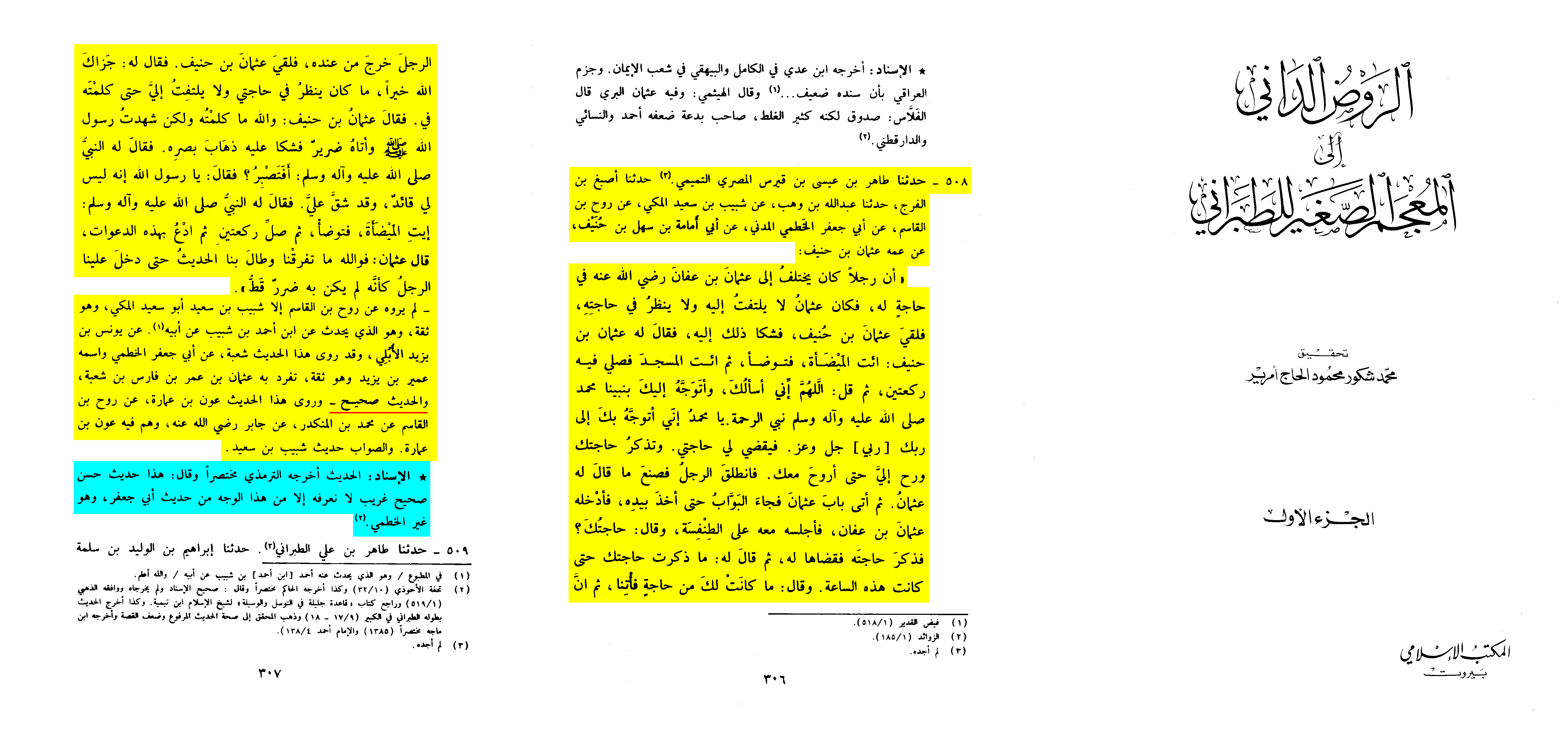
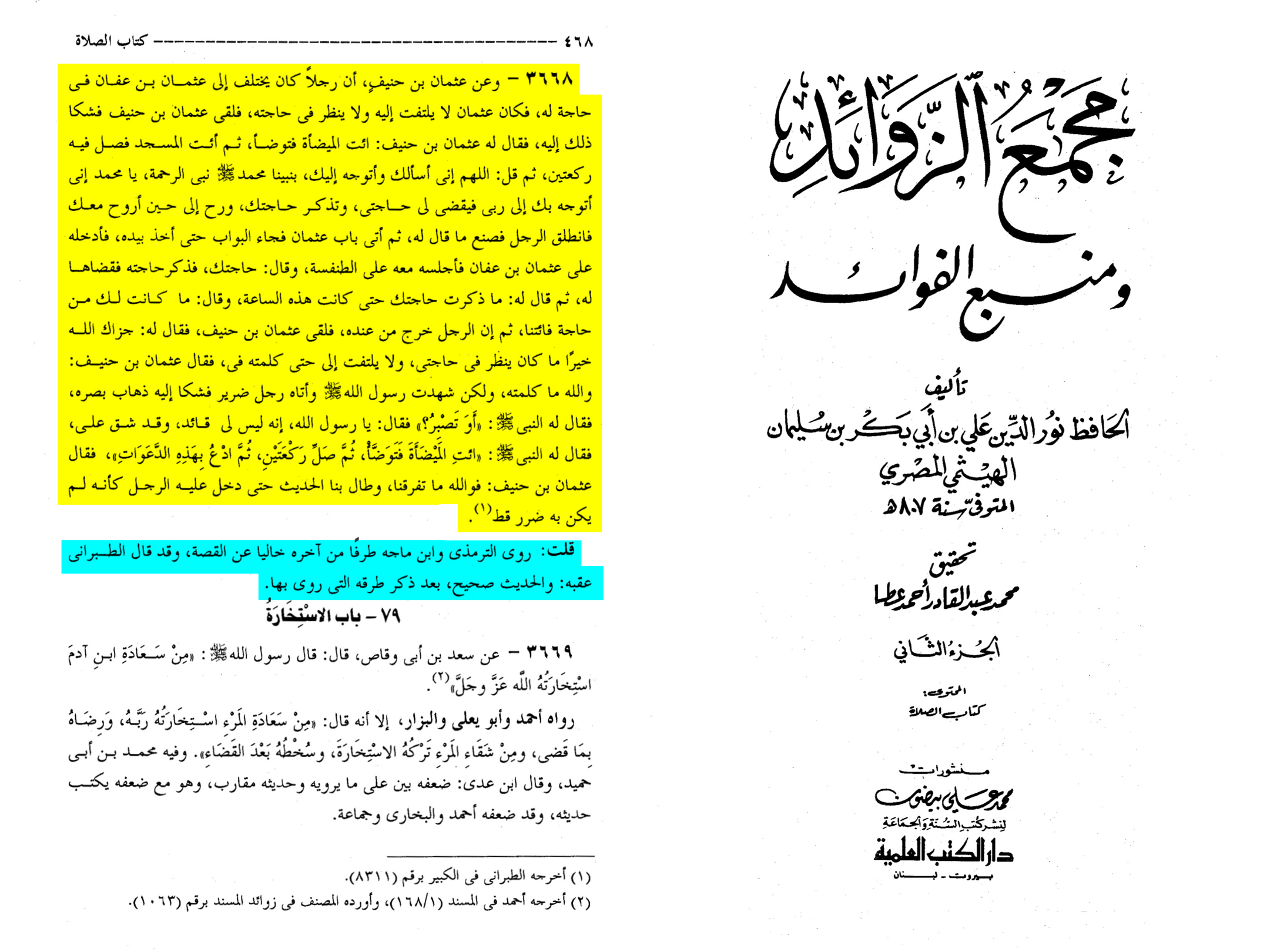
The chain of narration is authentic, as al-Ṭabarānī states, and al-Haythamī in Majmaʿ al-Zawāʾid Vol. 2, pg. 468, Ḥadīth # 3668. The narrators are all reliable.
However, some researchers argue that, while the narrator–Shabīb b. Saʿīd al-Makkī–is reliable, his narrations from Ibn Wahb are not. This is due to an argument put forth by al-Jirjānī in Kāmil Fīl Ḍuʿafāʾ Vol. 5, pg. 47 - 49:
Shabīb b. Saʿīd had a copy of al-Zuhrī's narrations, which he received through Yūnus, and those are reliable narrations. [However], Ibn Wahb narrated from him some munkar narrations. [...]
Whenever Shabīb's son, Aḥmad b. Shabīb, narrated from him the copy of Yūnus, from al-Zuhrī, they were reliable narrations. Thus, it is not the same as Shabīb b. Saʿīd whom Ibn Wahb transmitted the munkar narrations from.
Perhaps Shabīb was in Egypt on business, and Ibn Wahb wrote down narrations from him from memory, causing him to make mistakes and err. I hope that Shabīb did not deliberately intend to fabricate this lie."
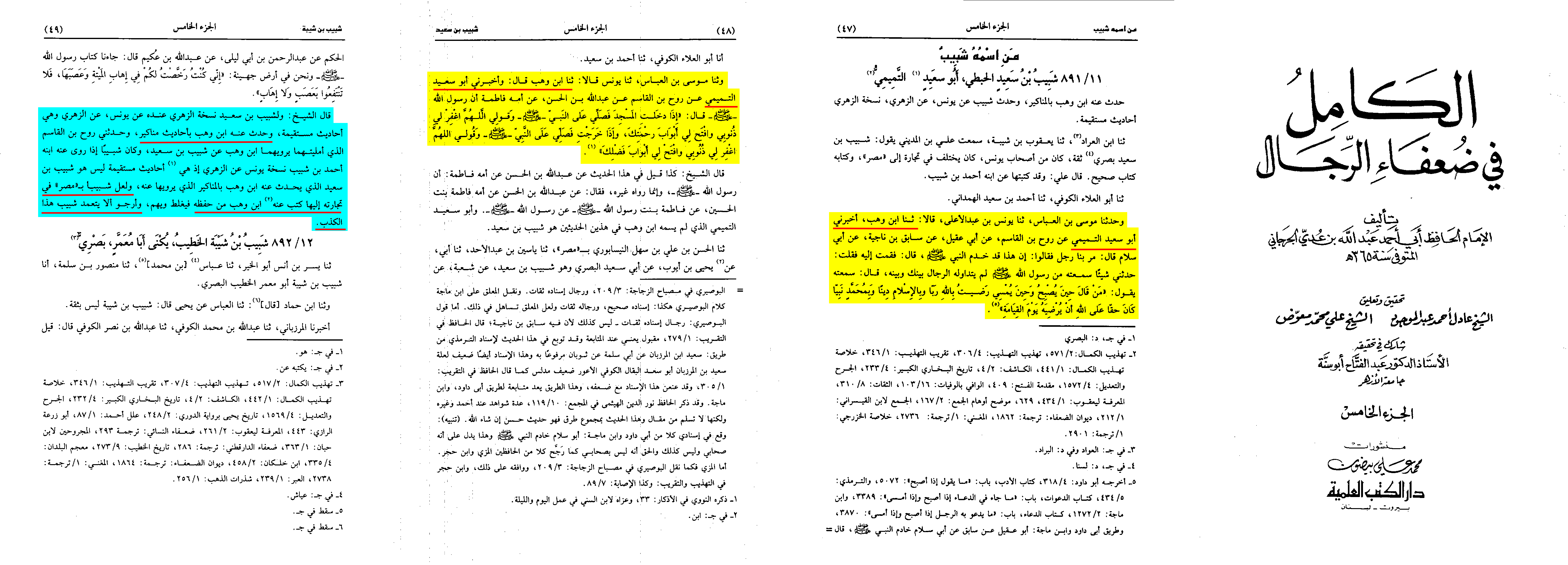
What al-Jirjānī is essentially saying is that whenever Ibn Wahb transmitted from Shabīb, the narrations would be odd. Thus, he theorises that this is due to Ibn Wahb narrating things from memory, and so makes errors which leads to the odd narrations.
The response to this is: Al-Jirjānī is presuming this without presenting any evidence to substantiate this matter. He neither provides the odd narrations he alludes to, and bases his statement on superstition. In fact, he himself provides two narrations that neither have oddity. Thus, it is rejected.
Furthermore, merely narrating oddities does not necessitate weakness. This is because narrating manākīr can simply mean narrating reports that are unfamiliar or not widely known. Linguistically, munkar comes from the root word نَكِرَ, meaning “to be unrecognized”.
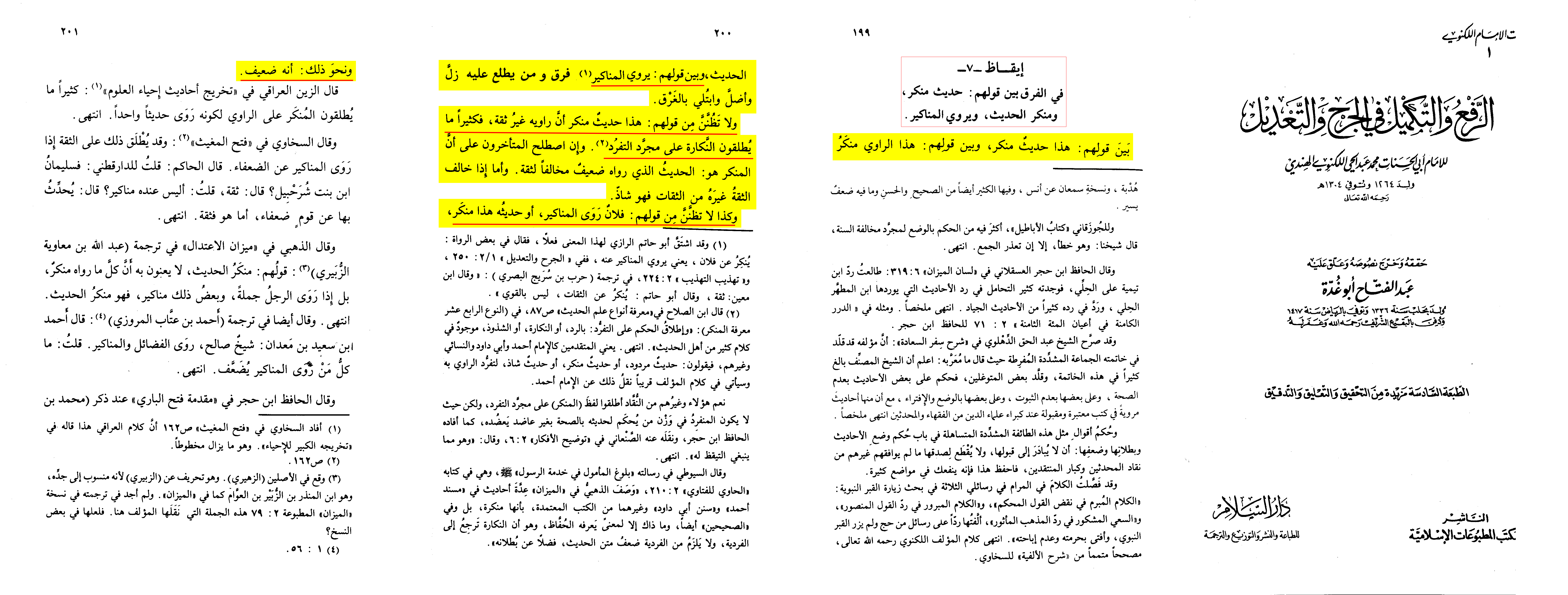
This was explained to us by al-Rāfiʿ wal-Takmīl Fī Jarḥ wal-Taʿdīl, pg. 335:
Do not assume from their statement, “This is a munkar hadith,” that its narrator is not trustworthy, for they often used munkar simply to refer to a report narrated uniquely by one person (tafarroud).
Later scholars, however, adopted the technical definition that a munkar hadith is one narrated by a weak narrator in contradiction to a trustworthy narrator…
Likewise, do not assume from their statements, “So-and-so narrated manākīr,” or “This hadith of his is munkar,” or similar expressions, that the narrator is weak.
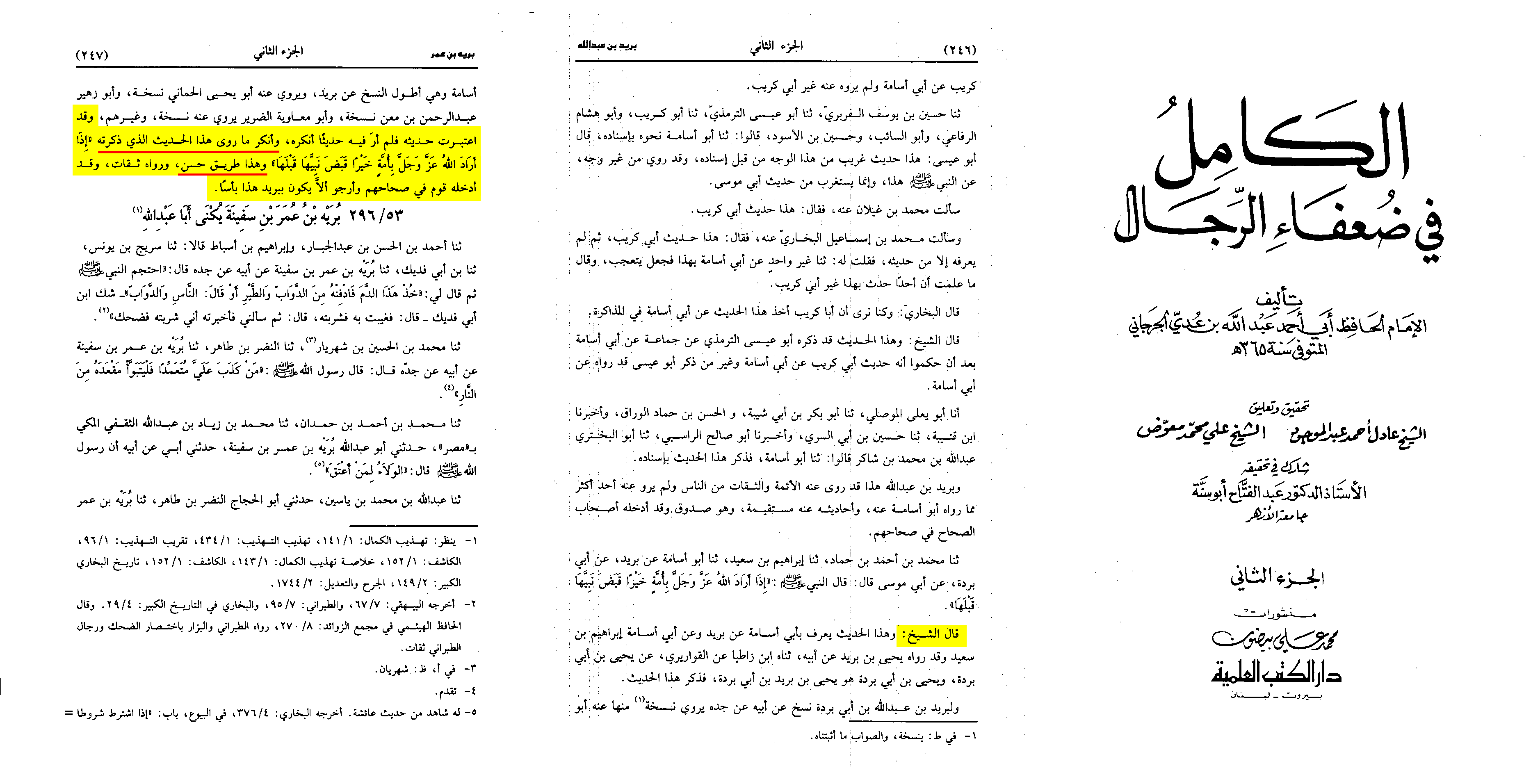
Ibn ‘Adī held the same opinion, for he authenticates odd reports in numerous places, such as in Kāmil Fīl Ḍuʿafāʾ Vol. 2, pg. 246 - 247:
I examined his narrations and did not find any ḥadīth in them that I considered odd. The only report I found odd from him was the ḥadīth I mentioned: “When Allah, the Mighty and Majestic, intends good for a nation, He takes its Prophet before it.”
This chain is good, and it was narrated by trustworthy transmitters. Some scholars even included it in their Ṣaḥīḥ collections. I hope that there is no harm (i.e. no issue) with Burayd.
So oddity appearing in one’s narrations, does not justify a person’s weakness, as the oddity may not be the fault of them, and it may not be an issue at all.
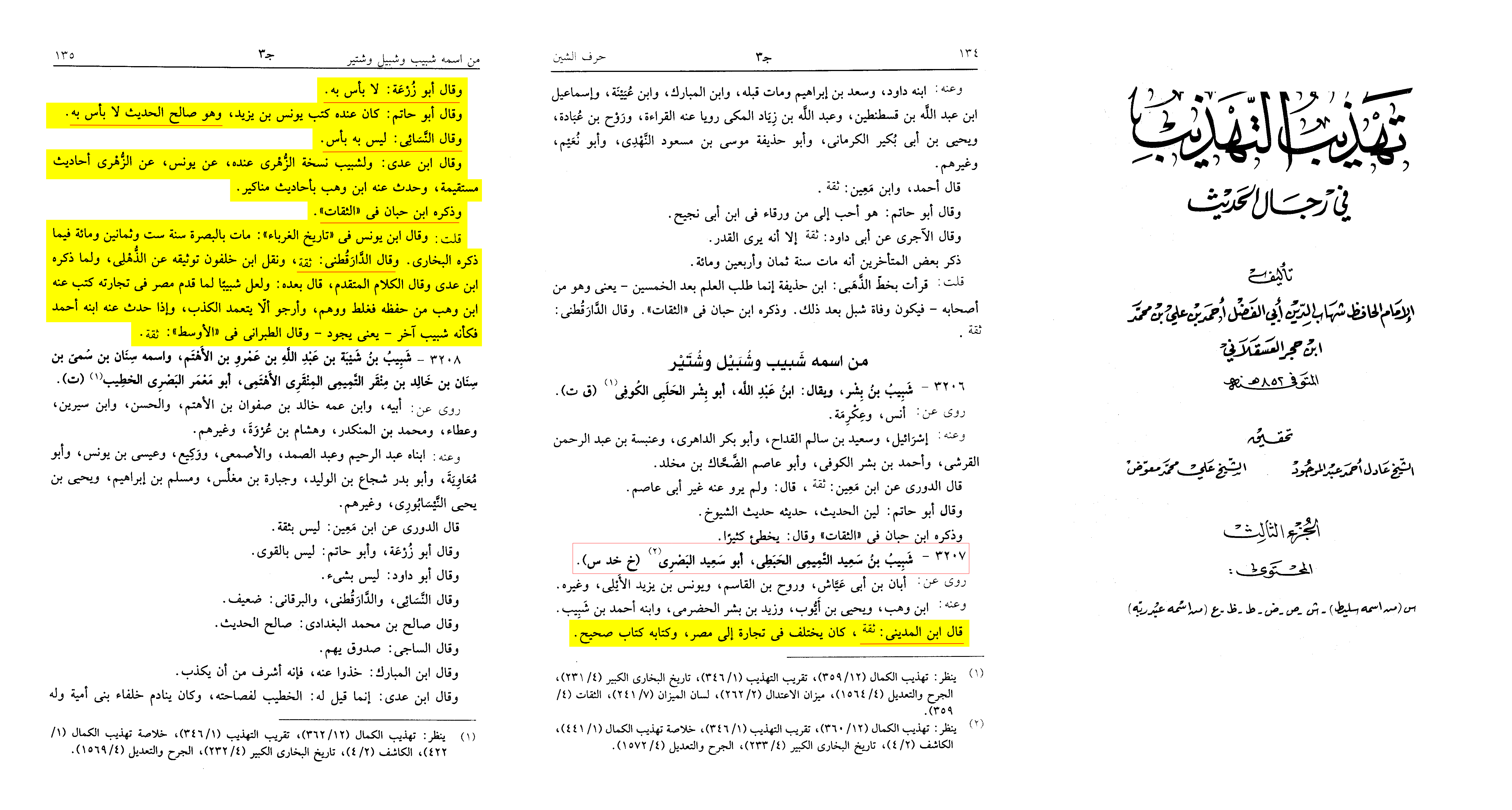
Moreover, no one besides him mentions this about Shabīb, especially when considering strict scholars like al-Nasa’i, Abu Hatim, Abu Zur’ah and Ibn Hibban all authenticate him without mention of criticisms. See Tahdhib al-Tahdhib Vol. 3, pg. 134 - 135.
Nevertheless, Ibn ‘Adī’s theory is totally refuted by the fact that this same tradition was narrated by Shabīb through routes besides Ibn Wahb.
Two alternative chains for this report was recorded by al-Bayhaqī in Dalāʾil al-Nubuwwah, Vol. 6, pg. 166 - 168:
Abu Saʿīd ʿAbd al-Malik b. Abī ʿUthmān al-Zāhid (may Allah have mercy on him) narrated from Muḥammad b. ʿAlī b. Ismāʿīl al-Shāshī al-Qaffāl from Abū ʿArūbah from al-ʿAbbās b. al-Faraj that:
Ismāʿīl b. Shabīb from his father from Rūḥ b. al-Qāsim, from Abū Jaʿfar al-Madanī, from Abū Umāmah b. Sahl b. Ḥunayf:
A man used to go repeatedly to ʿUthmān b. ʿAffān regarding a need of his. But ʿUthmān paid no attention to him and did not look into his request….
[…]
And Aḥmad b. Shabīb also narrated it from Saʿīd, from his father, in full.
[The Pathway to him is:] Abū ʿAlī al-Ḥasan b. Aḥmad b. Ibrāhīm b. Shādhān informed us, who was informed by ʿAbd Allah b. Jaʿfar b. Durastāwayh, who said: Yaʿqūb b. Sufyān narrated to us, who said: Aḥmad b. Shabīb b. Saʿīd narrated to us and he mentioned it in full, and this addition I have appended in the month of Ramaḍān in the year forty-four.
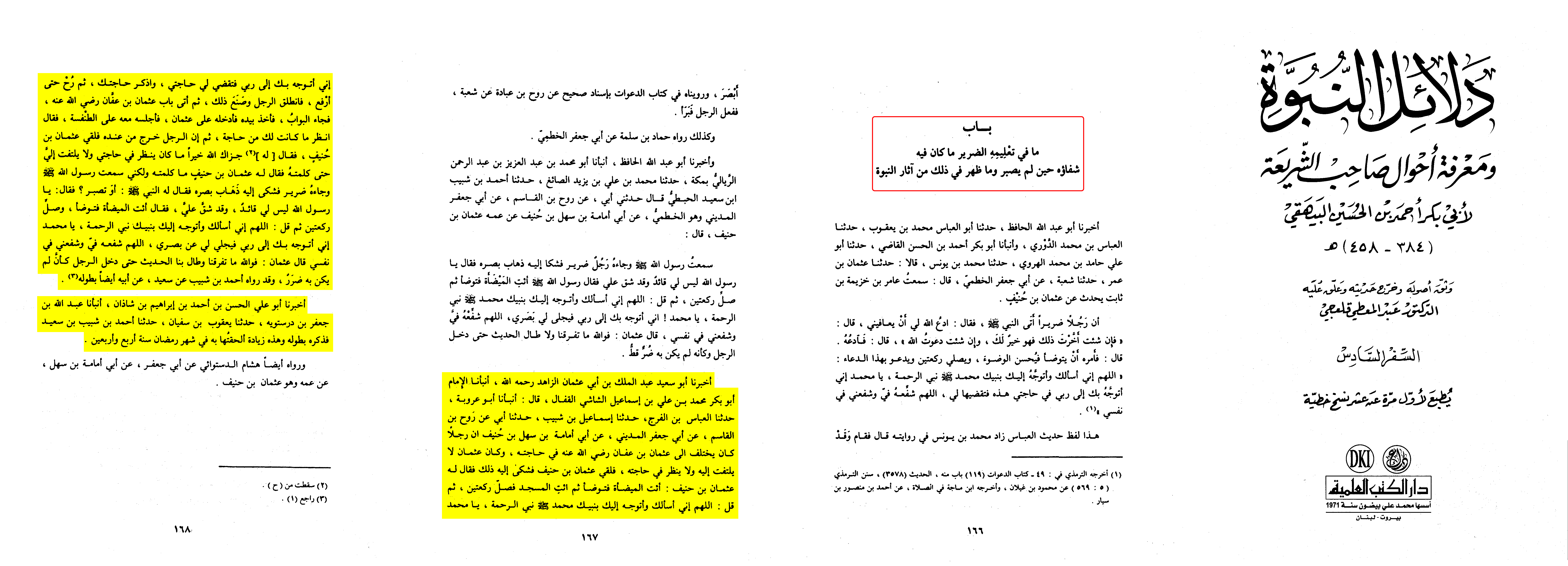
Al-Bayhaqī provides us with two additional pathways to Shabīb that both come from his two sons, Ahmad and Isma’il. Readers may click on the links of each narrator to find al-Dhahabi’s praise of each narrator, showcasing the reliability of both chains.
Since the issue of Ibn Wahb is not here, it shows that al-Jirjānī's theory is incorrect, as al-Bayhaqī transmitted the same report from Shabīb but through his sons instead. The rest of the chain is all reliable.
Conclusion
This concludes unequivocally that tawassul through the Prophet ﷺ in his absence is undoubtedly permissible. The fact that the Prophet ﷺ has to be alive in order to perform this prayer holds no precedent neither in the Qurʾān nor in the Sunnah, and it was certainly not held by the companion ʿUthmān b. Hunayf.
Unless Sunnis want to accuse him of shirk, and the scholars such as al-Nasāʾī, al-Bayhaqī and al-Ṭabarānī, who included it in their duʿāʾ books, of shirk too, then they should accept that this is a permissible prayer to make at all times.
This method of Tawassul is also mass-transmitted in the Shi’a corpus, with several Hadiths of the Ahl al-Bayt ﵇ outlining this as being recommended.
For example, in a Hadith attributed to Imam al-Jawad ﵇ in Tahdhib al-Ahkam Vol. 3, Chapter 9, Hadith 12 by al-Shaykh al-Tusi ﵀ he says:
Ahmad ibn Muhammad from Ahmad ibn Abi Dawud from Ibn Abi Hamzah from Abu Ja’far (a.s), who said:
A man came to al-Rida ﵇ and said to him: "O son of the Messenger of Allah! I have dependents and I am in debt, and my situation has become difficult. Teach me a supplication that when I supplicate to Allah the Mighty and Majestic with it, Allah will provide for me."
He said: "O servant of Allah, perform ablution and perfect your ablution completely, then pray two rak'ahs, perfecting the bowing and prostration in them. Then say:
'O Mighty One, O Generous One, O One, O Generous One. I turn towards You by Muhammad, Your Prophet, the Prophet of Mercy. O Muhammad! O Messenger of Allah! Indeed, I turn through you to Allah, your Lord and the Lord of all things.
[I ask You] to send blessings upon Muhammad and upon his Ahl al-Bayt, and I ask You for a breeze from Your breezes and an easy opening and a vast provision by which I may gather my scattered affairs, pay my debt, and be aided in caring for my dependents.'"
Similar inclusions of such formulas are in recorded in al-Kafi Vol. 7, Chapter 95, Hadith. 7 and Kamil al-Ziyarat Chapter 3, Hadith. 1 with all having entirely different chains.


Comments