Mu’awiya cursed ‘Ali (a) in Sahih Muslim
- Anonymous
- Jan 7
- 12 min read
بسم الله الرحمن الرحيم
The ritual of cursing Ali (AS) from the pulpits is one of the most infamous innovations instituted during Mu'awiya's regime.
Until recently, this abominable practice was confirmed by the majority of scholars. Our opponents realized the theological implications of accepting the idea that Mu’awiya cursed ‘Ali and, thus, rejected it.
Instead of sincerely reevaluating their theological stances (as a sincere person would) they sought to deny that Mu’awiya ever cursed ‘Ali and obfuscate the sources/narrations.
In this article, we shall go over the strongest evidence from both the books of hadith, as well as the books of history, that prove Muʿāwiya did curse ʿAlī and reveal the implications of said action.
The Sahih Muslim Report
Saʿd b. Abi Waqqaṣ was well-known for his political quietism during the early civil wars of Islam. He supported neither Ali (AS) nor his opponents, and adopted a neutral stance. He refrained from condemning either side, regardless of alleged crimes, sins, or transgressions.
Nonetheless, Mu’awiya enticed Sa’d to curse Ali (AS), thereby shifting his public image. This was famously recorded in Sahih Muslim, timing the incident during Mu’awiya’s Hajj pilgrimage in the year 50 AH.
As recorded in Sahih Muslim 2404d:
Amir b. Sa'd b. Abi Waqqas reported on the authority of his father that Muawiya b. Abi Sufyan appointed Sa'd as the Governor and said: What prevents you from rebuking Abu Turab?
He said: It is because of three things which I remember Allah's Messenger (ﷺ) having said about him that I would not rebuke him and even if I find one of those three things for me, it would be more dear to me than the red camels…
He then mentions 3 renowned virtues of ‘Amir al-Mu’minin (AS).
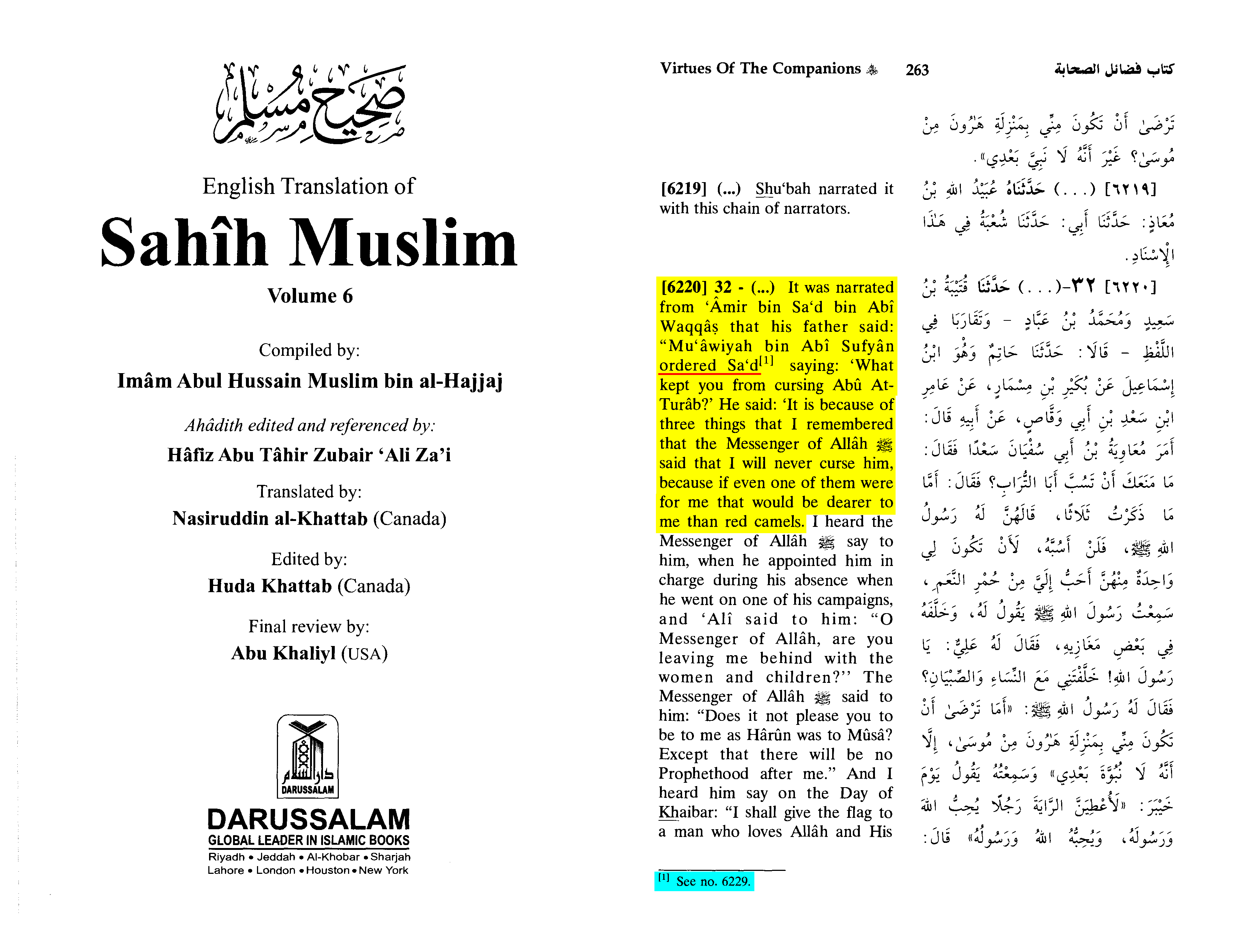
The translators did not adequately relay this report. The more accurate version of this report is in Darrusalam’s English Sahih Muslim Vol. 6, pg. 263 H. # 6220:
قَالَ: أَمَرَ مُعَاوِيَةُ بْنُ أَبِي سُفْيَانَ سَعْدًا فَقَالَ مَا مَنَعَكَ أَنْ تَسُبَّ أَبَا التُّرَابِ
He said: Muʿāwiyah b. Abī Sufyān ordered Saʿd and said, “What prevented you from cursing Abū Turāb?”
This is because the Arabic word Amara (أَمَرَ) means to command someone, such as when Allah (SWT) commanded Iblis in Surah al-A’raf 7:12:
قَالَ مَا مَنَعَكَ اَلَّا تَسۡجُدَ اِذۡ اَمَرۡتُكَ
Allah said: 'What prevented you from prostrating, when I commanded you to do so?'
In other reports, the Prophet (SAW) used the word in a congruent manner, such as in Sahih al Bukhari 684:
رَسُولُ اللَّهِ صلى الله عليه وسلم فَصَلَّى، فَلَمَّا انْصَرَفَ قَالَ: يَا أَبَا بَكْرٍ مَا مَنَعَكَ أَنْ تَثْبُتَ إِذْ أَمَرْتُكَ
When Allah's Messenger (ﷺ) finished the prayer, he said, "O Abu Bakr! What prevented you from staying when I ordered you to do so?"
In both examples, we find the phrase مَا مَنَعَكَ (what prevented you) present alongside أَمَرَ (command).
It is clear from the wording of the report that it literally means: “Mu’awiyah ordered Sa’ad [to curse] ‘Ali, so he said: What prevents you from cursing ‘Ali?”.
Refuting the conjecture of al-Nawawi
Our opponents struggle to weaken this report, as the chain of narration is sahih, which demonstrates Mu’awiya’s hostility towards ‘Ali, as he ordered Sa’ad to curse him.
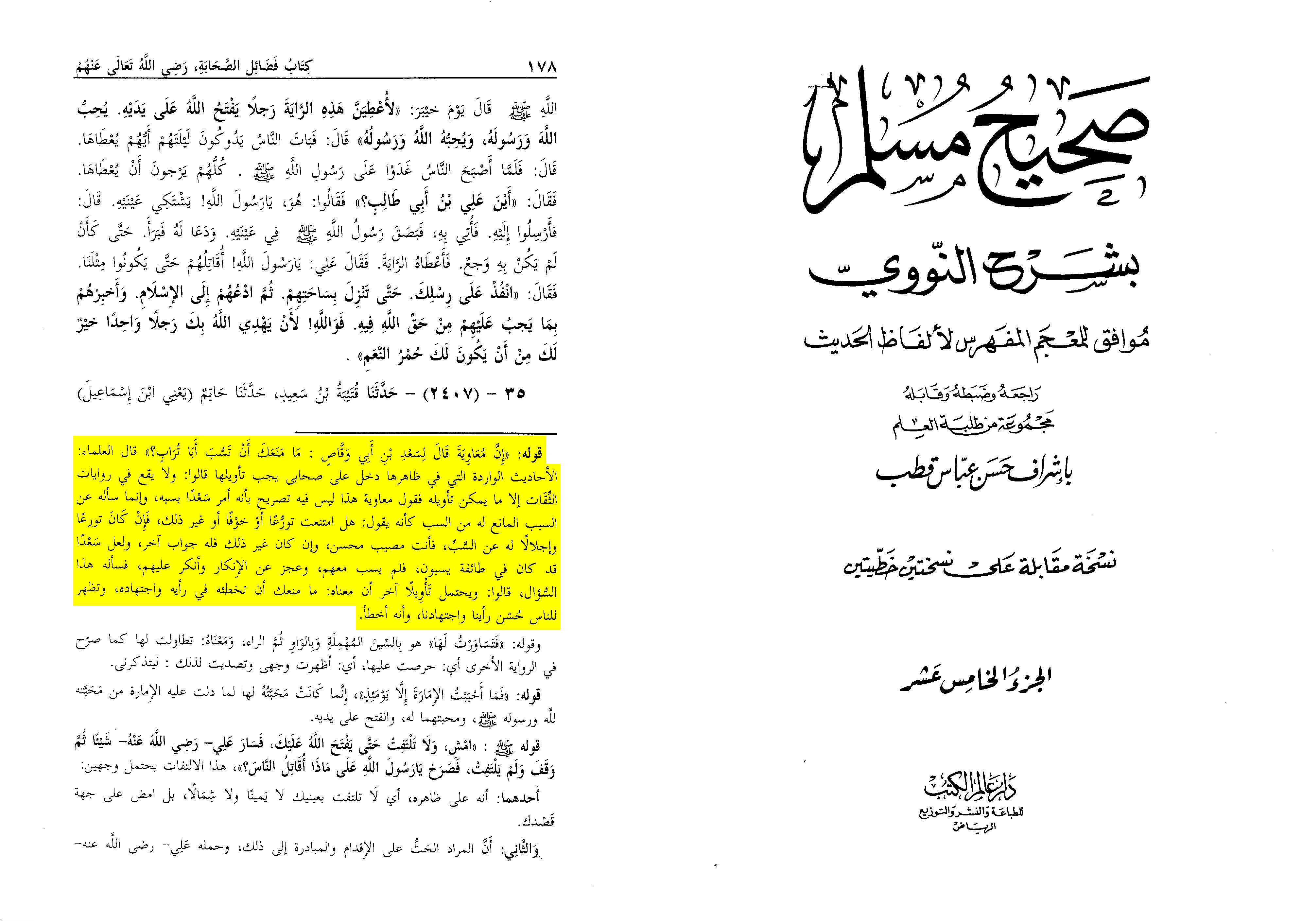
In his desperate attempts to defend his Amir Mu’awiya, al-Nawawi offered one of the most absurd ways to interpret this report in Sahih Muslim bi Sharh al-Nawawi, Vol. 15, pg. 178:
[Regarding] his statement, “Mu‘awiya said to Sa‘d b. Abi Waqqas: ‘What prevented you from insulting Abu Turab?’”:
The scholars said that reports whose outward wording appears to impugn a Companion must be interpreted. They stated that nothing occurs in the narrations of reliable transmitters except what is open to interpretation. Accordingly, this statement of Mu‘awiya does not contain an explicit order that Sa‘d insult him; rather, he merely asked him about the reason that prevented him from doing so.
It is as though he were saying: Did you refrain out of piety, or fear, or for some other reason? If it was out of piety and reverence for him, then you are correct and commendable; if it was for some other reason, then there is another possible response.
It may be that Sa‘d was among a group who were insulting him, but he did not insult him along with them, and he was unable to put a stop to it, though he disapproved of them. Thus Mu‘awiya asked him this question.
They also said that another interpretation is possible, namely that the meaning is: What prevented you from declaring him mistaken in his opinion and ijtihad, and from making clear to people the soundness of our opinion and ijtihad, and that he erred?
Rational response
Al-Nawawi posits two interpretations of Mu’awiya’s request from Sa’ad, but fails to provide any evidence for either and bases his reasoning on conjecture.
His last interpretation is the most absurd of the three, for it directly contradicts the wording of the report, as it does not say “mistaken in his opinion”, it says “what prevents you from cursing (تسب) Abu Turab”. Hence, even al-Nawawi did not subscribe to it but only attributed it to some scholars out of desperation to reinterpret this report.
From a rational perspective, it is not plausible to ask a question negating the act of abstaining from immorality, as it does not require justification. For example, no rational person asks, “Why do you not steal?” or “Why do you not lie?” By contrast, they do ask, “Why did you not pray?” or “Why did you not fulfill your duty?” because neglecting what is right or expected requires an explanation.
The only reason someone may ask “Why did you not lie” is in a case where they wanted or expected it. Thus, Mu’awiyah asked this question to entice Sa’ad to curse ‘Ali.
Linguistic response
Moreover, al-Nawawi deceitfully censored the report to aid his pathetic attempt to rescue Mu’awiya from kufr.
The report in Sahih Muslim states that Mu’awiya commanded (amara) Sa’d, but al-Nawawi replaced it with “and he said to Sa'ad (qala la-Sa’d)”.
The difference is pivotal since the fact that he was commanding Sa’d clearly implies that he commanded him to curse ‘Ali.
This is highlighted in another report in Sahih Muslim Vol. 6, pg. 269 - 270, which states:
It was narrated that Sahl bin Sa'd said:
"A man from the family of Marwan was appointed as governor of Al-Madinah, and he called Sahl bin Sa'd and ordered him to insult 'Alî, but Sa'd refused. He said: 'If you refuse to do it, then at least say: "May Allâh curse Abû At- Turâb."
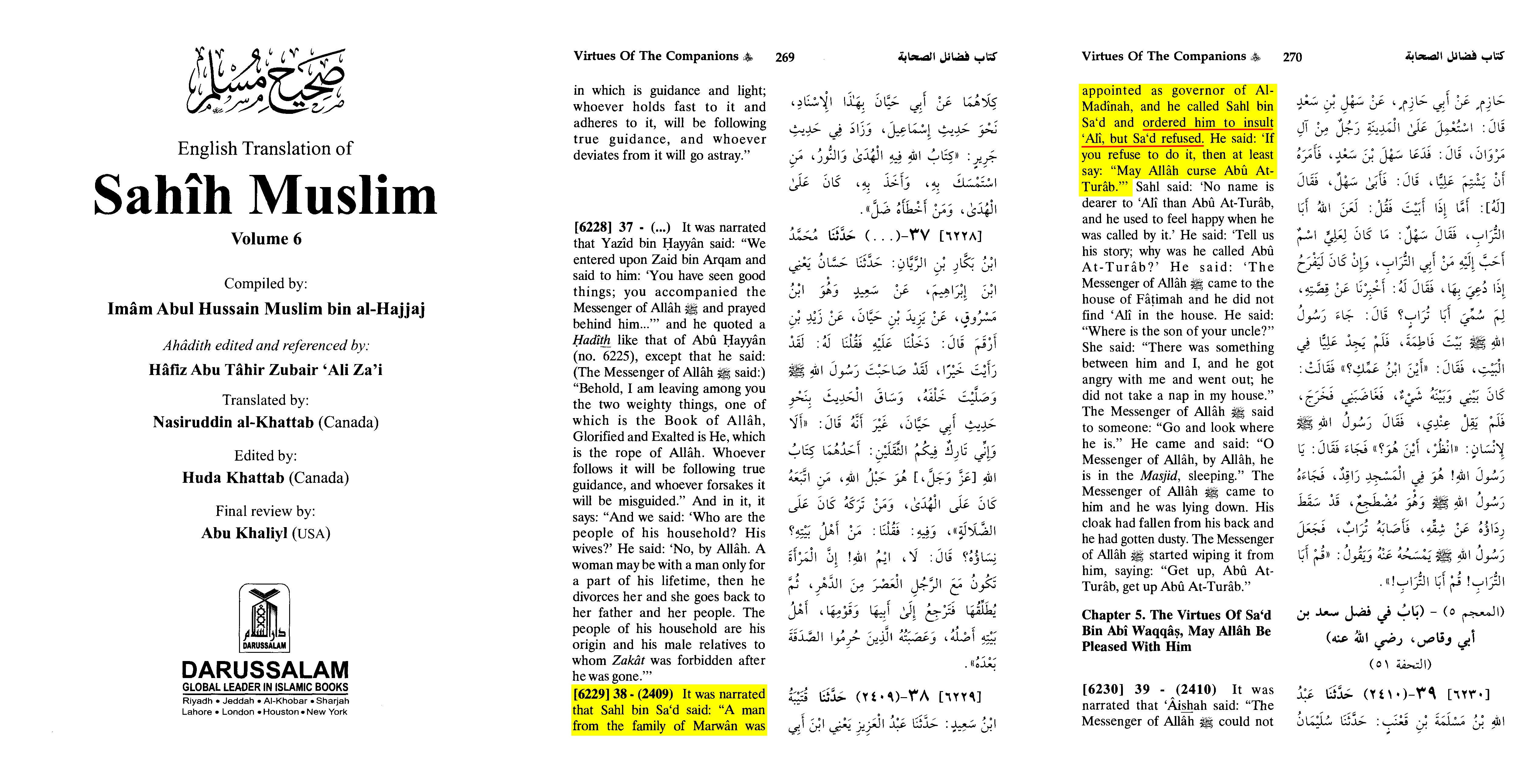
We see here that another Umayyad governor explicitly ordered (amara) another man to curse ‘Ali. As such, it is clear that the command is in reference to cursing ‘Ali, and is why al-Nawawi censored the word.
The scholarly etiquette of our opponents when engaging in debates is priceless. This is a prime example of their deceit and insincere tampering with the report to aid their argument.
Textual response
This is further clarified with another variant found in Musnad Abi A’wanah, pg. 474, where it records Mu’awiyah asking Sa’ad:
ألا تسب عليا؟
“Will you not insult ‘Ali?”.
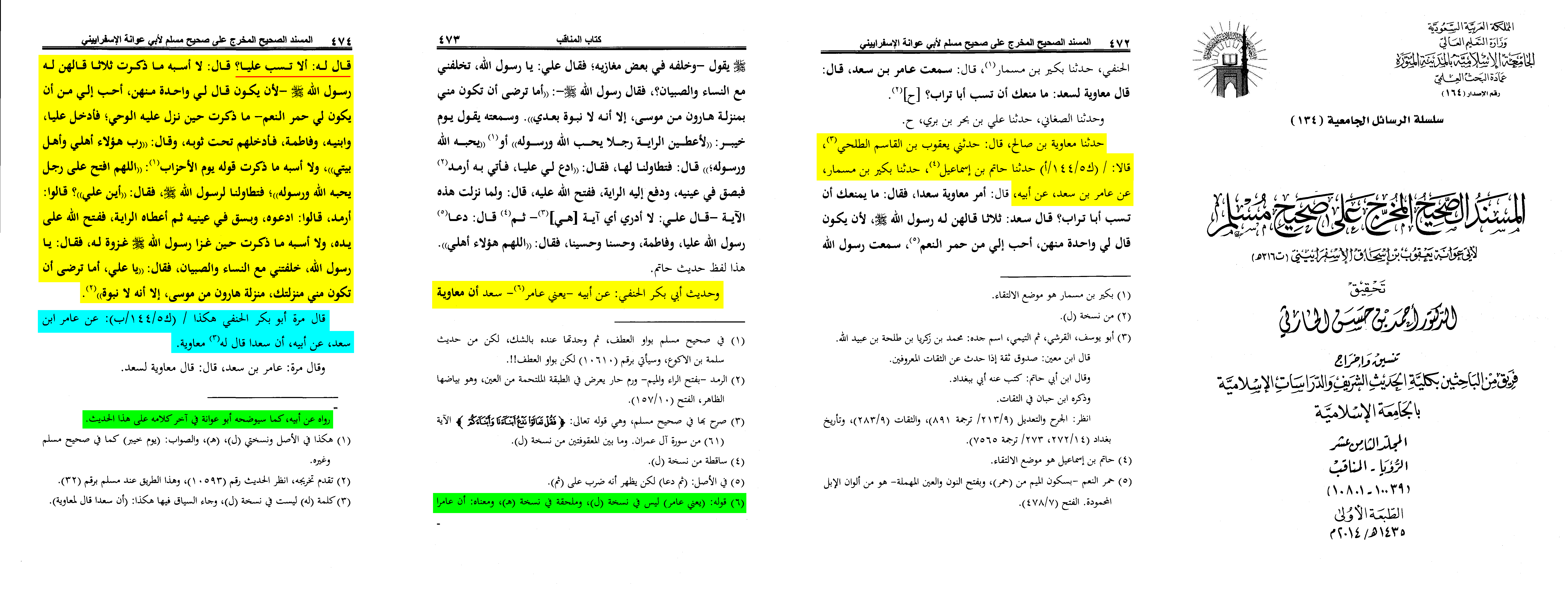
Note: All the narrators are reliable in the chain.
This variant proves that Mu’awiyah was not merely “asking Sa’ad”, but rather commanding him, because he directly asked him to curse ‘Ali.
While this variant is imprecisely similar to the Sahih Muslim narration, it is noteworthy that an oral transmission, unlike a written report, is subject to inconsistency in terminology. Such that the narrators understood the general meaning of the report to be a direct command from Mu’awiya to curse Ali (AS).
Scholarly critiques
For this reason, the contemporary Sunni scholar,Shaykh Musa Shahin Lashin, states in his commentary of Sahih Muslim, Fath al-Mun’im, Vol. 9 pg. 332:
Al-Nawawi attempts to absolve Mu‘awiya of this wrongdoing. This interpretation is clearly strained and far-fetched. What is established is that Mu‘awiya did, in fact, order the cursing of Ali. He was not infallible and could err.
Nevertheless, we are obliged to refrain from disparaging any of the Companions of the Messenger of God, peace and blessings be upon him. The practice of cursing Ali during Mu‘awiya’s rule, however, is explicit and undeniable.
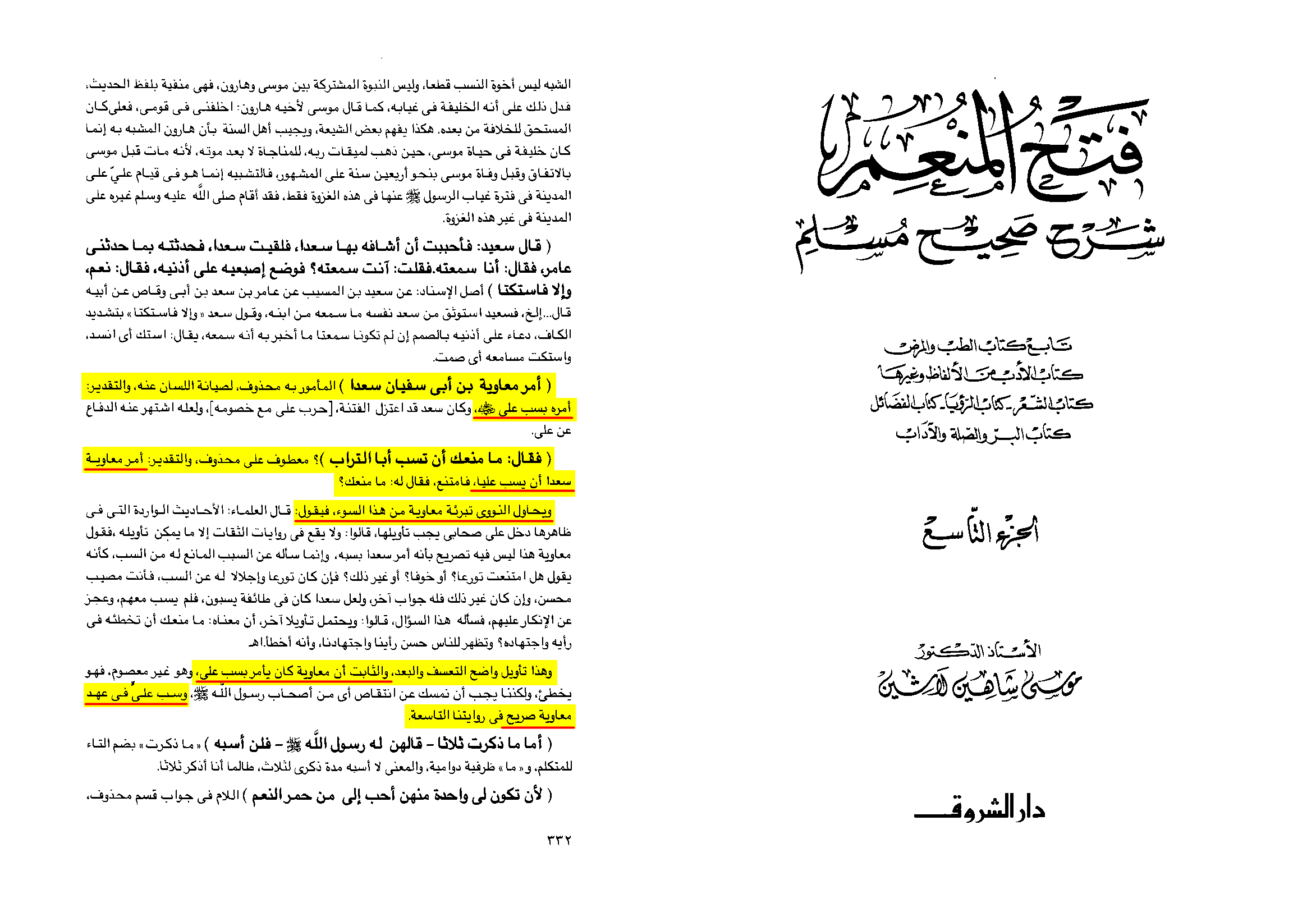
Furthermore, it is striking that our Salafi opponents, who routinely denounce and dissociate themselves from Ash‘ari scholars, have chosen to rally behind al-Nawawi while they have ignored what their own Salafi scholars have affirmed regarding the interpretation of this report.
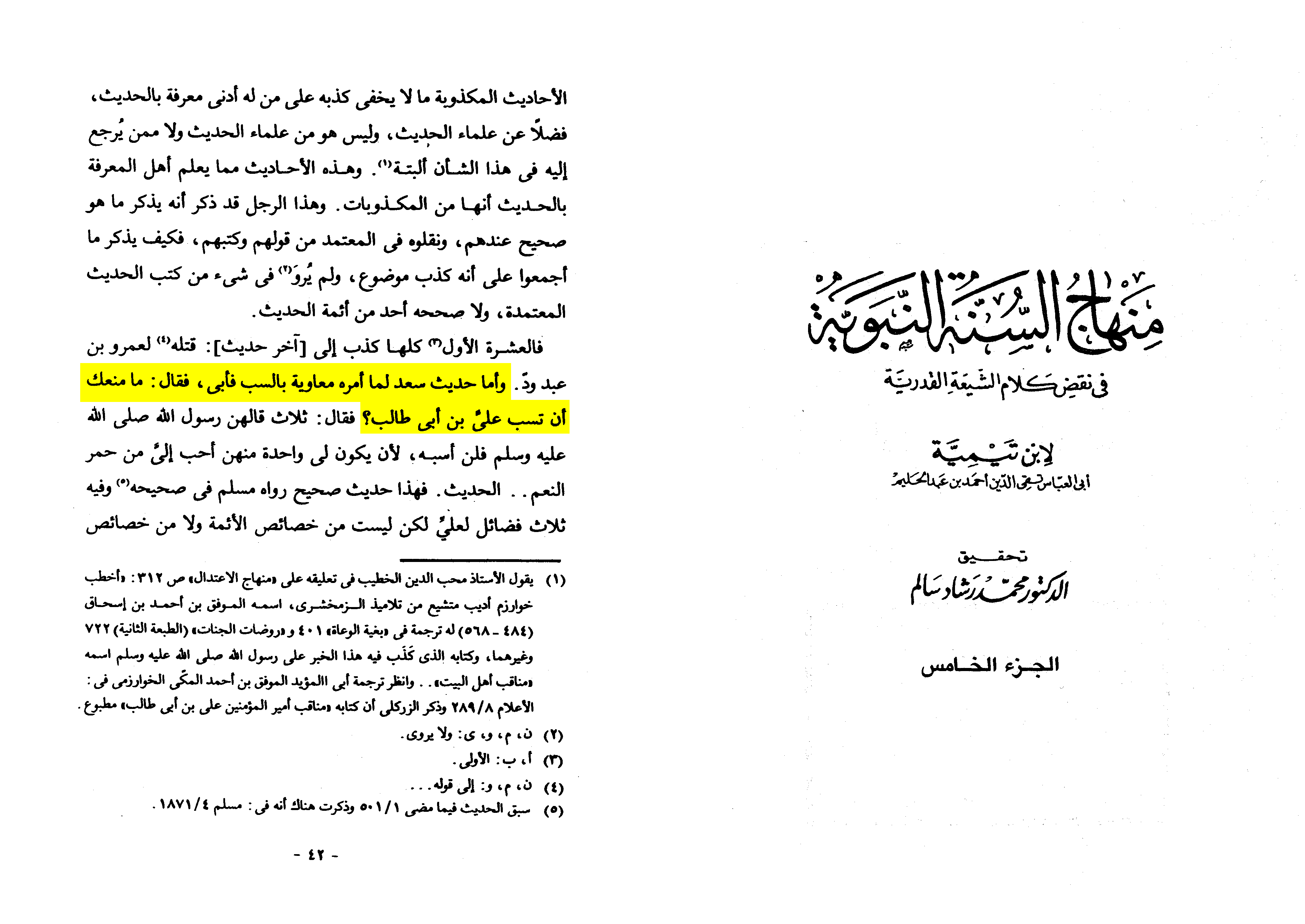
For example, Ibn Taymiyyah confirmed that Mu’awiyah ‘ordered’ Sa’ad to curse ‘Ali in Minhaj al-Sunnah, Vol. 5 pg. 42:
“As for the hadith of Sa‘d, when Mu‘awiya ordered him to insult [‘Ali] and he refused …”
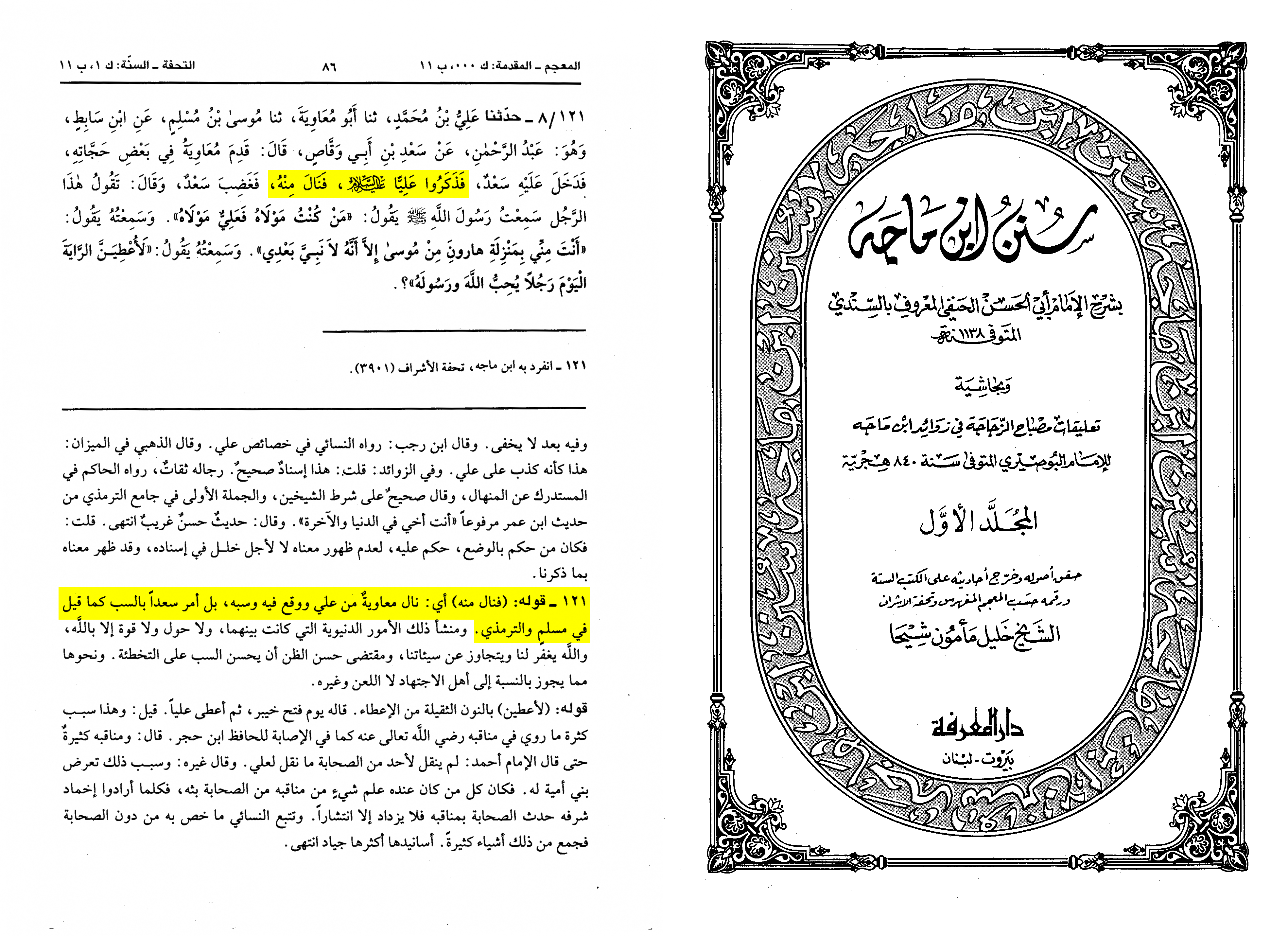
Likewise, another scholar, al-Shaykh Muhammad b. ‘Abd al-Hadi al-Sindi, affirmed this meaning of the report in Sharh Sunan Ibn Majah Vol 1, pg. 86:
Mu‘awiya reviled ‘Ali, spoke against him, and insulted him; indeed, he even ordered Sa‘d to insult him, as is reported in Muslim and al-Tirmidhi.
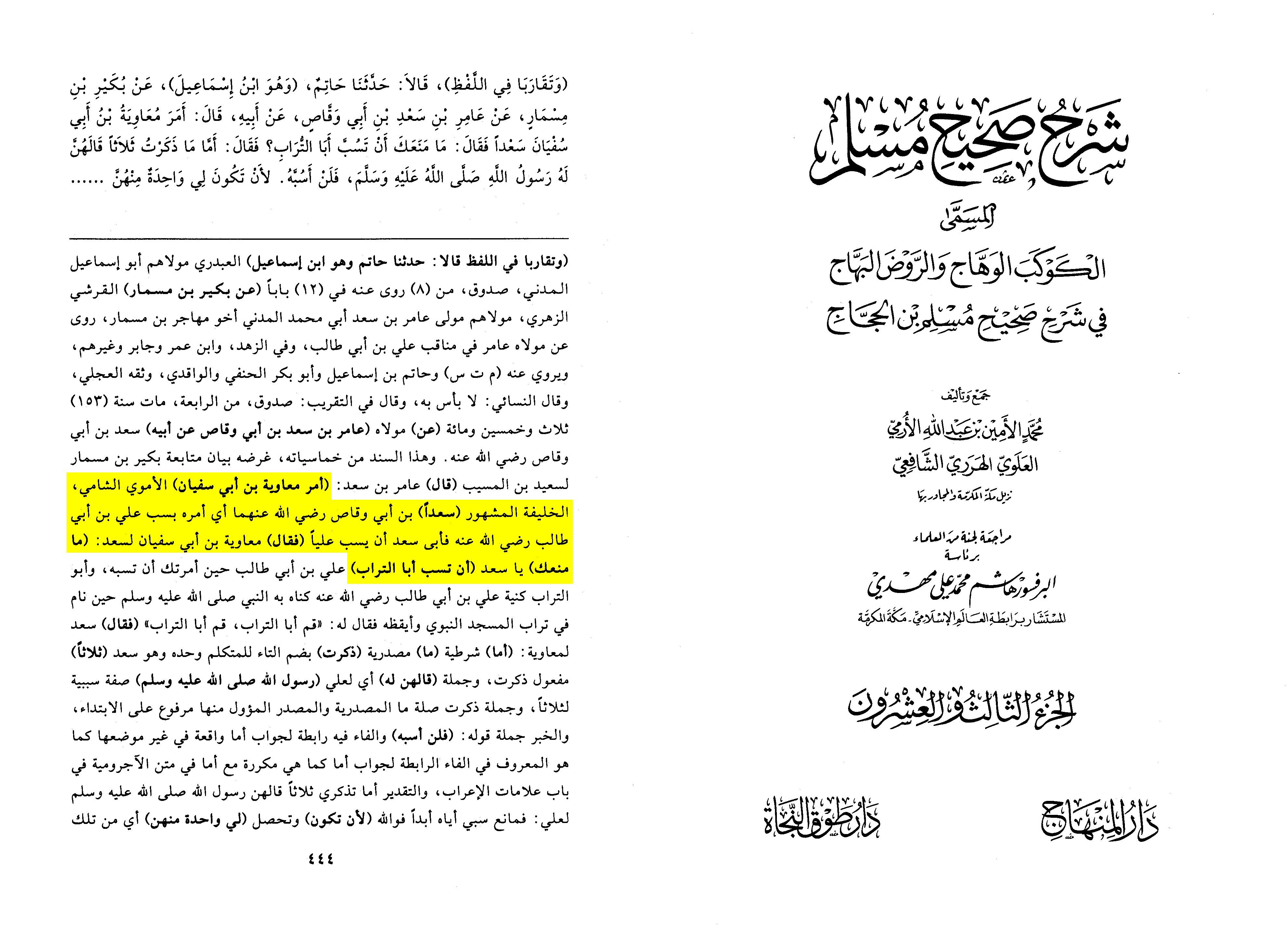
The contemporary Salafi teacher in Mecca, Muhammad al-Amin al-Hurarri, once again attests in his Al-Kawkab al-Wahaj Vol. 23 pg. 444:
Mu‘awiya b. Abi Sufyan, the Umayyad of Syria and the well-known caliph, ordered Sa‘d b. Abi Waqqas to insult ‘Ali b. Abi Talib, may Allah be pleased with him. Sa‘d refused to insult ‘Ali. Mu‘awiya b. Abi Sufyan then said to Sa‘d: “What prevented you, O Sa‘d, from insulting Abu Turab?”
Another modern Salafi scholar and student of Ibn Baz, Dr. Muqbil b. Hadi al-Wadi’i, confirms in his Tuhfat al-Mujib, pg. 9:
ودعا بعض الأمويين سعد بن أبي وقاص ليسب عليا، فما فعل، قالوا: ما منعك أن تسب عليا؟
Some of the Umayyads called upon Saʿd b. Abī Waqqāṣ to curse ʿAlī, but he did not do so. They said, What prevented you from cursing ʿAlī?
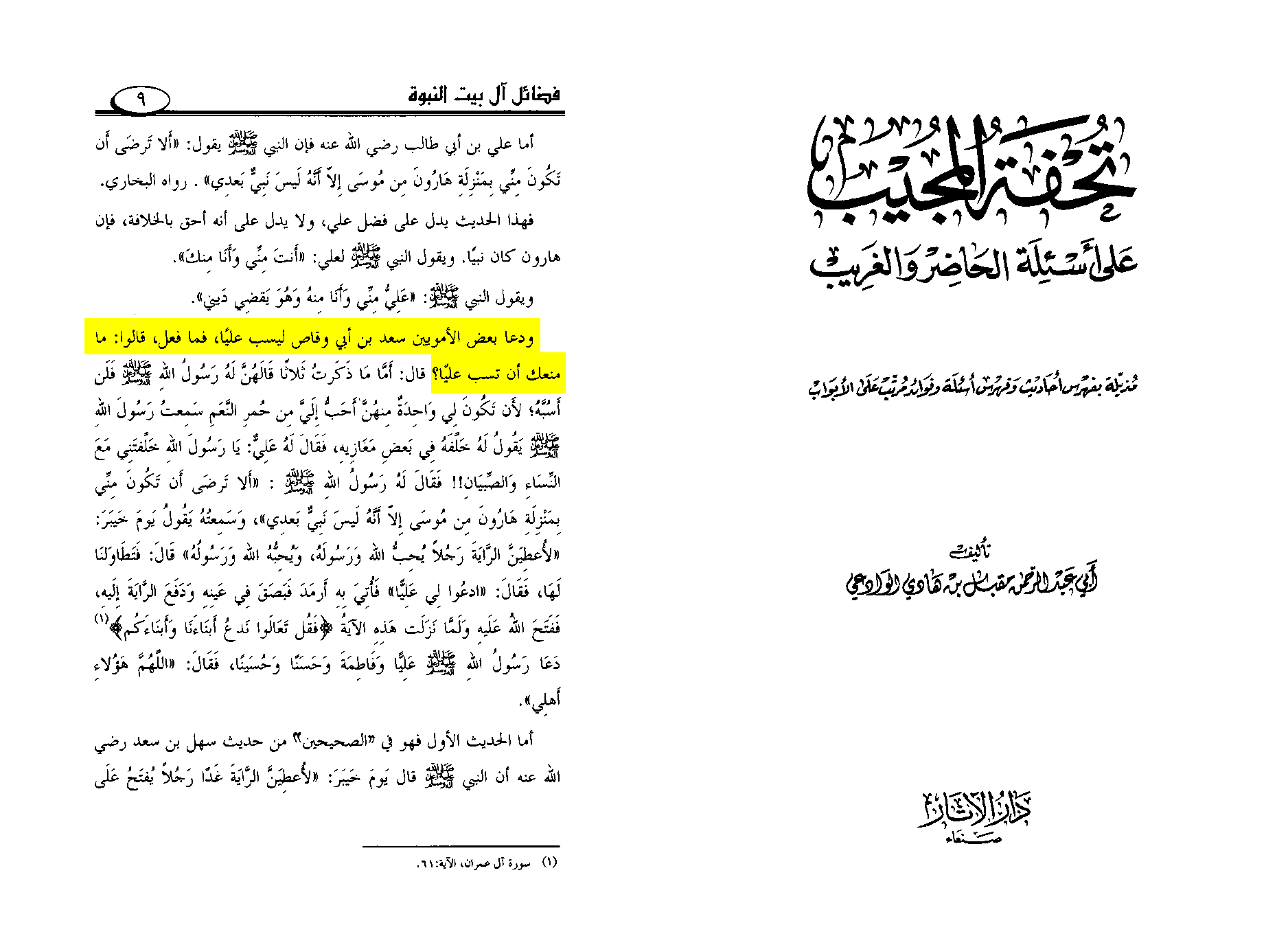
Notice that the author did not cite the source of this report to discourage the reader from investigating which Umayyad ordered Sa’ad to curse ‘Ali. The deception of our opponents knows no shame.
Contextual Implication
The report proves that Mu’awiyah engaged in the cursing of ‘Ali (AS) and it was normalized. This is evident from the wording; “what stops you” implies that the general public were actively engaging in said action and Sa’ad was innocent of it.
Al-Qurtubi derived this same meaning in his al-Mufhem, Vol. 6 pg. 272:
Mu‘awiya’s statement to Sa‘ad b. Abi Waqqas, “What prevented you from cursing Abu Turab,” indicates that the leading figures of the Umayyads were engaged in cursing and disparaging ‘Ali.
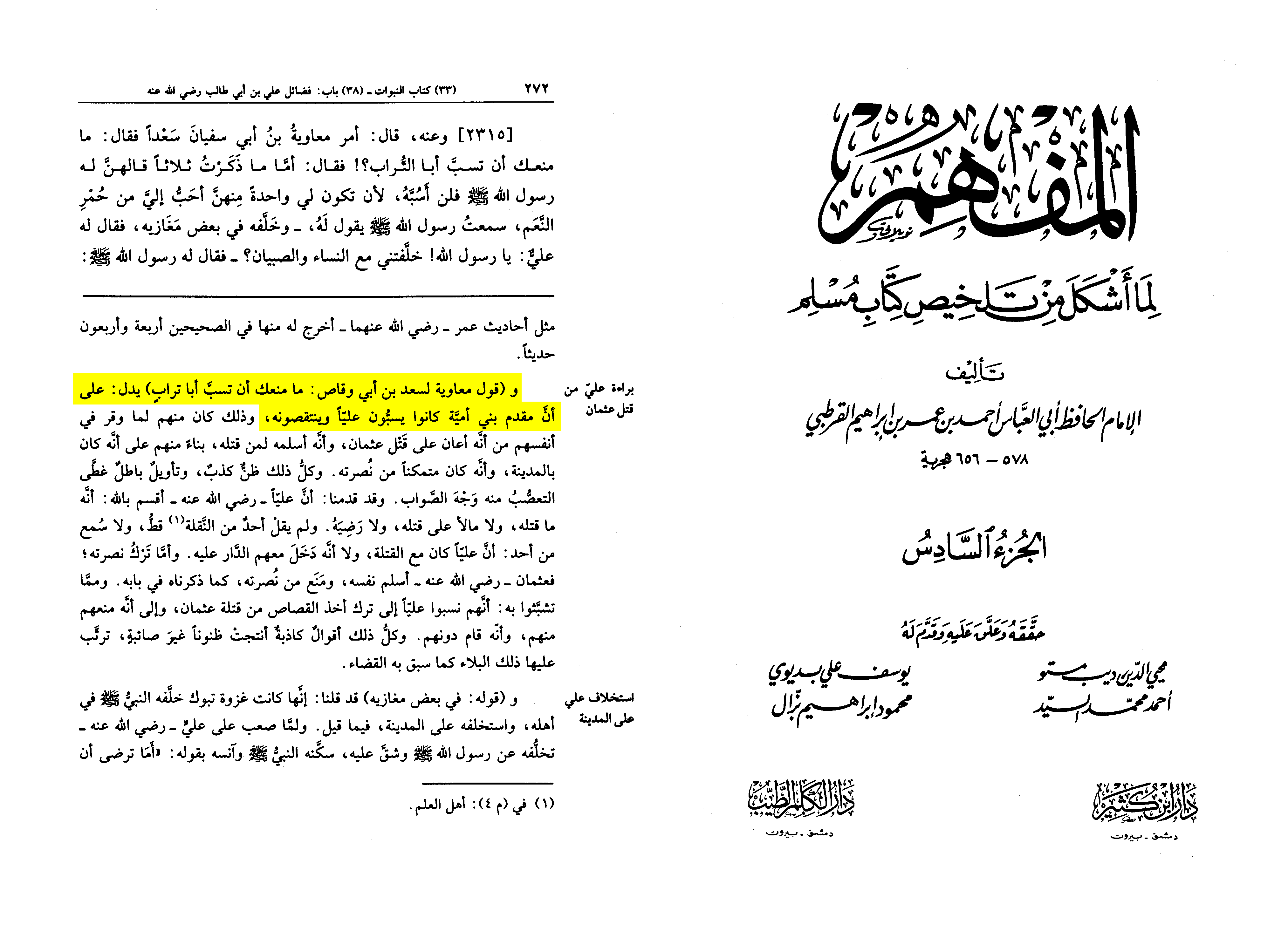
What was Mu’awiyah doing while the cursing of ‘Ali (AS) became a common practice amongst the Umayyads? He was performing it and condemning those who refused to engage in it; he approached Sa’ad who refused to participate.
Corroborating Reports
Several reports exist in corroboration of the one present in Sahih Muslim, which help us elucidate Mu’awiyah’s stance on ‘Ali (AS).
Sunan Ibn Majah
A similar report—that closely matches the one in Sahih Muslim—states the following in Sunan Ibn Majah 121:
It was narrated that Sa`d bin Waqqas said: "Mu`awiyah came on one of his pilgrimages and Sa`d entered upon him. They mentioned `Ali, and Mu`awiyah criticized him. Sa`d became angry and said: 'Are you saying this of a man of whom I heard the Messenger of Allah (ﷺ) say: "If I am a person's close friend, `Ali is also his close friend." And I heard him say: "You are to me like Harun was to Musa, except that there will be no Prophet after me." And I heard him say: "I will give the banner today to a man who loves Allah and His Messenger."
It was also recorded in Musannaf Ibn Abi Shayba, Vol 18 pg. 58 - 59, Hadith. # 34249.
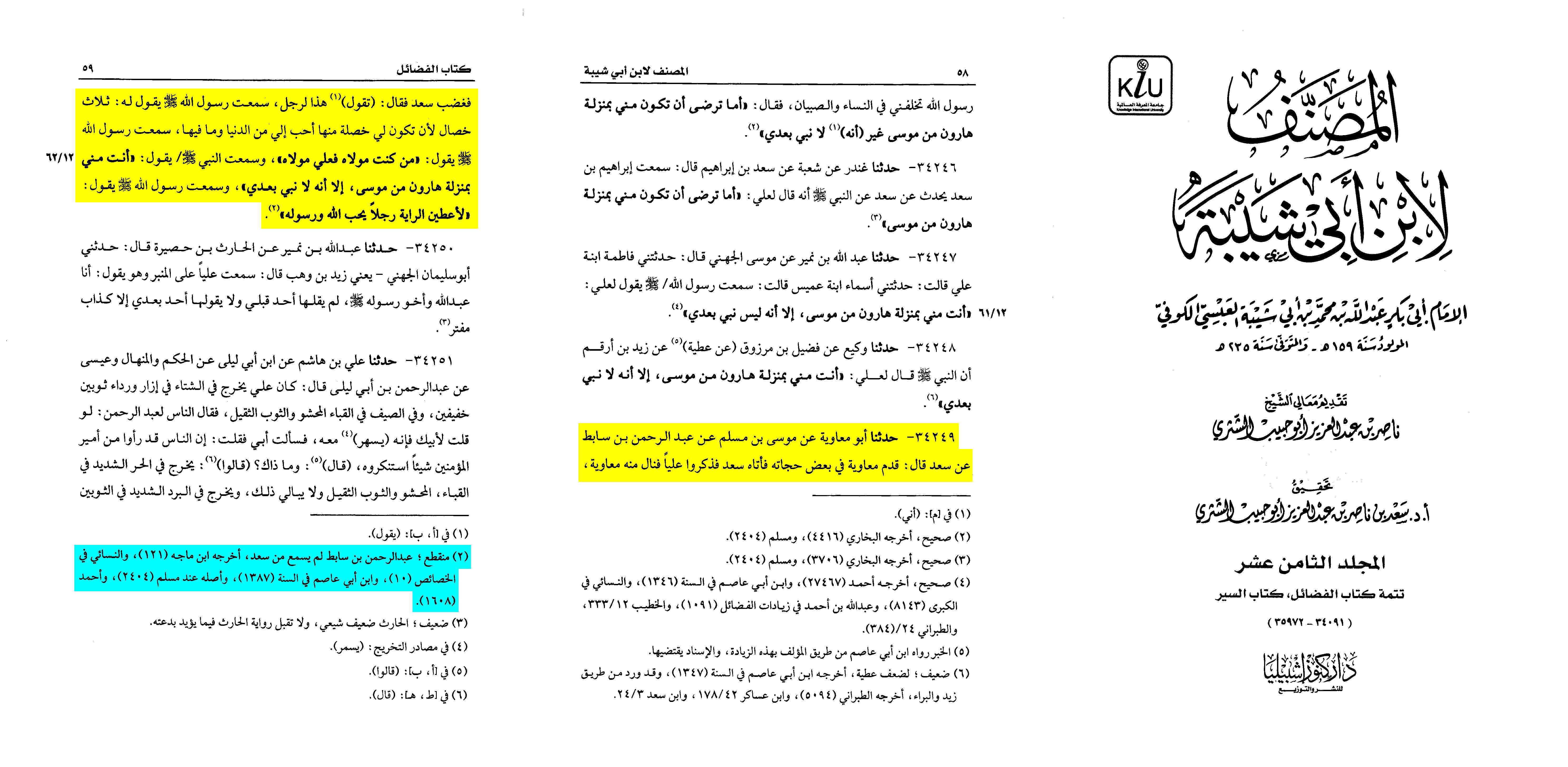
In this report, Mu’awiyah reviled ‘Ali (فَنَالَ مِنْهُ) but the translators once again altered the meaning into “criticised ‘Ali”.
Even Al-Albani, in commentary of this report in his Sahih Sunan Ibn Majah, Vol. 1 pg. 58,states:
فنال منه, أي: نال معاوية من علي وتكلم فيه.
Fanala minhu, it means: Mu‘awiya attacked Ali and spoke against him.
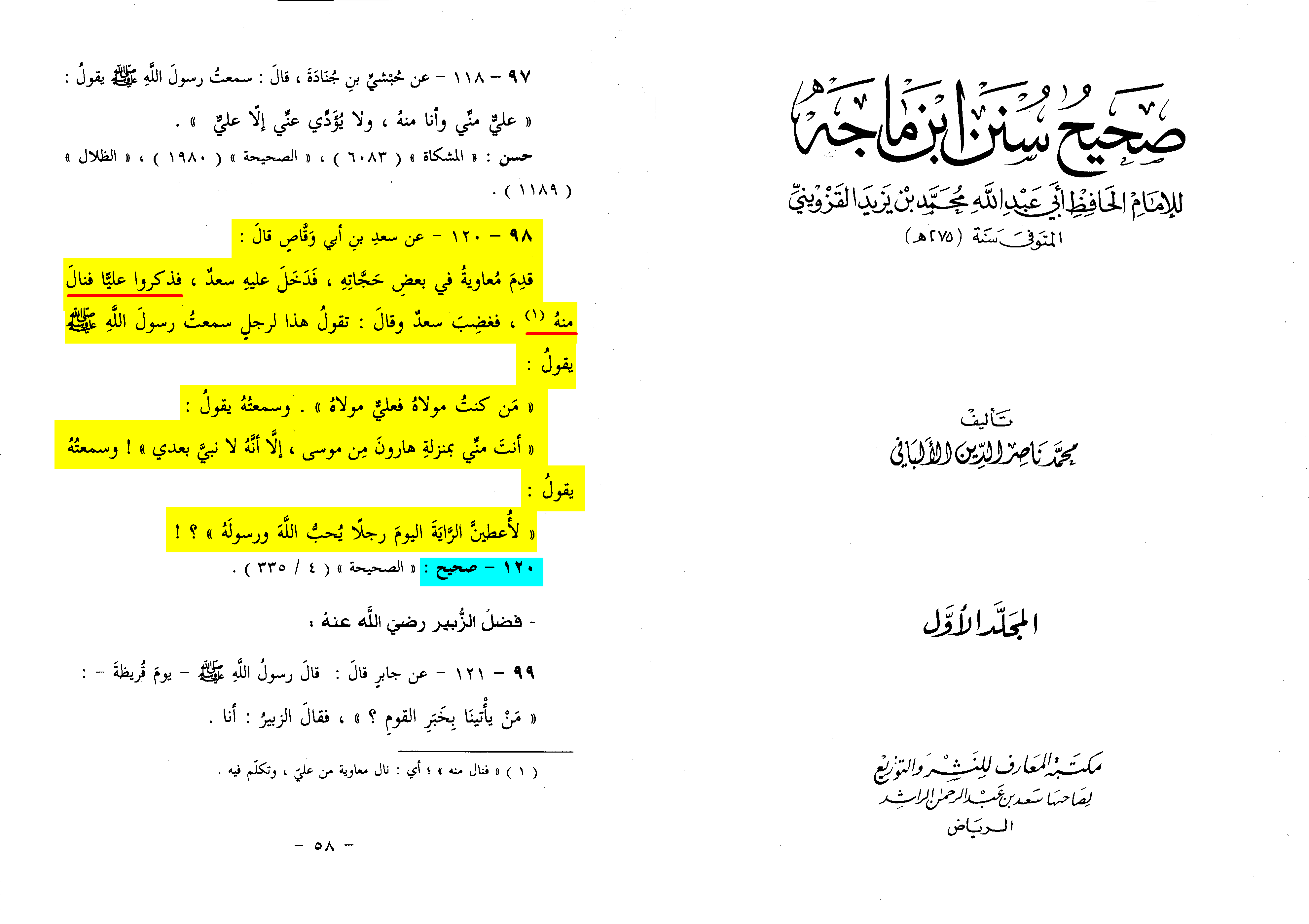
While Al-Albani certifies this chain, there is a disconnection between Ibn Sabit and Sa’ad b. Abi Waqqas. Regardless, this is not an issue for us because we are citing it as corroborative evidence.
Tarikh Dimashq
We read another narration endorsing the report of Sahih Muslim in Tarikh Dimashq Vol. 41, pg. 119:
…Abu Zur‘ah ‘Abd al-Rahman b. ‘Amr narrated to us; Ahmad b. Khalid al-Wahbi Abu Sa‘id narrated to us; from Muhammad b. Ishaq from ‘Abd Allah b. Abi Najih from his father, who said:
When Mu‘awiyah performed the pilgrimage, he took the hand of Sa‘ad b. Abi Waqqas and said:
“O Abu Ishaq, we are a people whose participation in military expeditions has kept us away from the pilgrimage until we nearly forgot some of its Sunnahs. So perform your circumambulation.”
When he finished, he brought him into the Dar al-Nadwah and seated him with him upon his couch. Then he mentioned ‘Ali b. Abi Talib and disparaged him.
He said: “You have brought me into your house and seated me on your couch, then you began attacking him and insulting him?
By Allah, for me to have one of the three virtues he had would be more beloved to me than everything over which the sun rises… [the tradition continues as usual].
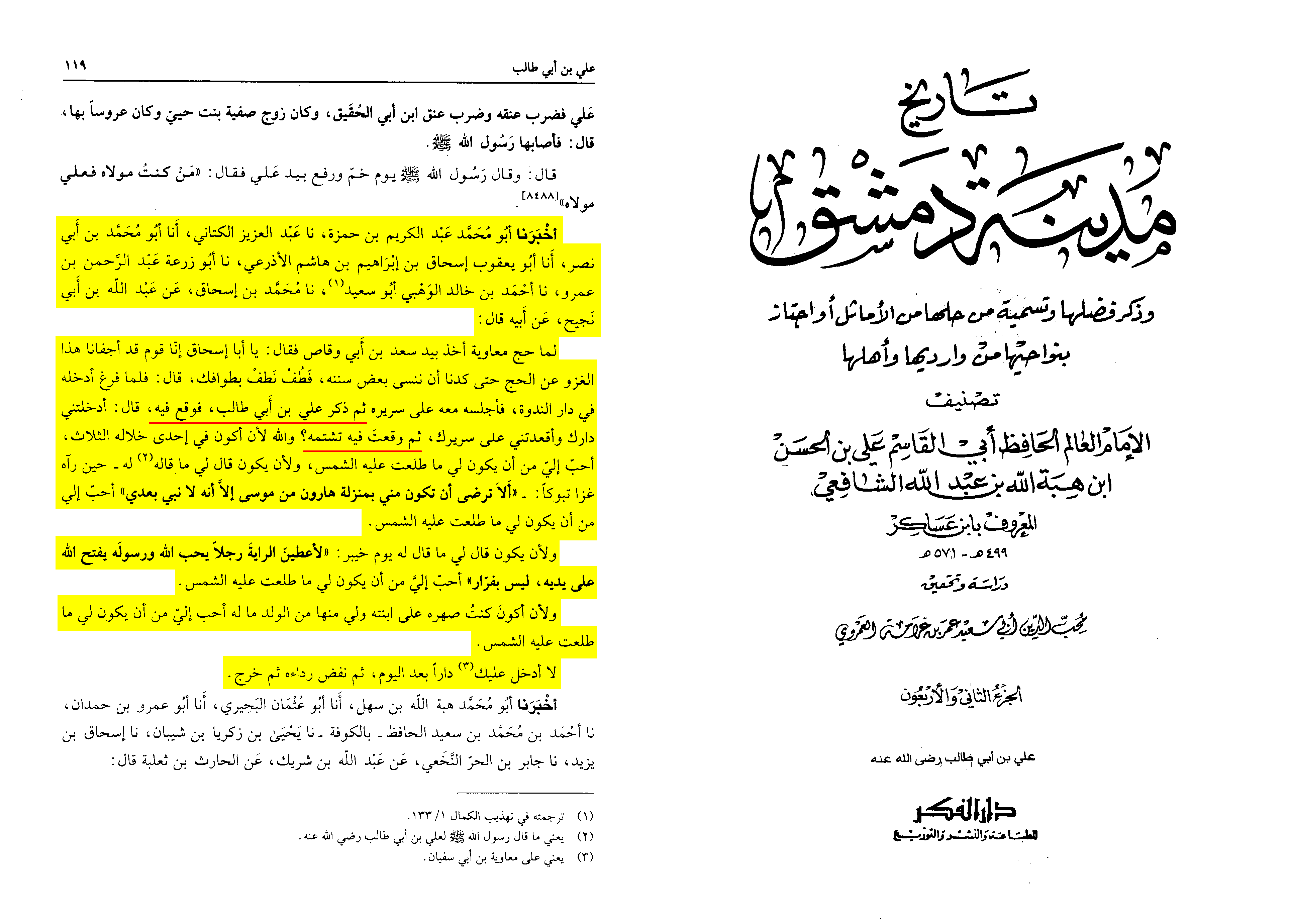
This tradition was also transmitted by Ibn Kathir in al-Bidaya wa al-Nihaya, Vol 11 pg. 50 - 51.
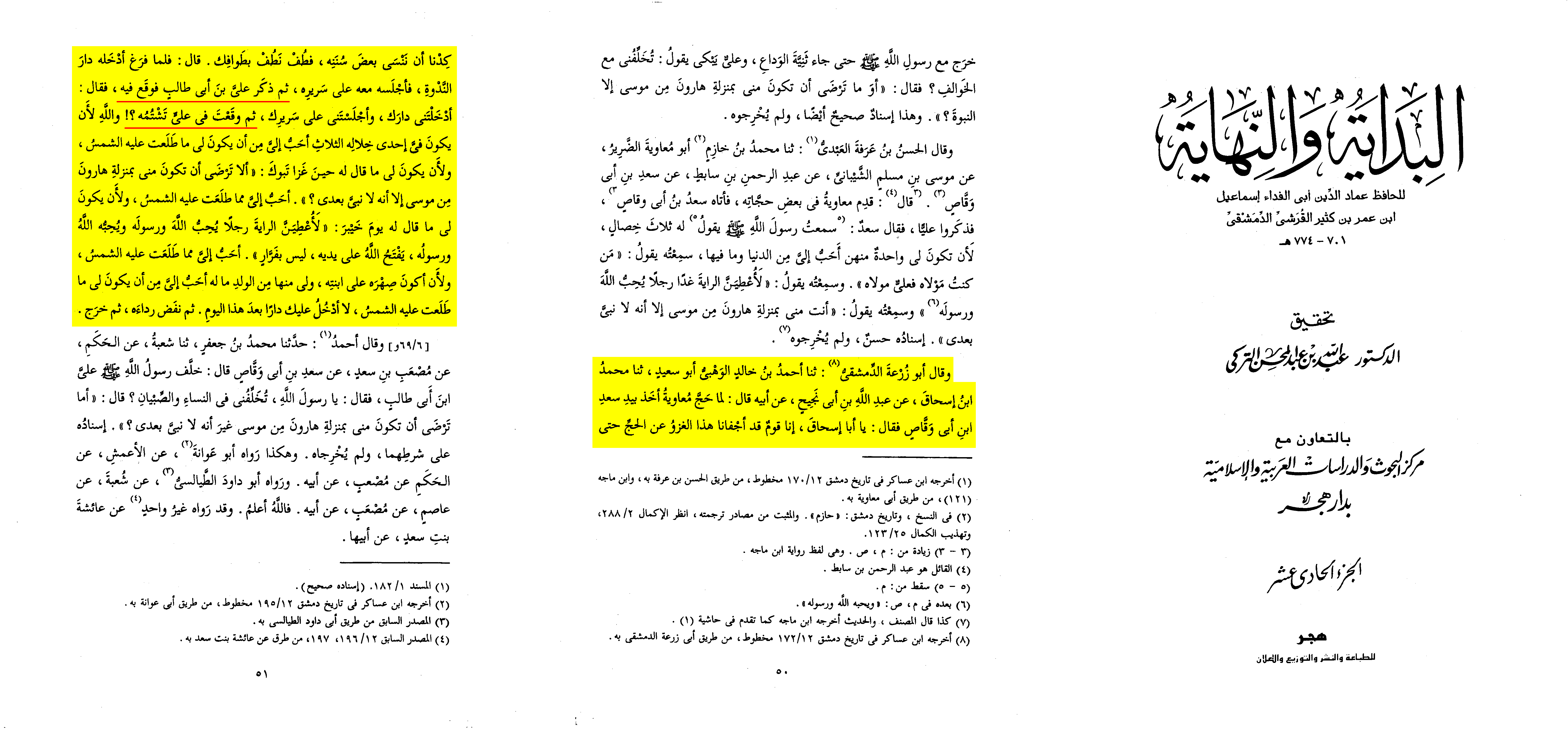
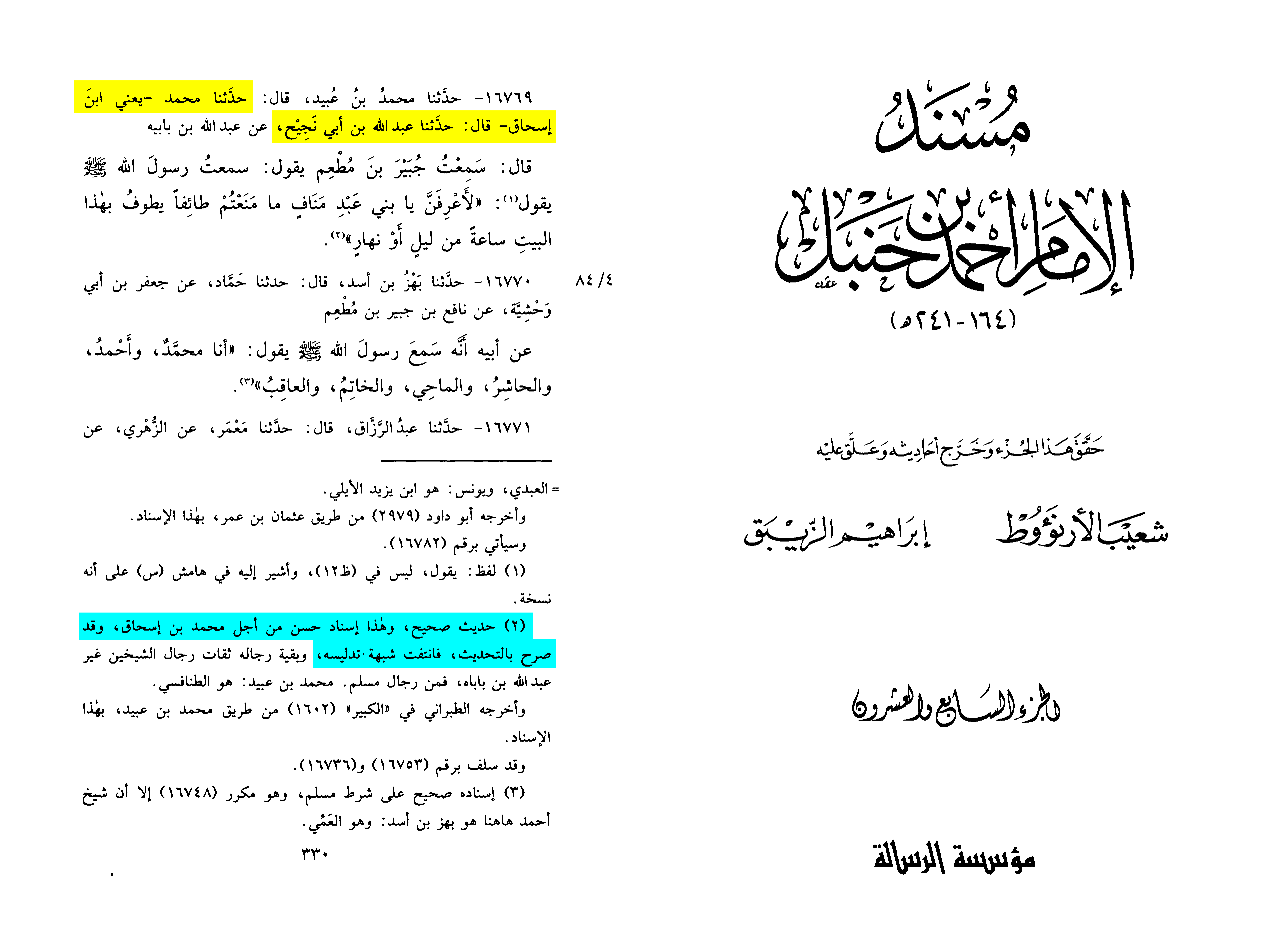
The narrators of the tradition are reliable, and the only issue with the chain of transmission is the ‘an’ana of Muhammad b. Ishaq.
However, there is a reliable chain in Musnad Ahmad Vol. 27, pg. 330, Hadith. # 16769 where Ibn Ishaq mentions that he directly narrates from ‘Abd Allah b. Abi Najih.
The report mentions that Mu’awiyah disparaged ‘Ali (فوقع فيه), then Sa’ad states that Mu’awiyah was speaking vulgarly about him (تشتمه).
Imam Hasan’s terms of the peace treaty
One of the other validating evidences for Mu’awiya’s insulting Imam ‘Ali (AS) is in the terms of the peace treaty between al-Imam al-Hasan (AS) and Mu’awiya (LA).
We read in Tabaqat Ibn Sa’ad Vol 1, pg. 319 - 322:
He (Muhammad b. Sa’ad) said: Abu Ubayd narrated to us, from Mujalid, from al-Sha‘bi, and from Yunus b. Abi Ishaq, from his father, and from Abu al-Safar and others. They said:
… Then he summoned Amr b. Salamah al-Arhabi and sent him with a letter to Muawiyah b. Abi Sufyan, asking for reconciliation and surrendering the matter to him, on three conditions:
… and that 'Ali (AS) not be reviled while he hears.
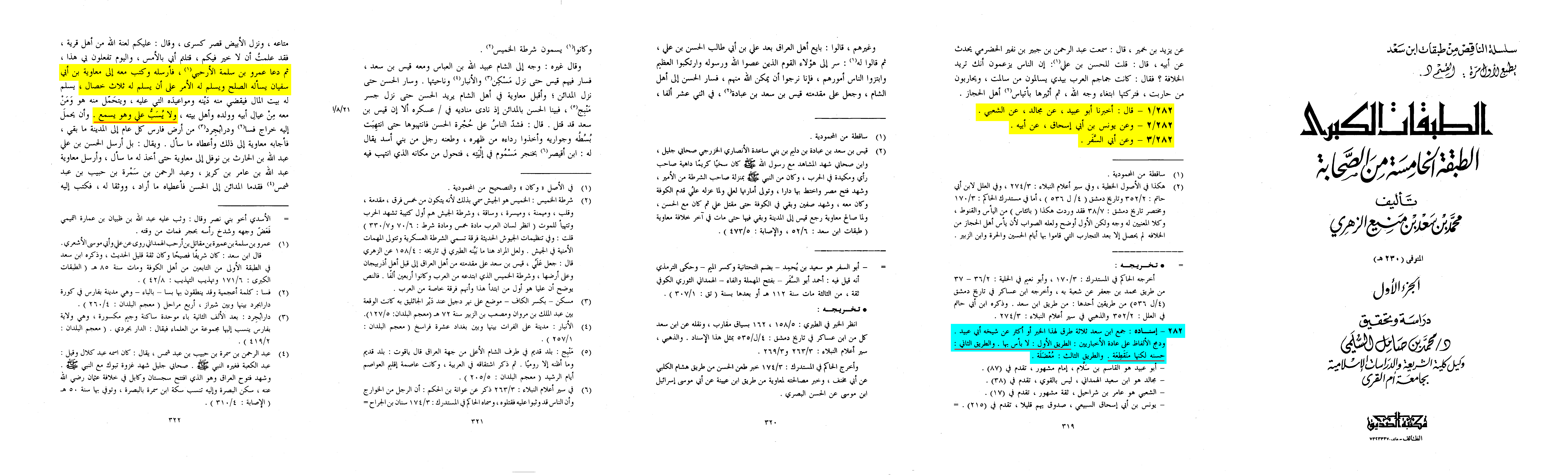
Al-Shaykh Muhammad al-Sulami, the editor of this edition of Taqabat Ibn Sa’ad has said that the first chain of transmission is acceptable, and the second is good though it has a disconnection.
If Mu’awiya had no involvement in the act of publicly cursing ‘Ali b. Abi Talib (AS), it is difficult to explain why Imam Hasan (AS) stipulated, as a binding condition, that neither Mu’awiya nor his governors should curse Imam ‘Ali (AS). The very inclusion of this condition undermines the claim advanced by our opponents that Ali (AS) was never cursed under Mu’awiya’s authority.
The Status of ‘Ali
Now that it is decisively proven that Mu’awiyah engaged in the cursing of ‘Ali (AS), we want to complete this article with some virtues of ‘Ali to illustrate to our readers the status of Mu’awiyah and his proven nifaq and kufur. .
We read the following report in Musnad Ahmad b. Hanbal Vol 18, pg. 314, Hadith # 26627:
Yahya b. Abi Bukayr narrated to us, he said: Isra'il narrated to us, from Abi Ishaq, from Abi 'Abd Allah al-Jadali, who said:
“I entered upon Umm Salama, and she asked me: ‘Is the Messenger of Allah (SAW) being insulted among you?’ I said: ‘God forbid!
She said: ‘I heard the Messenger of Allah (SAW) say: ‘Whoever insults 'Ali has insulted me.’
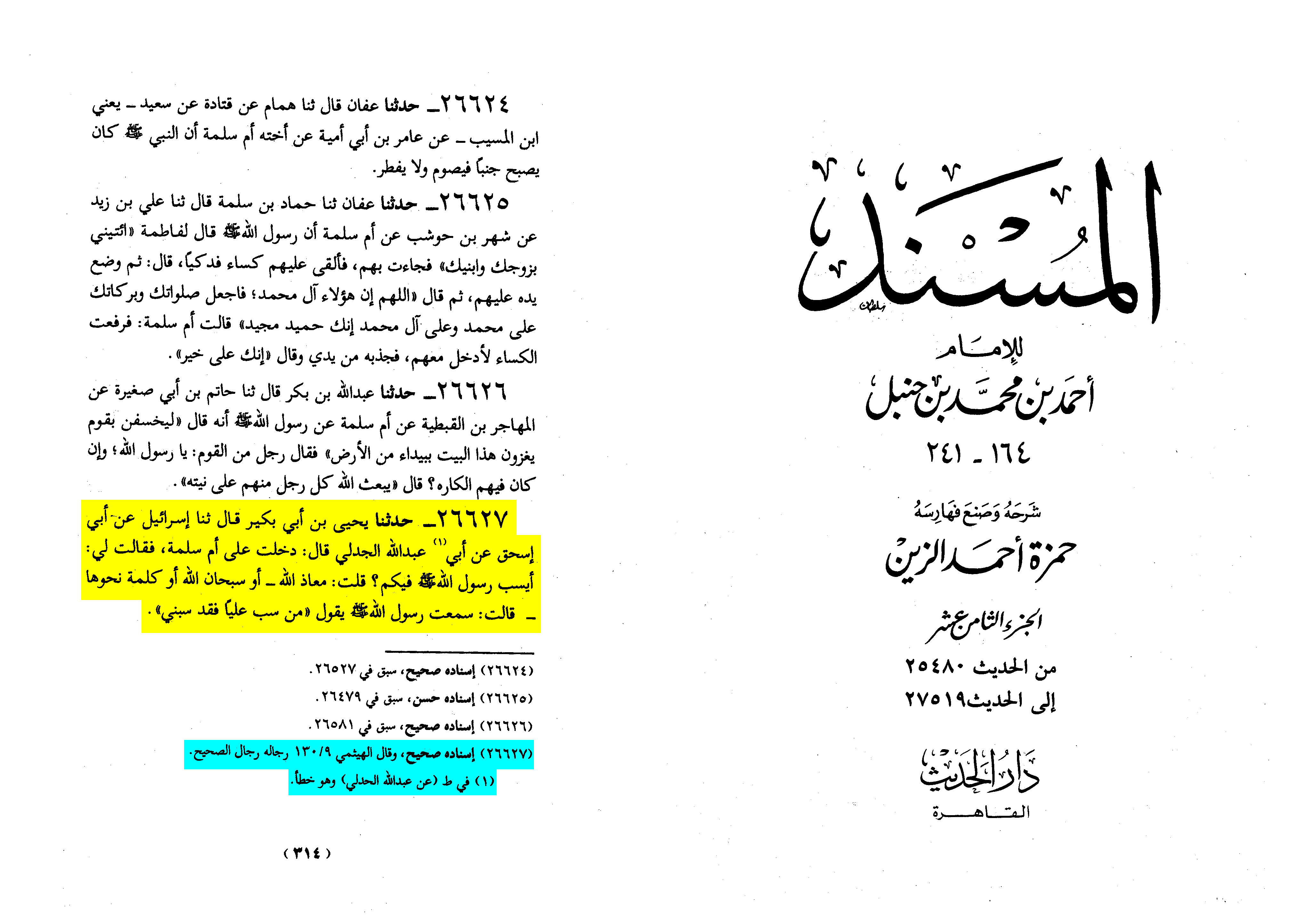
The following scholars have certified this report:
Ahmad Shakir declared the report Sahih in the footnote.
Wasiullah b. Muhammad certified the report in Fada'il al-Sahaba, Vol. 2, pg. 594 - 595, Hadith # 1011.
Al-Haythami certified the narrators in Majma’ al-Zawa’id Vol 9, pg. 123 Hadith # 14740.
Al-Dhahabi authenticated the report in al-Mustadrak ‘ala al-Sahihain Vol 3, pg. 130, Hadith # 3615.
Moreover, another chain of this report can be found in Musnad Abu Ya'la, Vol. 12 pg. 444 - 445, Hadith # 7013:
Abu Khaythama narrated to us; Ubayd Allah b. Musa narrated to us; Isa b. Abd al-Rahman al-Bajali narrated to us; from al-Suddi; from Abu Abd Allah al-Jadali, who said:
Umm Salama said, “Is the Messenger of Allah (SAW) being cursed from the pulpits?” I said, “How could that be?”
She replied, “Is not Ali being cursed, along with those who love him? I bear witness that the Messenger of Allah (SAW) used to love him.”
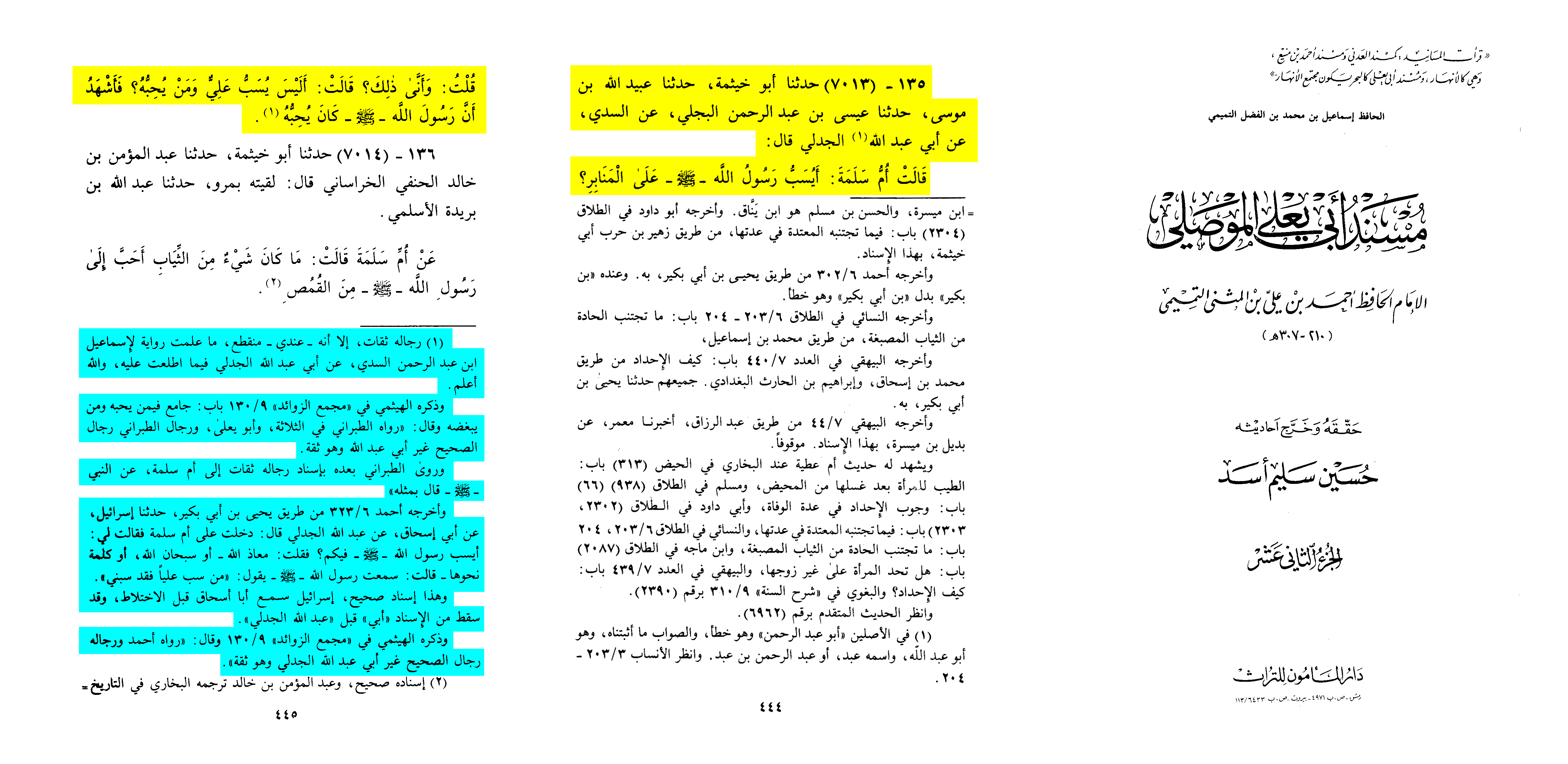
The editor of the book, Dr. Husayn Saleem, authenticated all the narrators of the report; however, he cast doubt on whether al-Suddī actually heard this narration from al-Jadali.
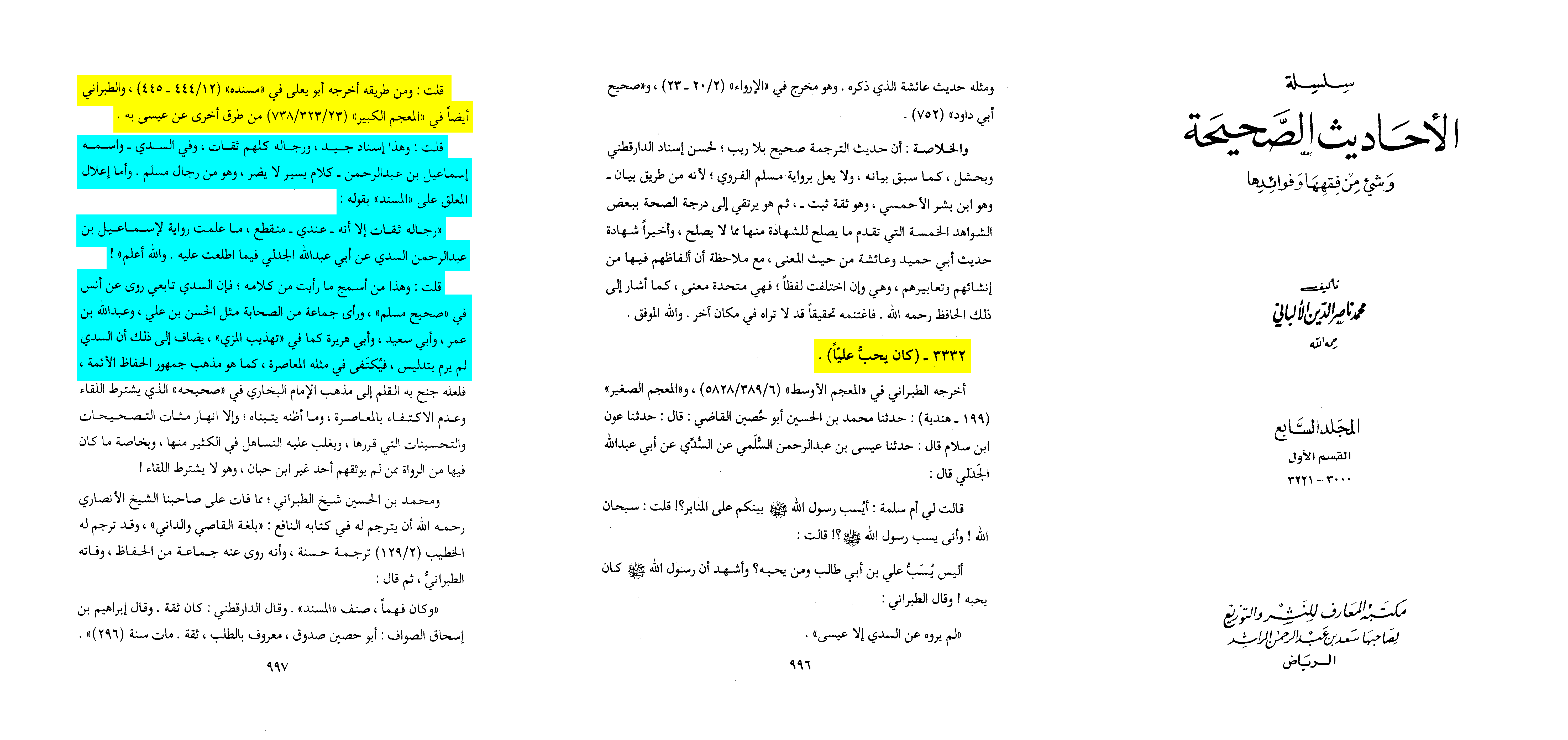
In response to this objection, al-Albani addressed the issue in Silsilat al-Ahadith al-Sahihah Vol 7, p. 996 - 997, responding as follows:
I said: “This is among the most absurd statements I have encountered; for al-Suddī, a Tābiʿī, narrated from Anas in Ṣaḥīḥ Muslim, and he met a group of the Companions such as al-Ḥasan b. ʿAlī, ʿAbd Allāh b. ʿUmar, Abū Saʿīd, and Abū Hurayrah, as mentioned in Tahdhīb al-Mizzī.
Moreover, al-Suddī did not practice tadlīs (misleading narration), so he is deemed sufficient in cases such as this, in accordance with the contemporary position, which is also the view of the majority of the leading hadith scholars.”
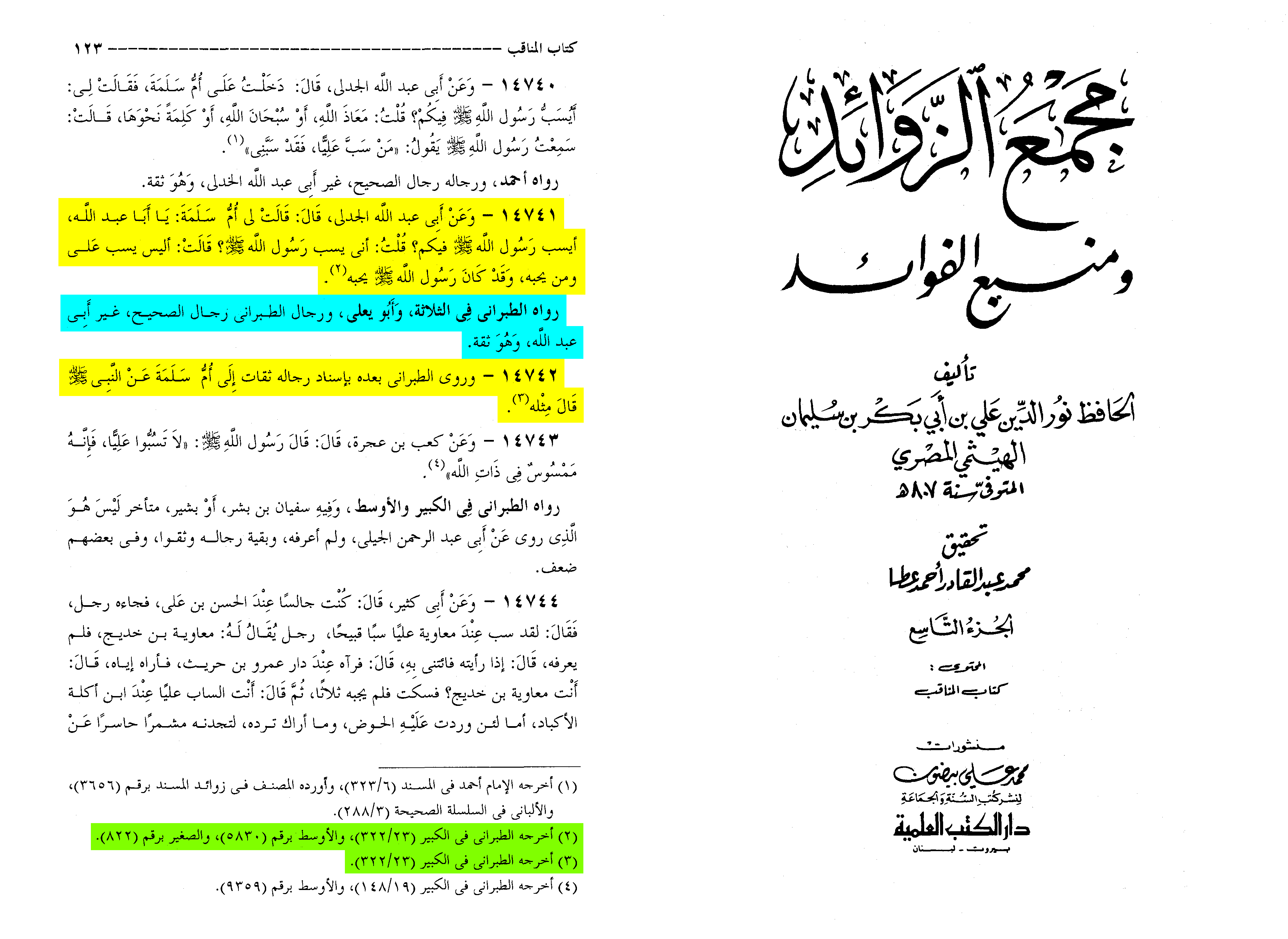
Al-Tabarani also transmitted this variant of the report in al-Mu’jam al-Saghir Vol 2, pg. 83, Hadith # 822 and it was certified by al-Haythami in Majma’ al-Zawa’id Vol. 9, pg. 123, Hadith # 14741 & 14742.
As we have evidenced from the tradition of Umm Salama (AS), reviling ‘Ali is equal to reviling the messenger of Allah (SAW). Therefore, the ruling of Mu’awiya and the Umayyads is just as Allah (SWT) states in Surat al-Ahzab 33:57:
إِنَّ الَّذِينَ يُؤْذُونَ اللَّهَ وَرَسُولَهُ لَعَنَهُمُ اللَّهُ فِي الدُّنْيَا وَالْآخِرَةِ وَأَعَدَّ لَهُمْ عَذَابًا مُّهِينًا
Indeed, those who abuse Allah and His Messenger - Allah has cursed them in this world and the Hereafter and prepared for them a humiliating punishment.
Thus, it is proven that Mu’awiya is accursed in the Holy Qur’an and damned to hell, per the Qur'an's promise.