Chain Analysis of Ziyarat Ashura

Ziyarat Ashura is the most famous Shi’i devotional visitation text, recited in remembrance of Imam al-Husayn and the martyrs of Karbala. Many scholars have drawn theological points from this Ziyara and serve it as decisive proof for tabarra (disassociation) of the Ahl al-Bayt (AS) from their enemies. In it exists curses sent upon the likes of Mu’awiyah, Ale Marwan and most famously, the curse upon the first couple Sunni caliphs.
In this article, we will be reviewing the authenticity of the Ziyara and cover some of the great virtues attributed to it by the Imams (AS) for the ones who recite it.
The Authenticity of the Ziyarah itself
The most important source for Ziyarat Ashura is what was transmitted by Shaykh al-Tusi (RA) in his Misbah al-Mutahajjid, pg. 536:
It is narrated from Muhammad b. Isma‘il ibn Bazi‘, from Salih ibn ‘Uqbah, from his father, from Abu Ja‘far, peace be upon him, who said:
“Whoever visits al-Husayn b. ‘Ali, not on the day of ‘Ashura, and remains with him until the shade covers him while weeping, will meet Allah (SWT) on the day he meets Him with the reward of two thousand pilgrimages, two thousand ‘umrahs, and two thousand military expeditions, the reward of every expedition, pilgrimage, and ‘umrah being like the reward of one who performed pilgrimage, ‘umrah, and expeditions with the Messenger of Allah and with the rightly guided Imams
I said: “May I be ransomed for you, what about one who is in a distant land, at its farthest reaches, and is unable to go to him on that day?”
He said: “If that is the case, let him go out into the open desert or ascend to a high place on the roof of his house, gesture toward him with salutation, exert himself in supplication against his killer, and then pray two units of prayer afterward.
Let that be at the beginning of the day before the sun declines. Then let him mourn al-Husayn and weep for him, and command those in his household whom he does not fear to weep for him.
Let him establish the calamity in his house by manifesting grief over him, and let some of them console others over their affliction with al-Husayn. I am the guarantor for them, if they do that, before Allah, Exalted is He, of all of that.”
I said: “How should some of us console others?”
The Imam said, “You say:
أَعْظَمَ اللهُ أُجُورَنَا بِمُصَابِنَا بِالحُسَيْنِ عَلَيْهِ السَّلامُ وَجَعَلَنَا وَإِيَّاكُمْ مِنَ الطَّالِبِينَ بِثَارِهِ مَعَ وَلِيّهِ الإمام المَهْدِي مِنْ آلِ مُحَمَّدٍ صَلَّى اللَّهُ عَلَيْهِ وآله.
May Allah magnify our rewards through our affliction with al-Husayn and make us and you among those who seek vengeance for him together with his guardian, Imam al-Mahdi, from the family of Muhammad.”
And if you are able not to go out for any need on that day, then do so, for it is a day of misfortune; no need of a believer is fulfilled on it. If it is fulfilled, it will not be blessed for him, nor will he see guidance in it.
Let none of you store anything for his house on that day, for whoever stores something on that day will not be blessed in what he stored, nor will he be blessed in his family.
When they do that, Allah, Exalted is He, will write for them the reward of one thousand pilgrimages, one thousand ‘umrahs, and one thousand expeditions, all of them with the Messenger of Allah. And he will have the reward and recompense of the calamity of every prophet, messenger, trustee, truthful one, and martyr who died or was killed from the time Allah created the world until the Day the Hour is established.
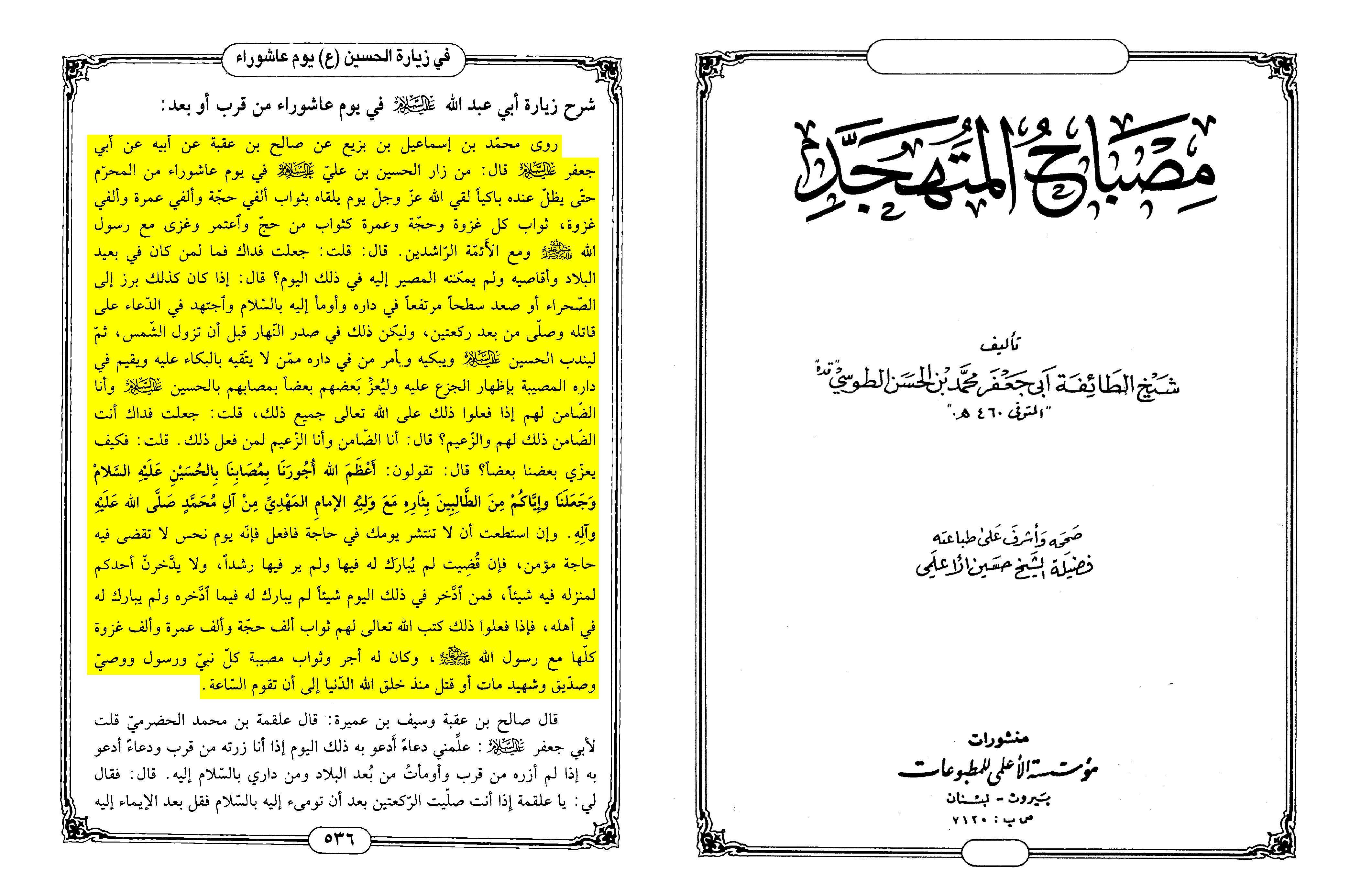
This tradition establishes the reward of visiting al-Husayn (AS) on Ashura, be it to his grave in Karbala or distant from its land. Imam al-Baqir (AS) would after this teach Ziyarat Ashura that is to be recited at distant lands to the narrator.
Investigating the Chain of Narration
Muhammad b. Isma’il b. Bazi’ was a companion of Imam al-Kadhim (AS) and al-Ridha (AS). Shaykh al-Tusi (RA) narrates this tradition from his work directly, and he provides two chains of transmissions to this book, and they were both deemed as authentic by Sayyid al-Khu’i in his Mu’jam Rijal al-Hadith Vol. 16, pg. 104 - 105.
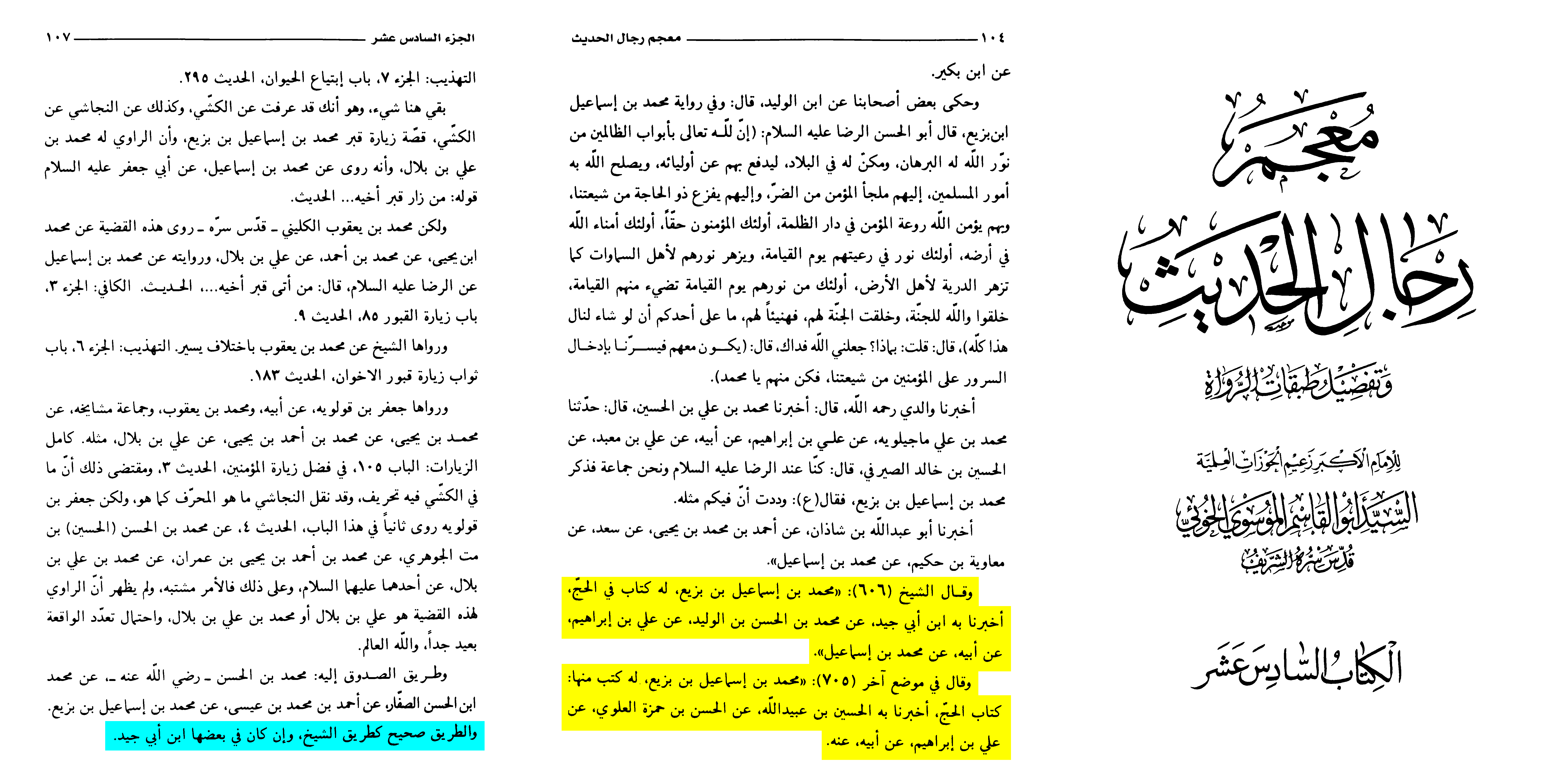
Thus, al-Tusi's transmission to Muhammad b. Isma'il b. Bazi' is reliable. But he then narrates this from Salih. Uqba b. Qays, from Uqba b. Qays, from Imam al-Baqir (AS). Now Salih alongside his father are both unknown (maj'hul). There even contains some criticism against him put forth by Ibn al-Ghada’iri.
However, Muhammad b. Isma’il provides another chain of narration for this report on pg. 536 - 537:
Salih b. ʿUqbah and Sayf b. ʿUmayrah said: ʿAlqamah b. Muhammad al-Hadrami said: I said to Abu Jaʿfar ʿAli:
Teach me a supplication that I may supplicate with on that day if I visit him from nearby, and a supplication that I may supplicate with if I do not visit him from nearby, but instead gesture toward him with peace from distant lands and from my home.
He then said to me: O ʿAlqamah, when you have prayed the two units of prayer after gesturing toward him with peace, then say after gesturing toward him, following the takbir, these words. For if you say that, you will have supplicated with what the angels who visit him supplicate with, and God will record for you one hundred thousand thousand degrees.
You will be like one who was martyred with al-Husayn while wounded, so that you share with them in their ranks, and you will be recognized only among the martyrs who were martyred with him. God will record for you the reward of visiting every prophet and every messenger, and the reward of visiting every one who has visited al-Husayn (AS) from the day he was killed, upon him and upon his family.
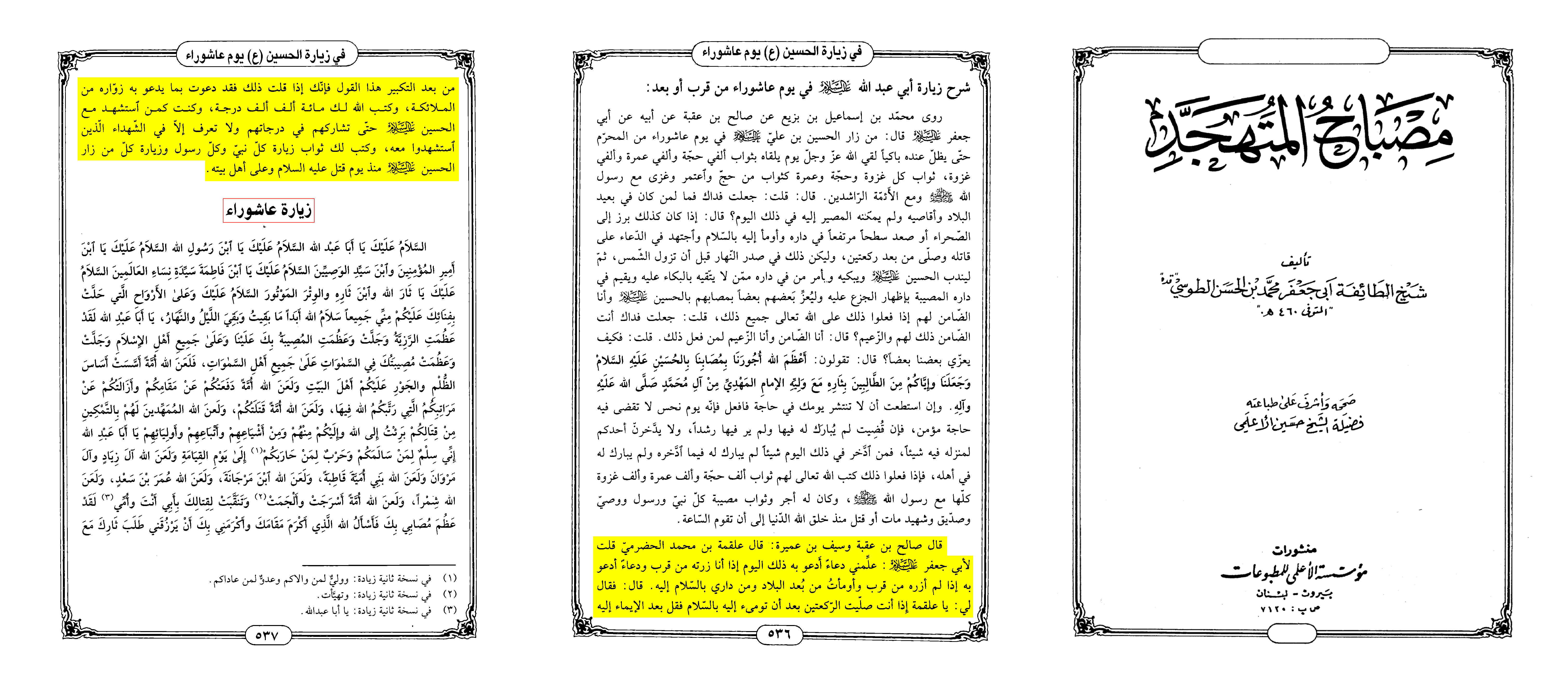
He then cites the text of Ziyarat Ashura. This chain states Muhammad b. Isma’il also cites the Ziyara from Sayf b. Umayrah, who is in fact a trustworthy narrator as explicitly declared by Shaykh al-Najashi & Shaykh al-Tusi.
Sayf then transmits this ziyara from ‘Alqamah b. Muhammad al-Hadhrami, who does not have explicit statements about his reliability, but many scholars have made other arguments to prove his reliability.
Setting them aside, his report can be accepted regardless because Sayf b. Umaira has advanced this Ziyara to Safwan b. Mihran, who in turn advanced it to Imam al-Sadiq (AS) who confirmed it to be true as Alqama transmitted it.
This was recorded in pg. 542 - 543:
Sayf b. ʿUmayrah asked Safwan: “Alqamah b. Muhammad al-Hadrami did not bring this to us from Abu Jaʿfar; rather, he only brought us the supplication of the visitation.”
Safwan said: “I went with my master Abu ʿAbdillah to this place, and he did just as we did in our visitation, and he supplicated with this supplication at the time of farewell after he prayed as we prayed and bade farewell as we bade farewell.
Then Abu ʿAbdillah said to me: ‘O Safwan, keep to this visitation, supplicate with this supplication, and perform the visitation by it, for I guarantee before God, exalted is He, for everyone who visits with this visitation and supplicates with this supplication, from near or far, that his visitation will be accepted, his effort appreciated, his salutation conveyed without being barred, and his need fulfilled by God, no matter how great it may be. [...]
Then he said: “O Safwan, if a need arises for you with God, then perform this visitation from wherever you are, supplicate with this supplication, and ask your Lord for your need; it will come to you from God. God does not break His promise, nor does His Messenger, by His grace. And praise belongs to God.”
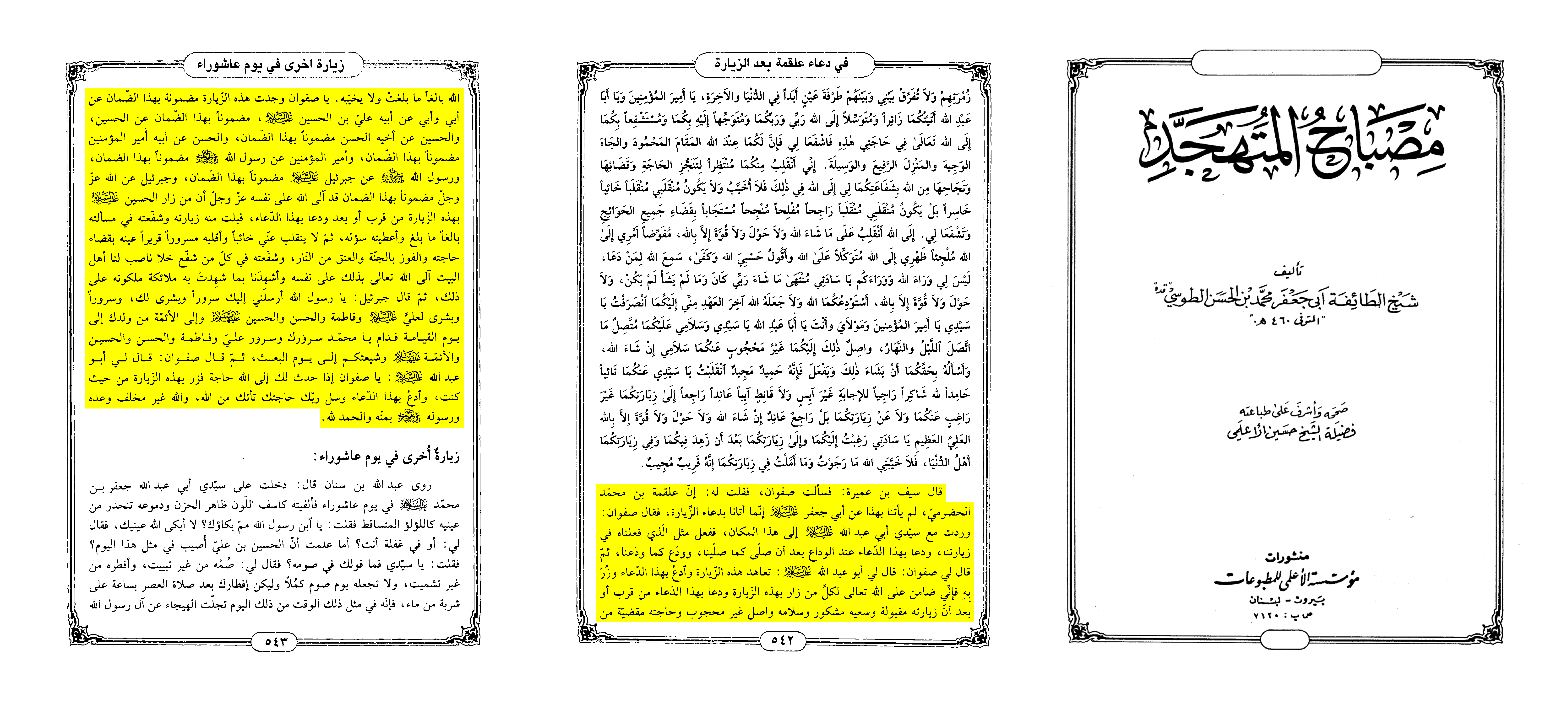
Therefore, this transmission of ‘Alqamah is reliable because of the fact that it was confirmed by the Imam himself, based on the transmission of Muhammad b. Isma’il b. Bazi’, from Sayf b. Umayra, from Safwan b. Mihran from Imam al-Sadiq (AS). This is an authentic chain.
In addition to what Shaykh al-Tusi provided, Ibn Qulawayh also provides a corroborating chain in his Kamil al-Ziyarat, pg. 316 - 317, Hadith. # 497:
Muhammad b. Ismaʿil, from Salih b. ʿUqbah, from Malik al-Juhani, from Abu Jaʿfar al-Baqir (AS) who said…
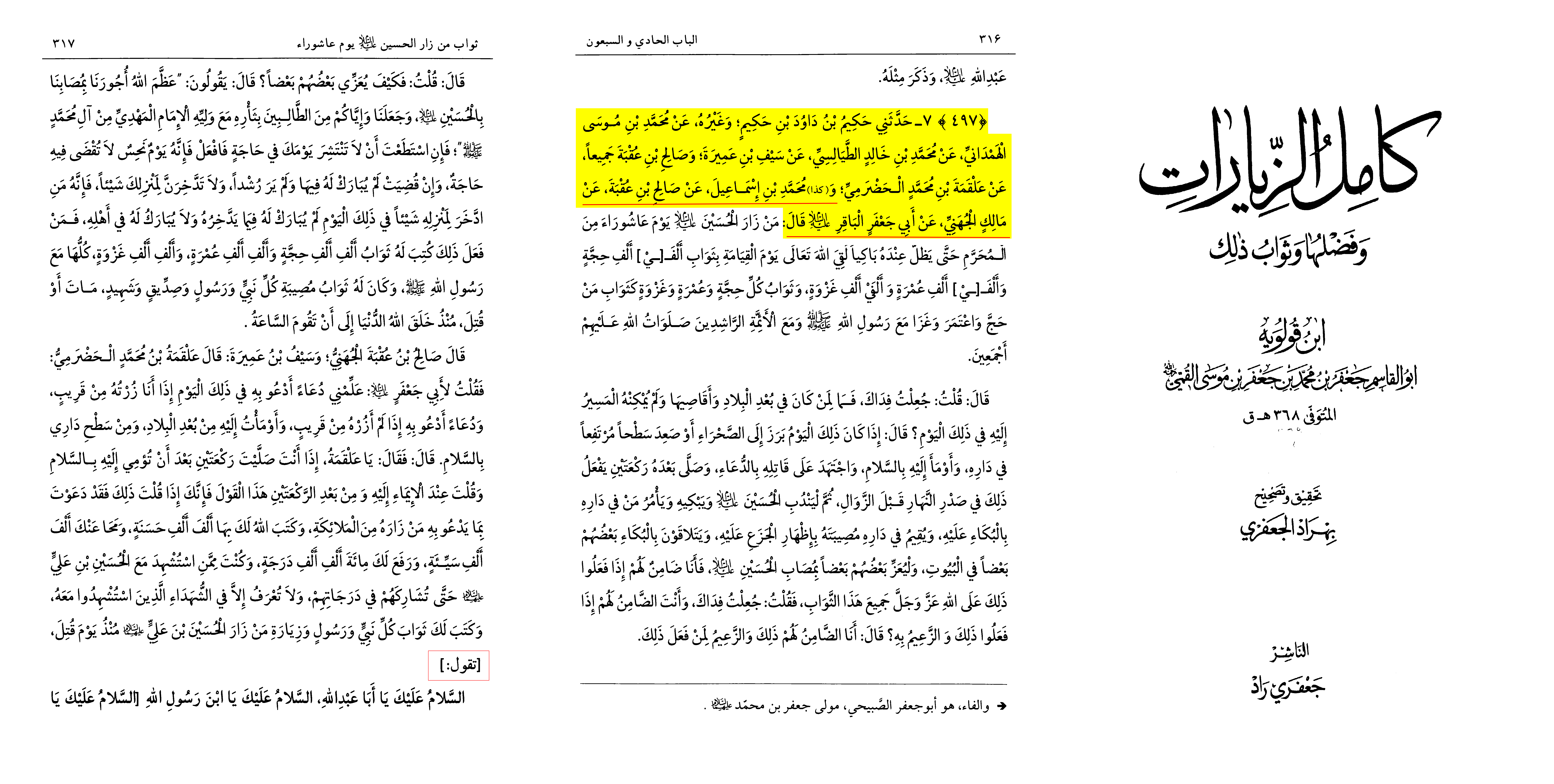
This chain is similar to the previous mentioned one, with the only difference being that Salih b. ‘Uqbah also narrated this tradition on the authority of Malik al-Juhani, who heard it directly from Imam al-Baqir (AS) in the same manner as ‘Alqama transmitted. Despite Malik not having explicit reliability, this serves as corroboration for Alqama's confirmed report.
The Authenticity of the End part
There has been some discussion regarding the end part of the Ziyara that concerns cursing the first Sunni caliphs, which have been argued by some as being unreliable.
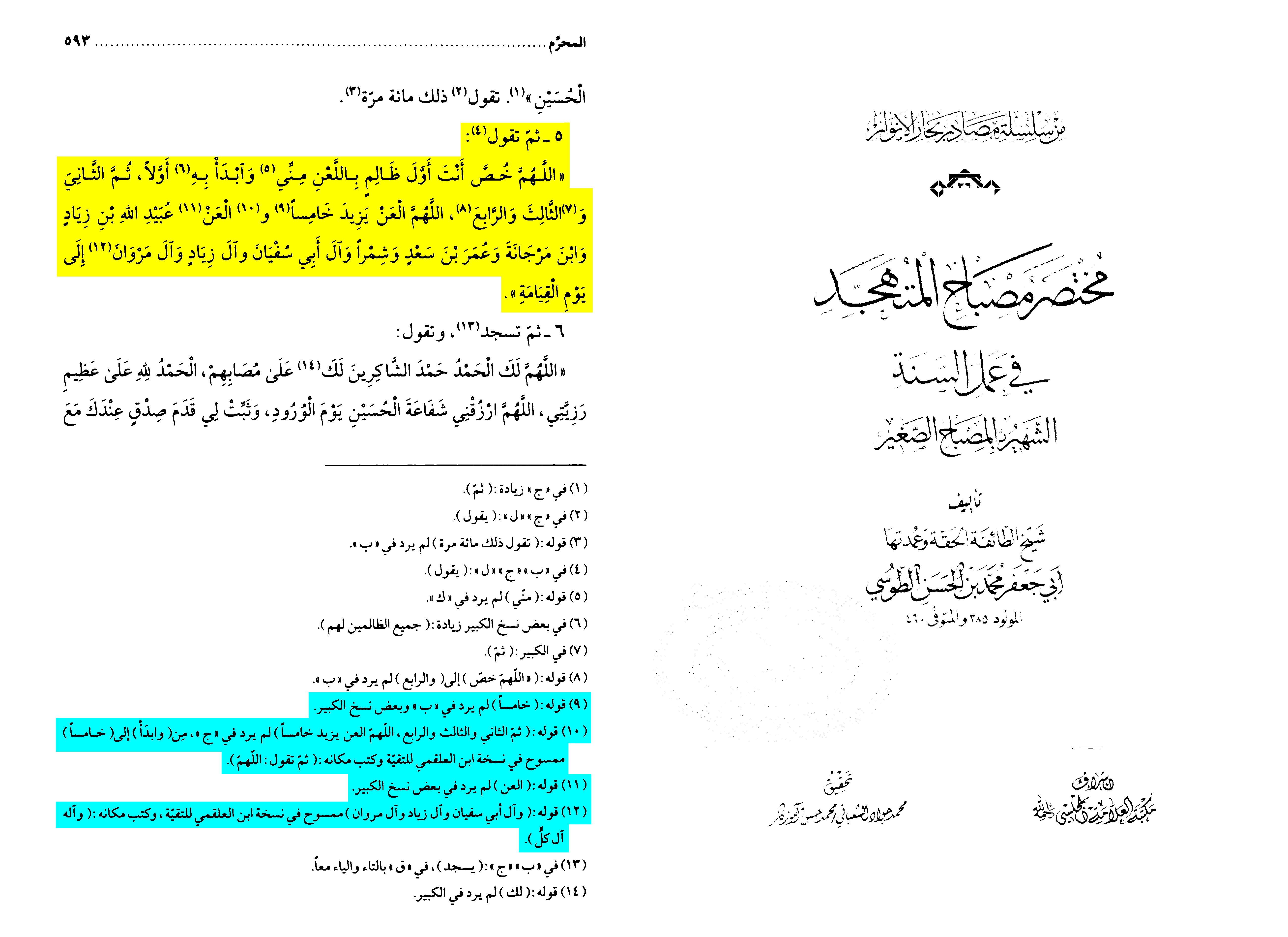
In some manuscripts of Misbah al-Mutahajjid, this part does not exist. The Muhaqiq (editor) of Mukthasar Misbah al-Mutahajjid, pg. 593, Dr. Muhammad Jawad Sha’bani, states that this paragraph’s phrases do not exist in some manuscripts:
اللَّهُمَّ خُصَّ أَنْتَ أَوَّلَ ظَالِمٍ بِاللَّعْنِ مِنِّي وَأَبْدَأْ بِهِ أَوَّلاً، ثُمَّ الثَّانِيَ وَالثَّالِثَ وَالرَّابِعَ، اللَّهُمَّ الْعَنْ يَزِيدَ خَامِساً وَالْعَنْ عُبَيْدِ اللَّهِ بْنِ زِيَادٍ وَابْنَ مَرْجَانَةَ وَعُمَرَ بْنَ سَعْدٍ وَشِمْراً وَآلَ أَبِي سُفْيَانَ وَآلَ زِيَادٍ وَآلَ مَرْوَانَ إِلَى يَوْمِ الْقِيَامَةِ.
O Allah, single out the first oppressor for curse from me, and begin with him first; then the second, the third, and the fourth. O Allah, curse Yazid as the fifth, and curse Ubayd Allah b. Ziyad, the son of Marjanah, Umar b. Sa’ad, Shimr, the family of Abu Sufyan, the family of Ziyad, and the family of Marwan, until the Day of Resurrection.
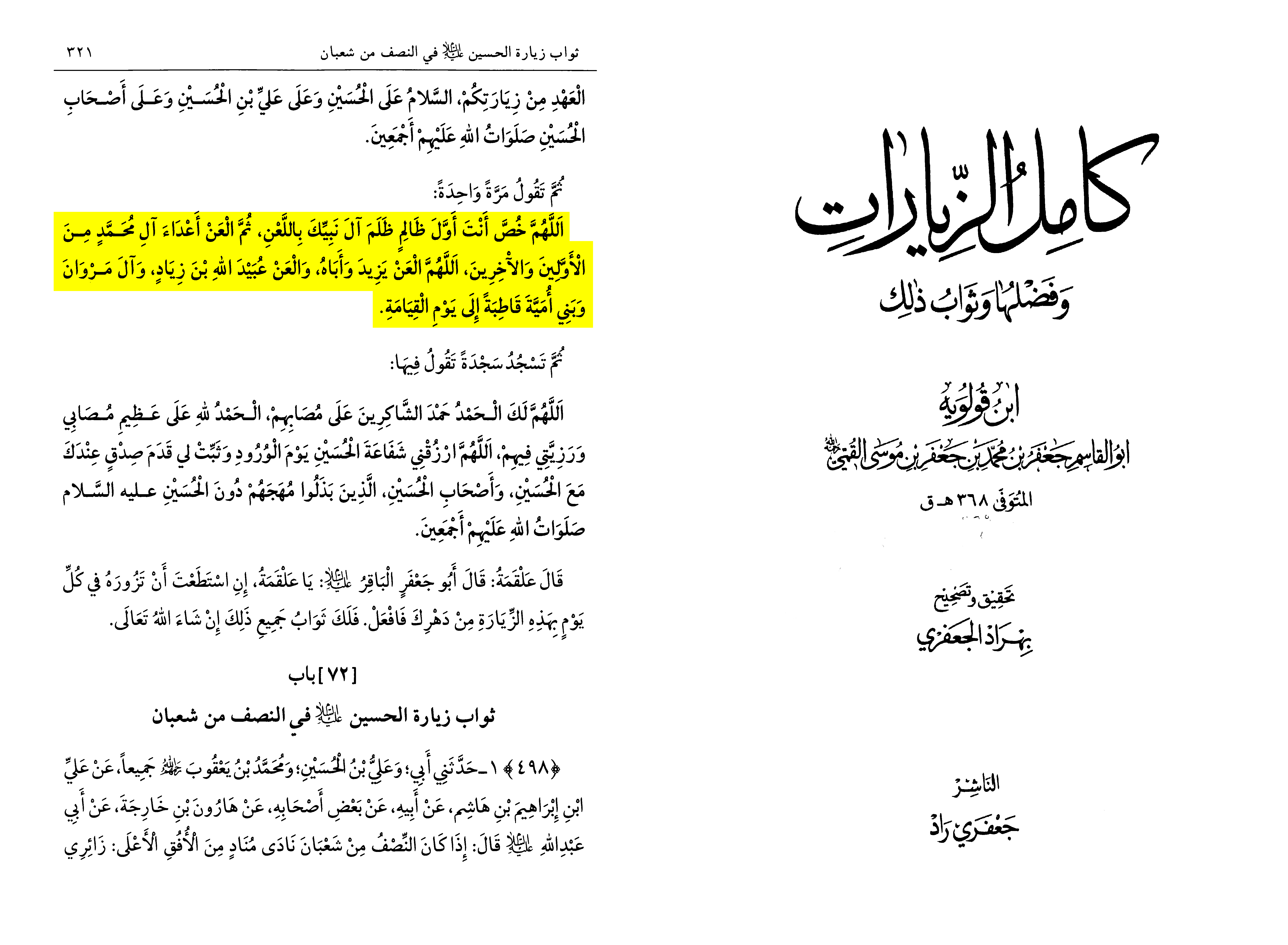
Moreover, the version transmitted by Ibn Qulawayh (d. 386), who is earlier than al-Tusi (d. 460), is missing this part entirely. Rather, the Ziyara he records states the following in pg. 321:
اللَّهُمَّ خُصَّ أَنْتَ أَوَّلَ ظَالِمِ ظَلَمَ آلَ نَبِيِّكَ بِاللَّعْنِ، ثُمَّ الْعَنْ أَعْدَاءَ آلِ مُحَمَّدٍ مِنَ الْأَوَّلِينَ وَالْآخِرِينَ، اَللَّهُمَّ الْعَنْ يَزِيدَ وَأَبَاهُ، وَالْعَنْ عُبَيْدَ اللَّهِ بْنَ زِيَادٍ، وَآلَ مَرْوَانَ وَبَنِي أُمَيَّةَ قَاطِبَةً إِلَى يَوْمِ الْقِيَامَةِ.
O Allah, single out to curse the first oppressor who wronged the family of Your Prophet, then curse the enemies of the family of Muhammad, from the former and the latter. O Allah, curse Yazid and his father, curse Ubayd Allah b. Ziyad, and cursed the family of Marwan and the entirety of Banu Umayyah until the Day of Resurrection.
For this reason, scholars have cast doubt on the authenticity of this end part of the Ziyara.
However, later scholars such as Allama al-Majlisi and others have recorded this Ziyara in their works with the same phrasing as the one preserved by al-Tusi, and since he had early manuscripts of the work it would strongly imply that it was once part of the Ziyara.
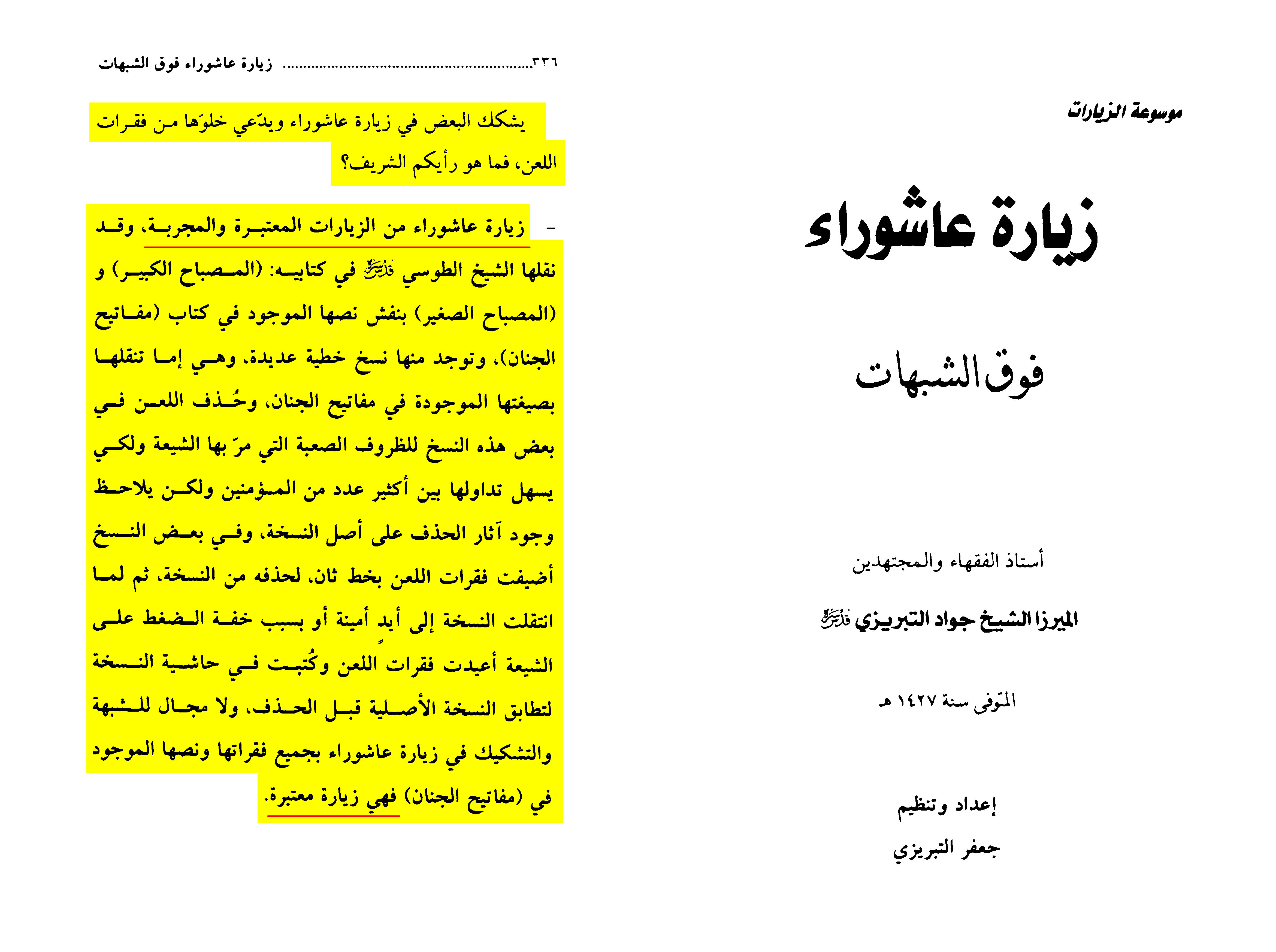
It has been argued by some scholars that it’s missing from some manuscripts due to taqiyya. This was explained to us by Ayatullah Jawad al-Tabrizi (RH) in Fawq al-Shubuhat, pg. 336:
Ziyarat Ashura is among the reliable and well-tested ziyarat. Shaykh al-Tusi transmitted it in his two books al Misbah al-Kabir and al-Saghir with the same text found in the book Mafatih al-Jinan.
There are many manuscript copies of it. Some of them transmit it in the form with the cursing (as Mafaith has), while in other copies the curse was removed due to the difficult circumstances that the Shiʿa went through, in order to make it easier to circulate among a larger number of believers, yet the traces of deletion can be observed in the original copy.
In some copies, the passages of curse were added in a second hand because they had been removed from the copy. Then, when the copy came into trustworthy hands or when the pressure on the Shiʿa lessened, the passages of curse were restored and written in the margins of the manuscript to match the original copy before deletion. There is no room for doubt or suspicion regarding Ziyarat Ashura in all of its passages and in its text as found in Mafatih al-Jinan, for it is a reliable Ziyara.
In any case, there is nothing wrong with the phrasing, and it is better to recite it then to discard it, and that is because if it is part of the Ziyara then one attains the reward its attributed with, and if it’s not part of the Ziyara then one loses nothing from saying it. The only loss is abstaining from it and discovering it was actually part of the Ziyara and so losing its rewards.
Besides that, the Ziyara is authentic and reliable, and this was affirmed by the great Shi’i leader of this century, Ayatullah Sayyid ‘Ali al-Sistani (HA) in the following letter published from his office on the 27th of Dhul Qaʿdah 1435 AH (22nd September 2014):
زيارة عاشوراء والجامعة الكبيرة من أهم الزيارات وأحسنها وأصحها سنداً ومتنا ومضمونها وارد في كثير من الروايات الصحيحة فينبغي للمؤمنين عليهما ولا يضعون التسهيلات المغرضين.
Ziyarat Ashura and Ziyarat al-Jami‘a al-Kabira are among the most important, finest, and most authentic visitations in terms of chain of transmission and content. Both are reported in many sound narrations. Therefore, believers should remain consistent in reciting them and should not give attention to the misleading insinuations of ill-intentioned individuals.
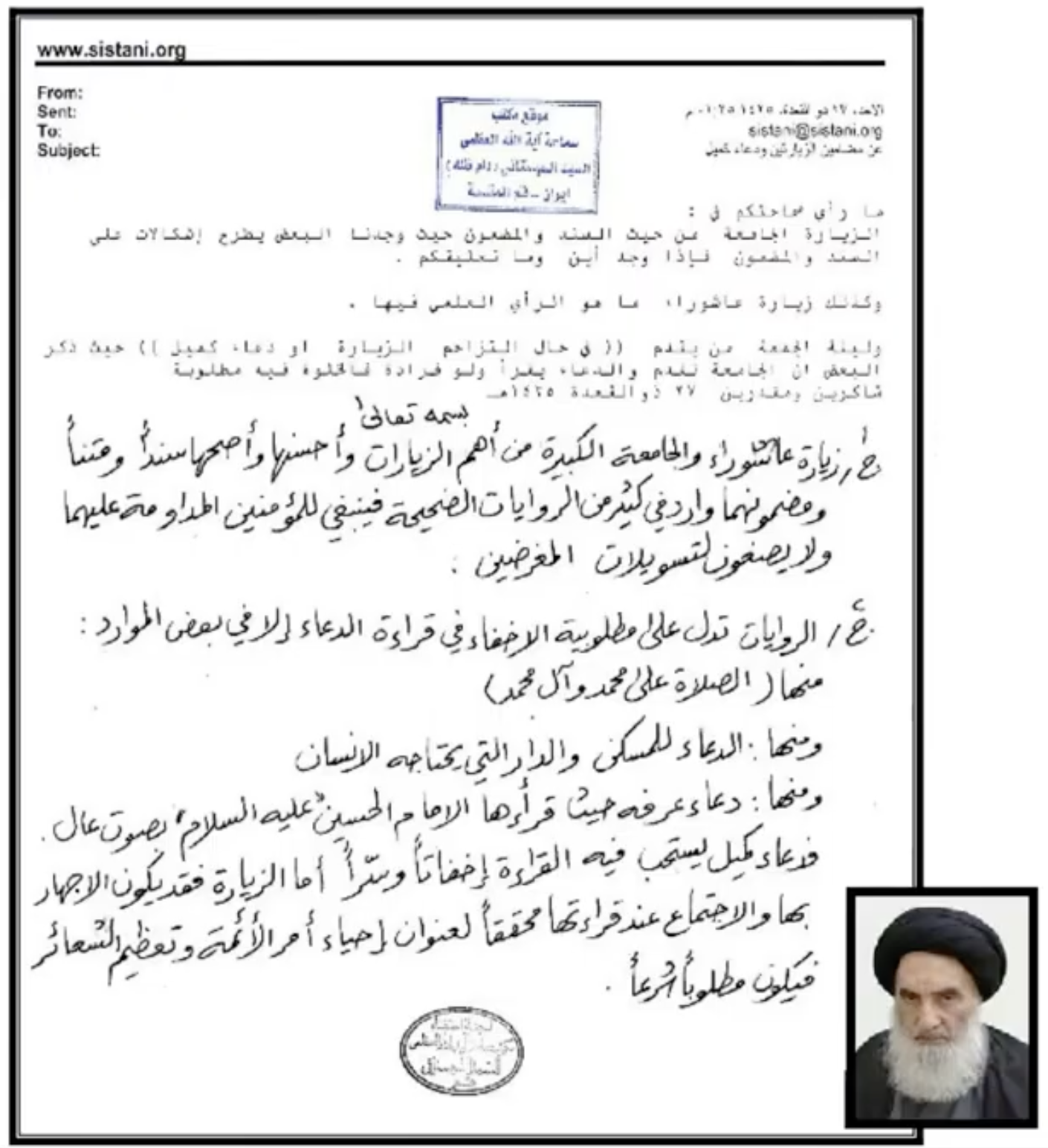
In another letter, Sayyid al-Sistani has explicitly mentioned that those who cast doubt on these Ziyarat are misguided misguiders (ضال مضل).


The last part is fabricated. As for your argument that Majlesi had some manuscripts that included this wording, that isn’t actual evidence. Tabrizi (RH) didn’t provide any evidence either, but rather speculation and implications. Also, his argument that its inclusion in Mafatih al-Jinan proves that it is reliable is unconvincing. There is Hadith al-Kisa, which is also considered fabricated, despite being included in Mafatih al-Jinan, so I don’t see how this establishes the reliability of the narration. Lastly, Sayyid al-Sistani isn’t the one who decides who is misguided; that is ultimately the choice of the Ahlulbayt. If a scholar has his own evidence that certain parts of the Ziyarat are fabricated, you cannot simply call him a misguided person. Otherwise,…
beautiful article bro