Fadak Series Part I: What is Fadak?

In this article, we will explore key facts about Fadak to introduce the topic and provide insightful context for newcomers. This will help them understand the significance of the debate and the essential details surrounding it.
Ahl al-Bayt's entitlement to Fadak |
What is Fadak?
Fadak was originally a land inhabited by Jews who made their living by farming date orchards. Historians have mentioned that this land was named after Fadak b. Ham, who was the first to inhabit this place.
Fadak came under the ownership of the Holy Prophet (saw) following the success achieved by the Muslims at Khaybar. After their defeat in the battles, the Jews pleaded for peace and opted to sign a peace treaty with the Muslims, under which they gave half of their property in Fadak to the Holy Prophet (saw).
The Prophet (saw) used this land to support his family, who gained from the income it generated. Fadak became exceedingly valuable due to its agricultural potential, with the Prophet (saw) planting numerous date trees on it. These trees eventually thrived, yielding a significant income for its owners.
By the time we reach Umar b. Abd al-Aziz’s reign, its income produced was the following recorded in Sunan Abi Dawud 2972:
Abu Dawud said: ‘When Abdul-Aziz became Caliph, the income (from the property of Fadak) was 40,000 Dinars.’
Despite the efforts of Banu Hashim to reclaim this land, they were unable to challenge the State's authority to demand its return as their rightful property. This loss was devastating for them, as their income heavily relied on the estate, leaving them nearly impoverished when it was confiscated.
The Size of Fadak
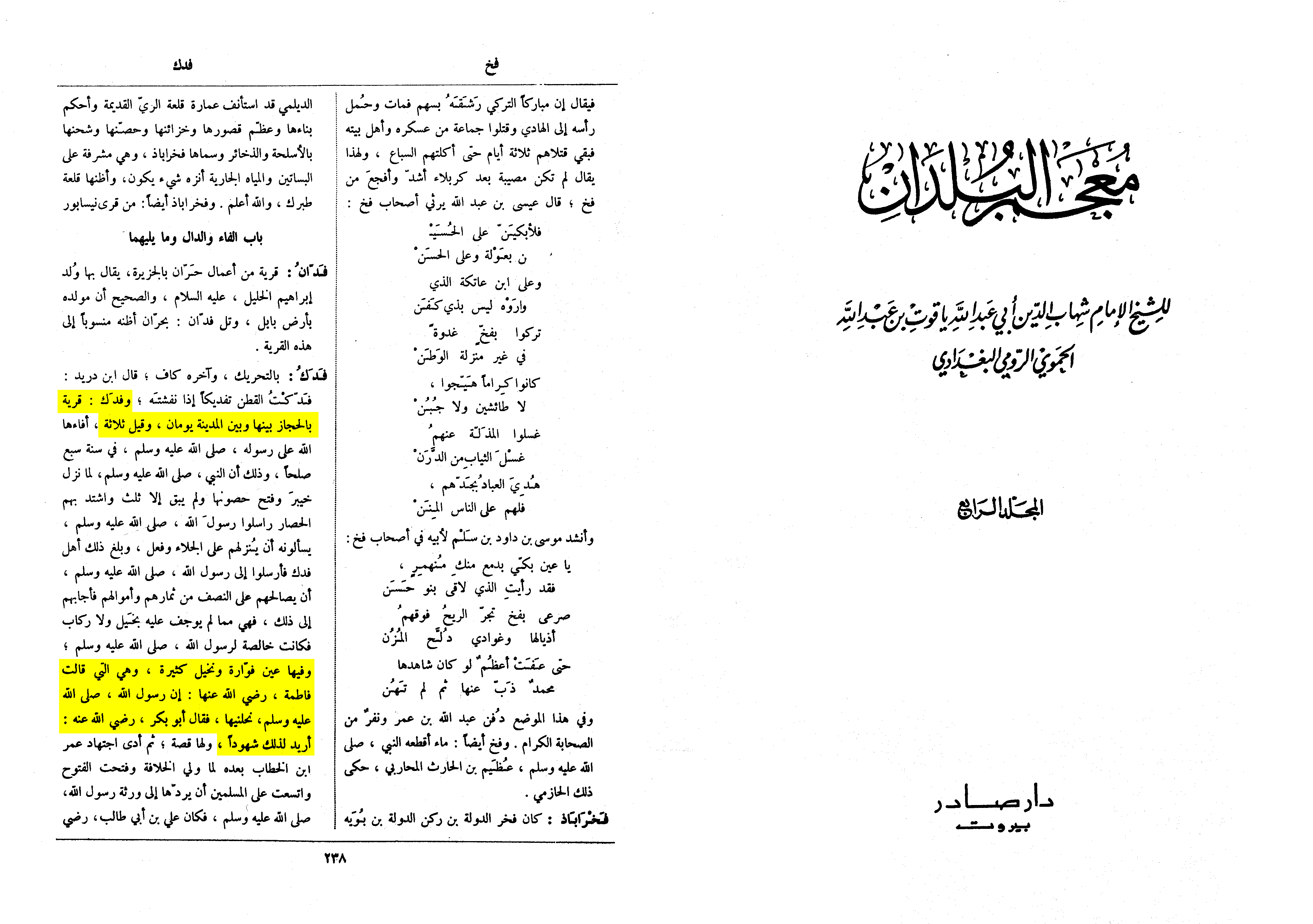
The Abbasid geographer and historian, Yaqut al-Hamawi (5th century Hijri), in Mu’jam al-Buldan, Vol. 4, pg. 270 describes Fadak in the following way:
Fadak is the name of a Qariya near Khaybar, between it and Medina is a journey of two days and some say three.
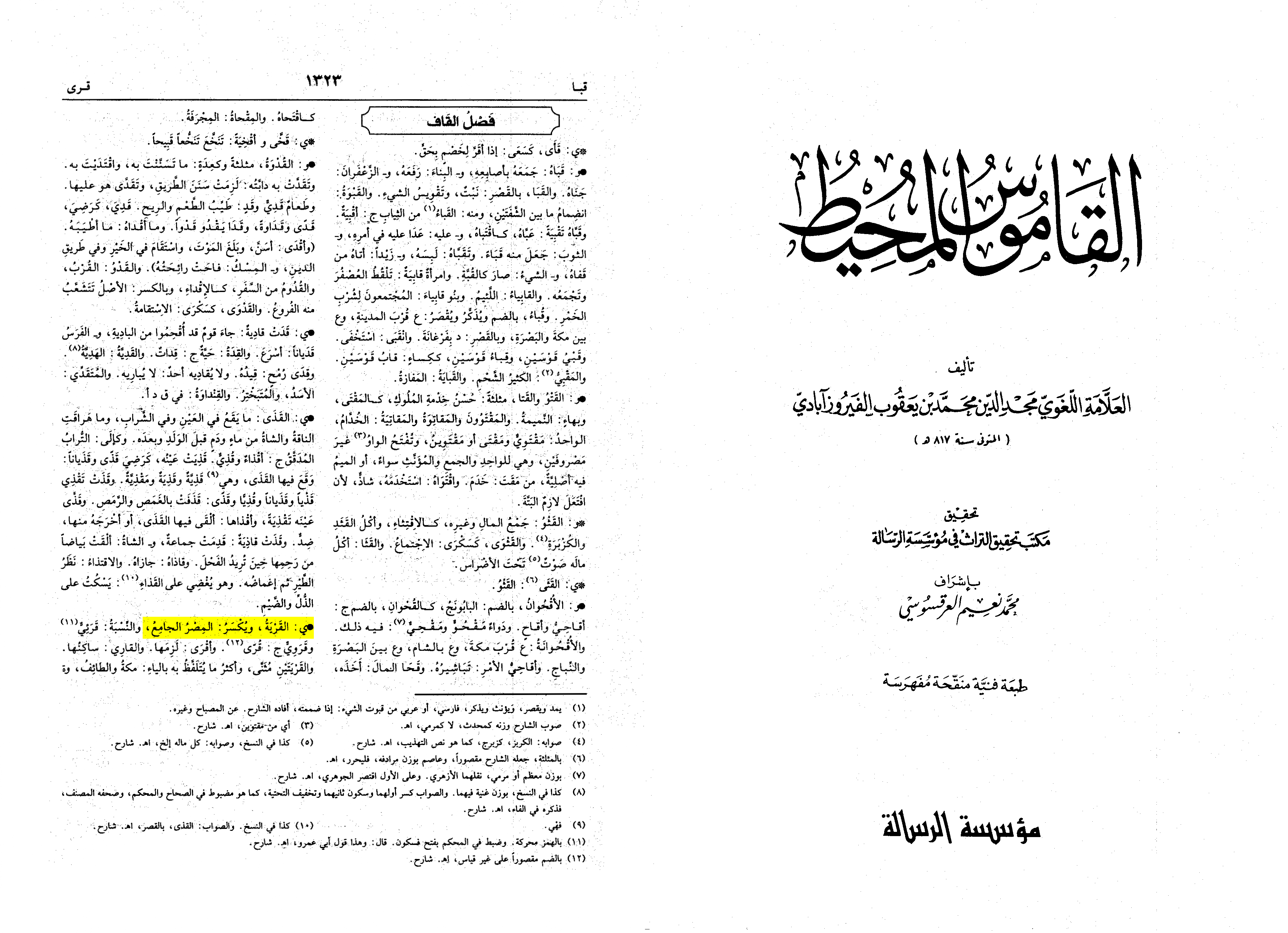
The term Qariya refers to a large settlement. For reference, refer to al-Firuzabadi’s famous arabic dictionary, al-Qamus al-Muhit, pg. 1323:
Qariya: A large settlement (al-Jami’).
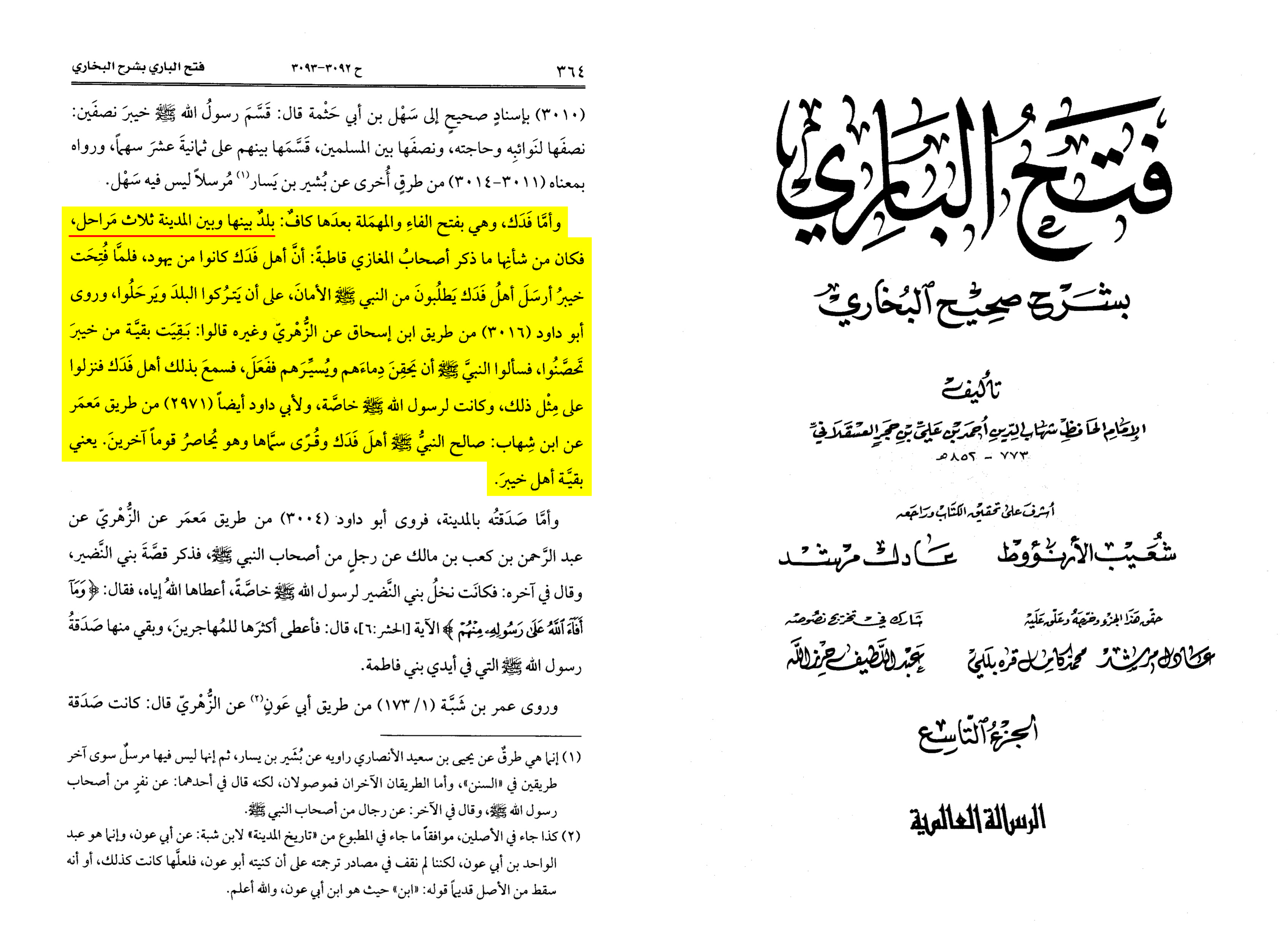
Similarly, Ibn Hajar al-’Asqalani says in Fath al-Bari, Vol. 9, pg. 363:
وَأَمَّا فَدَكُ: بَلَدٌ بَيْنَهَا وَبَيْنَ الْمَدِينَةِ ثَلَاثُ مَرَاحِلَ
As for Fadak: It is a balad located three days away from Medina.
Balad means city, as in the Qur’an the word is used to refer to Mecca, which is by no means a mere village but a large city in fact. Thus, Fadak is a fertile and profitable land. This gives it significant political advantages to its owner. However, such benefits certainly do not justify usurping it for personal political ambitions.
The ruling of Fay’
Allah (SWT) says in the Holy Qur’an, Surat al-Hashr 59:6:
وَمَآ أَفَآءَ ٱللَّهُ عَلَىٰ رَسُولِهِۦ مِنْهُمْ فَمَآ أَوْجَفْتُمْ عَلَيْهِ مِنْ خَيْلٍۢ وَلَا رِكَابٍۢ وَلَـٰكِنَّ ٱللَّهَ يُسَلِّطُ رُسُلَهُۥ عَلَىٰ مَن يَشَآءُ ۚ وَٱللَّهُ عَلَىٰ كُلِّ شَىْءٍۢ قَدِيرٌ
And what Allah restored [of property] to His Messenger from them - you did not spur for it [in an expedition] any horses or camels, but Allah gives His messengers power over whom He wills, and Allah is over all things competent.
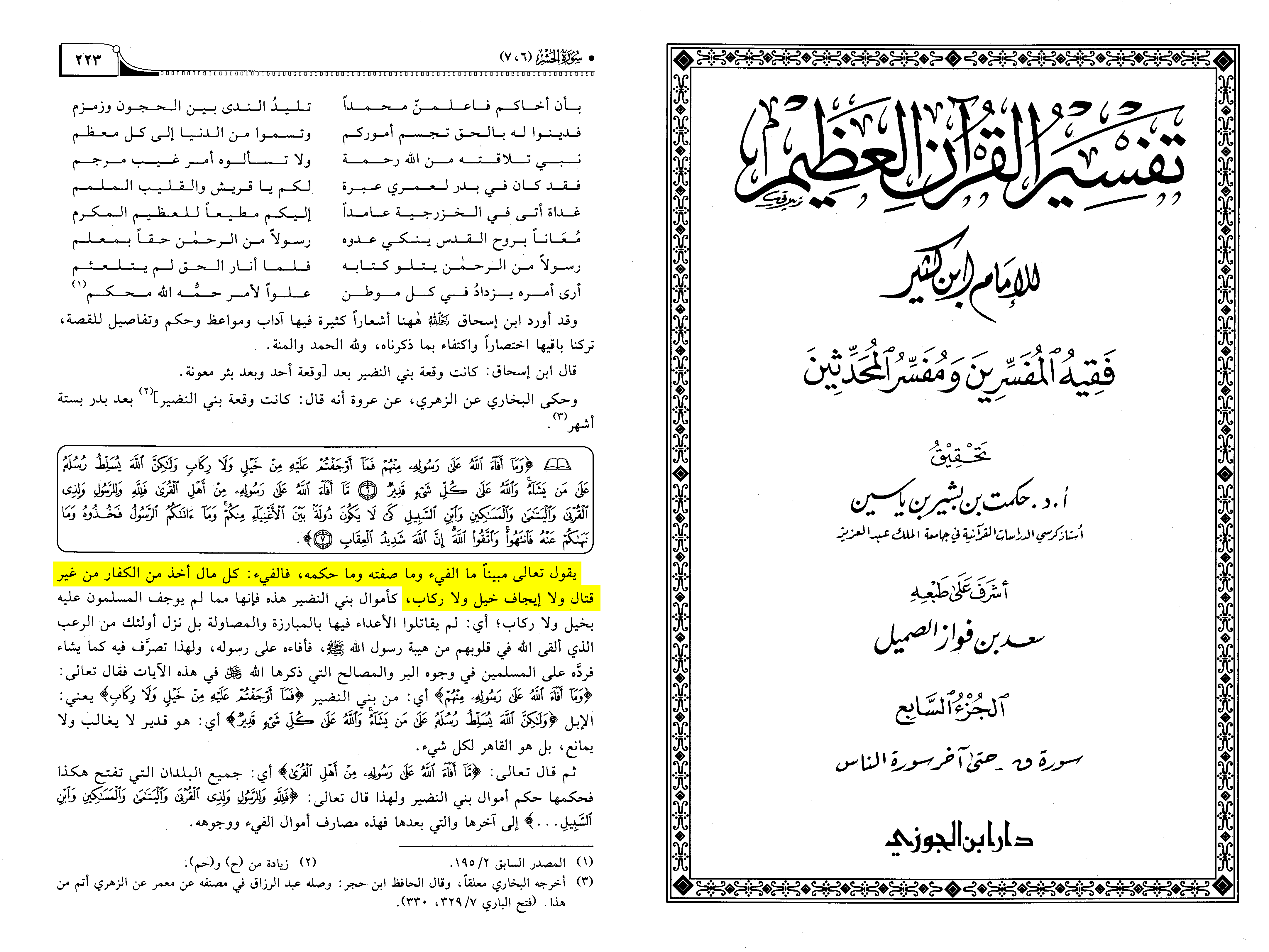
Fay’ in Islamic jurisprudence, refers to spoils of war acquired without armed conflict. This was mentioned in Tafsir Ibn Kathir Vol. 7, pg. 223:
Fay' in Islamic jurisprudence refers to spoils acquired without fighting or military expedition.
In contrast, the spoils acquired through wars are referred to as Ghanima.
Now the land of Fadak was a property of Fay’ and not Ghanimah because no battle was fought to conquer Fadak as mentioned earlier, rather it was given as a result of a peace treaty with the Jews. All Islamic historians affirm this fact.
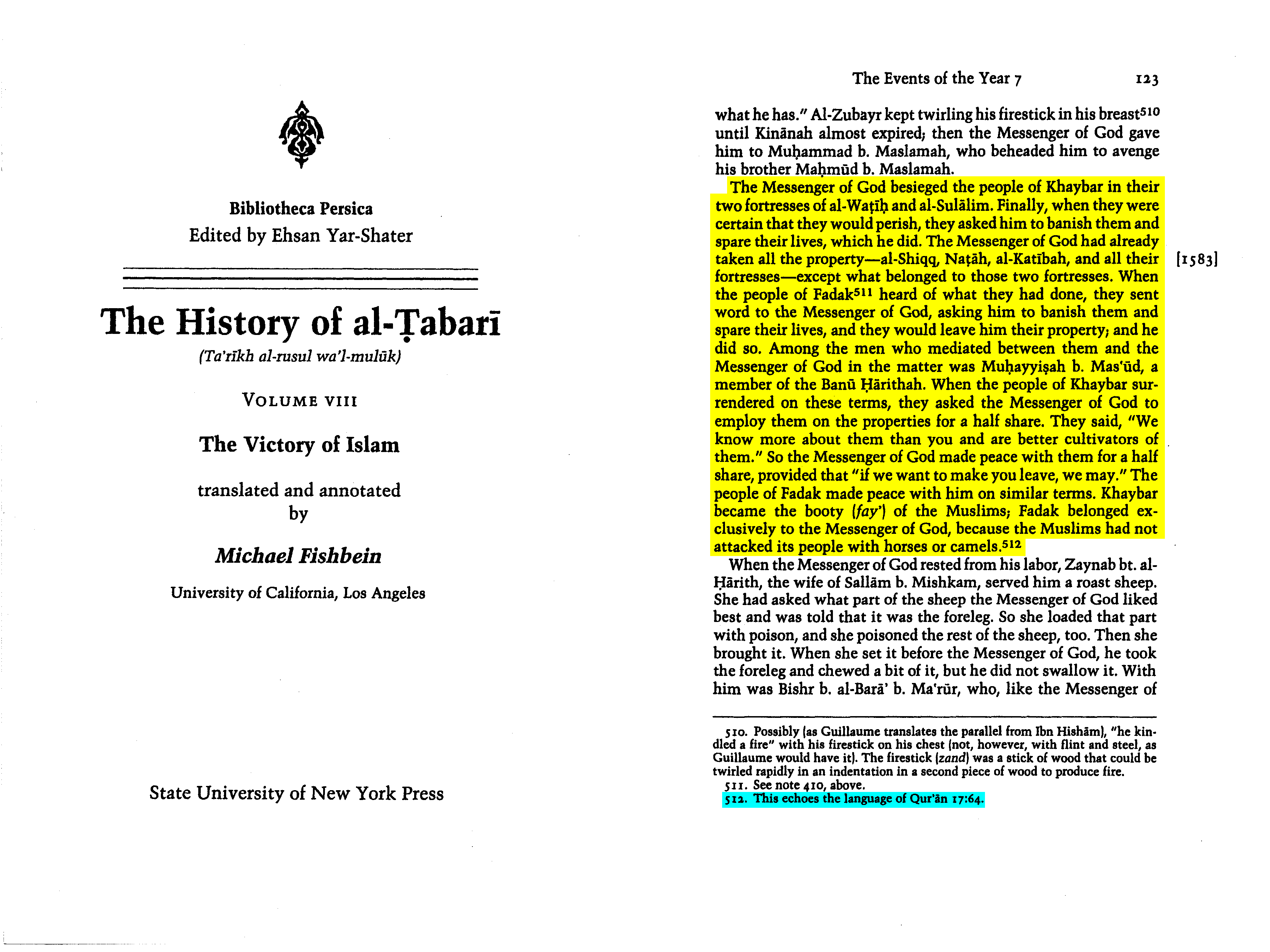
For instance, we read in Tarikh al-Tabari. Vol. 8, pg. 123 (Arabic):
The Messenger of God besieged the people of Khaybar in their two fortresses of al-Watīh and al-Sulālim. Finally, when they were certain that they would perish, they asked him to banish them and spare their lives, which he did. The Messenger of God had already taken all the property-al-Shiqq, Națāh, al-Katībah, and all their fortresses-except what belonged to those two fortresses.
When the people of Fadak heard of what they had done, they sent word to the Messenger of God, asking him to banish them and spare their lives, and they would leave him their property; and he did so. Among the men who mediated between them and the Messenger of God in the matter was Muhayyişah b. Mas'ūd, a member of the Banū Harithah. When the people of Khaybar surrendered on these terms, they asked the Messenger of God to employ them on the properties for a half share.
They said, "We know more about them than you and are better cultivators of them." So the Messenger of God made peace with them for a half share, provided that "if we want to make you leave, we may." The people of Fadak made peace with him on similar terms. Khaybar became the booty (fay') of the Muslims; Fadak belonged exclusively to the Messenger of God, because the Muslims had not attacked its people with horses or camels.
The same was recorded and affirmed by:
Al-Nawawi in his Sharh Sahih Muslim. Vol. 12, pg. 118 - 119.
Al-Dhahabi in Tarikh al-Islam. Vol. 1, pg. 421 - 422.
Ahl al-Bayt's entitlement to Fadak
Knowing that Fadak was a land of Fay is crucial, as the next verse also states that some of the share (of fay land) was for his family:
مَّآ أَفَآءَ ٱللَّهُ عَلَىٰ رَسُولِهِۦ مِنْ أَهْلِ ٱلْقُرَىٰ فَلِلَّهِ وَلِلرَّسُولِ وَلِذِى ٱلْقُرْبَىٰ وَٱلْيَتَـٰمَىٰ وَٱلْمَسَـٰكِينِ وَٱبْنِ ٱلسَّبِيلِ كَىْ لَا يَكُونَ دُولَةًۢ بَيْنَ ٱلْأَغْنِيَآءِ مِنكُمْ ۚ وَمَآ ءَاتَىٰكُمُ ٱلرَّسُولُ فَخُذُوهُ وَمَا نَهَىٰكُمْ عَنْهُ فَٱنتَهُوا ۚ وَٱتَّقُوا ٱللَّهَ ۖ إِنَّ ٱللَّهَ شَدِيدُ ٱلْعِقَابِ
And what Allah restored to His Messenger from the people of the towns - it is for Allah and for the Messenger and for [his] near relatives and orphans and the [stranded] traveler - so that it will not be a perpetual distribution among the rich from among you. And whatever the Messenger has given you - take; and what he has forbidden you - refrain from. And fear Allah; indeed, Allah is severe in penalty.
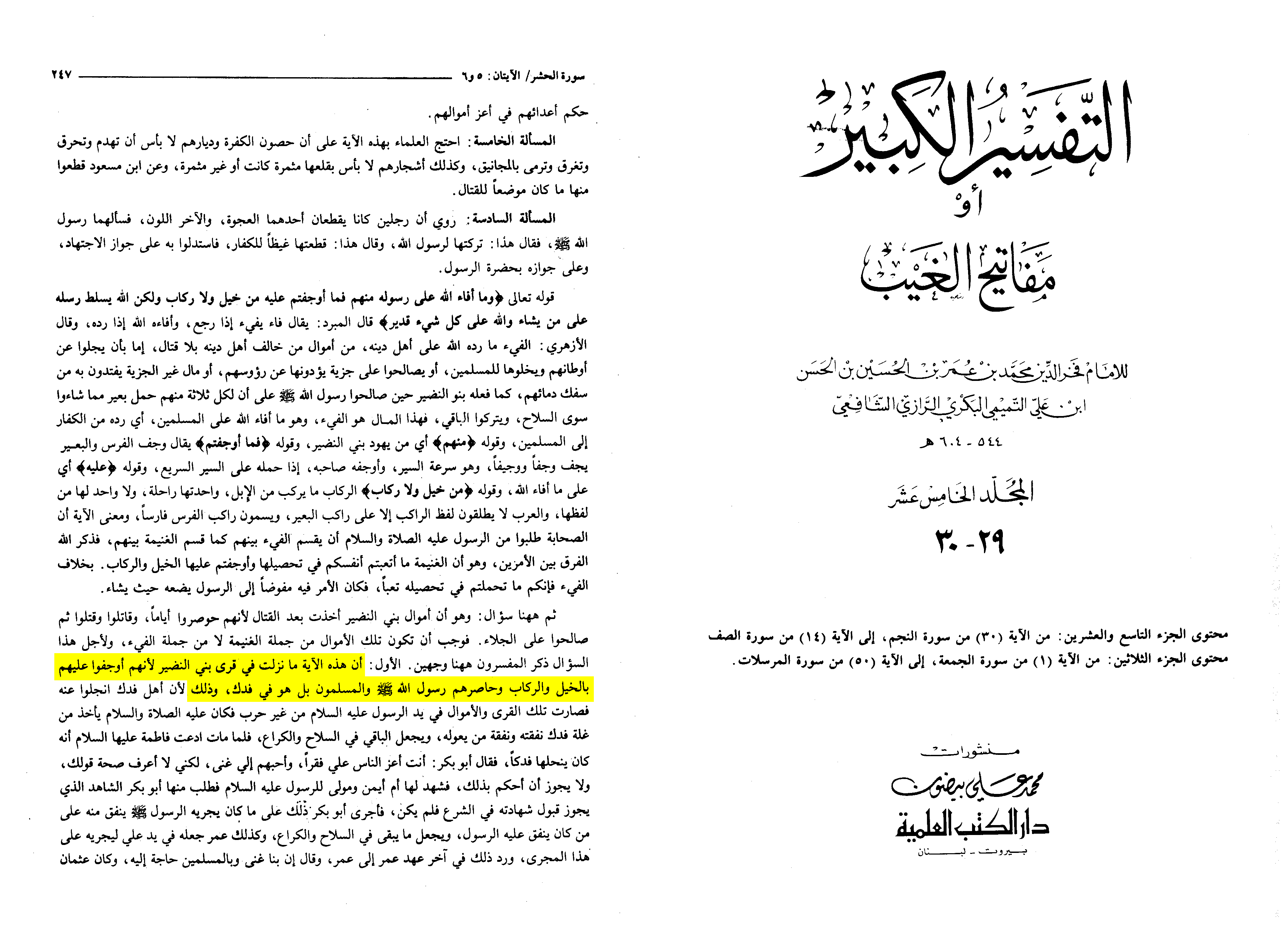
The Sunni exegetes have differed on what land is referred to in this incident. The popular opinion is that it concerns the property of Banu Nadhir, however, this view has been criticised because the Muslims fought against them many times. Another oft cited opinion is that it concerns Fadak as Fakhr al-Din al-Razi mentions in Tafsir al-Kabir, Vol 15, pg. 247:
“That this verse was not revealed concerning the villages of Banu al-Nadir, because horses and camels were driven against them and the Messenger of Allah (SAW) and the Muslims besieged them; rather, it is regarding Fadak.”
Regardless of this, the fact is that a share of the property of Fadak comes under the same ruling is undisputed because the principles of this verse applies to it. This therefore means that the Ahl al-Bayt (AS) have a right to its share.
This also means that the Ahl al-Bayt, such as Fatima bt. Muhammad (AS), were actively using Fadak for their own needs during the time of the Holy Prophet (SAW). ‘Umar himself affirmed this in Sahih al-Bukhari 7305:
So that property was totally meant for Allah's Messenger (ﷺ), yet he did not collect it and ignore you, nor did he withhold it with your exclusion, but he gave it to you and distributed it among you till this much of it was left behind, and the Prophet, used to spend of this as the yearly expenditures of his family and then take what remained of it and spent it as he did with (other) Allah's wealth.
The Income Produced by Fadak
For a government to consider usurping land that does not belong to them, several factors must motivate their actions, including its geography, size, and, arguably most importantly, the potential profit it can generate. Fadak was one of those lands that, if properly utilized, could produce vast wealth. There is considerable evidence to support this, highlighting the land's immense economic potential.
Firstly, prior to the conquest of Mecca the Muslims struggled to even fulfill their hunger. It was not until the success achieved at Khaybar that this situation changed. This was testified by the likes of Ibn Umar in Sahih al-Bukhari 4243:
Narrated Ibn Umar: We did not become full after eating until we conquered Khaybar.
The estates of Fadak and Khaybar played a crucial role in providing financial stability for the Islamic State. The wealth generated from these lands was so significant that the Prophet (saw) used it to fund military expenditures, which are typically the largest area of government spending. This highlights the immense economic value of Fadak.
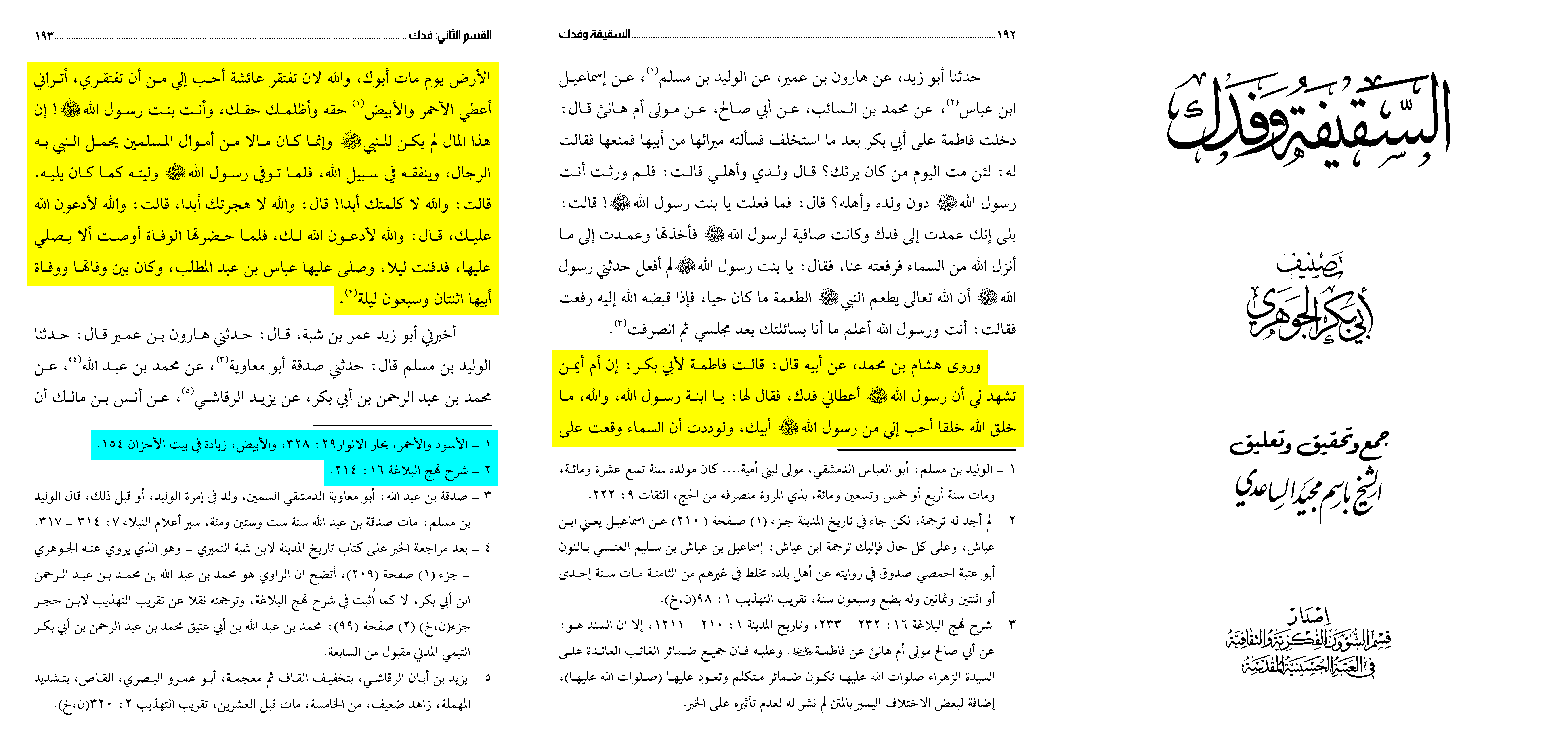
Abu Bakr al-Jawahri records the words of Abu Bakr when he confiscates it from Fatima (as) in his Kitab al-Saqifa wal-Fadak, pg. 192 - 193:
It (i.e. Fadak) was, in fact, wealth from the Muslims, which the Prophet (saw) used to equip men and spend in the way of Allah.
An alternative source to demonstrate this is from Sahih Muslim 1757a:
It has been narrated on the authority of Umar, who said: The properties abandoned by Banu Nadir were the ones which Allah bestowed upon His Apostle for which no expedition was undertaken either with cavalry or camelry.
These properties were particularly meant for the Holy Prophet (may peace be upon him). He would meet the annual expenditure of his family from the income thereof, and would spend what remained for purchasing horses and weapons as preparation for Jihad.
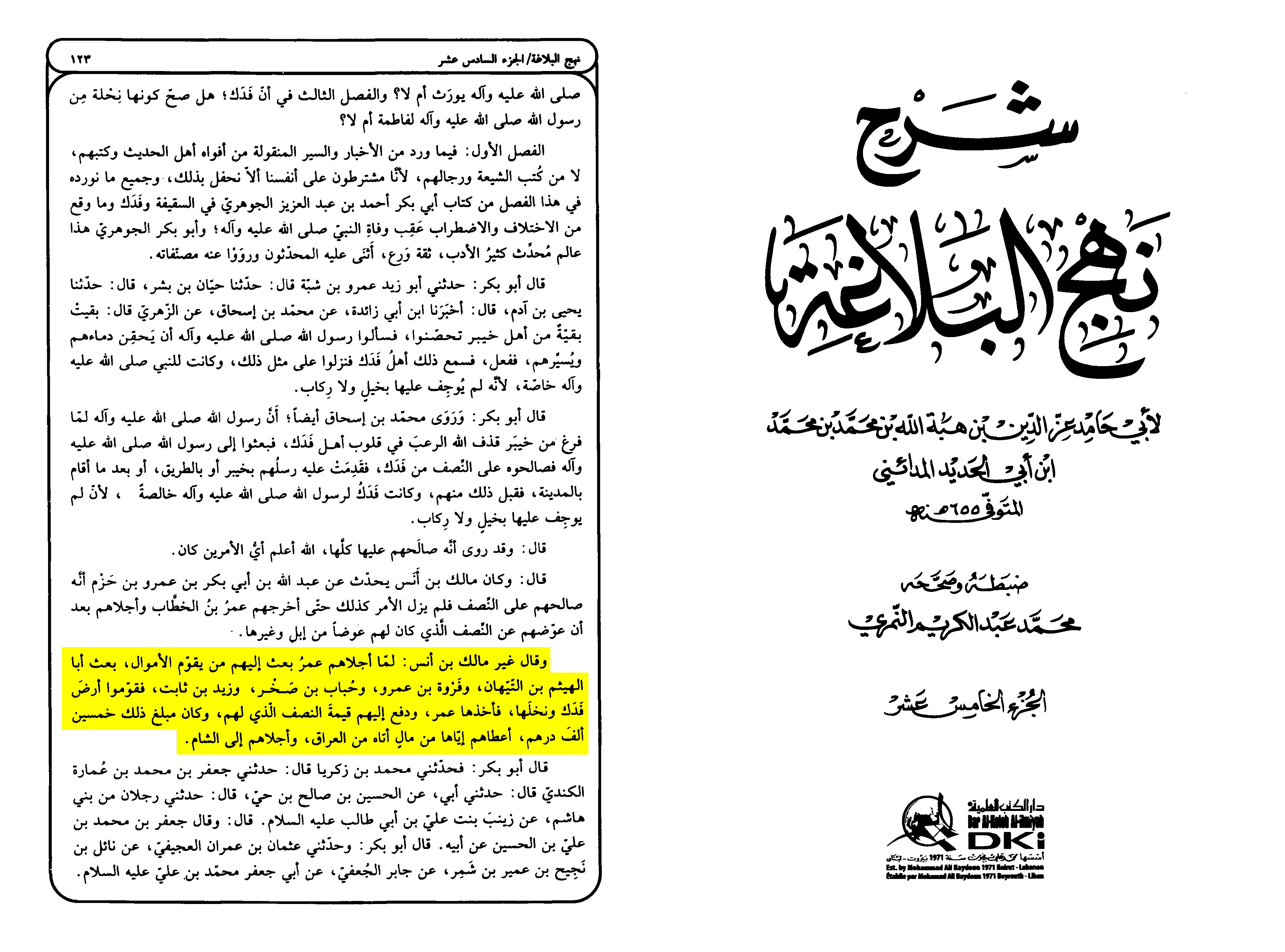
In fact, it was so valuable that while the Prophet only kept one half of the land as per the treaty’s condition, Umar b. al-Khattab later expelled the Jews and claimed the entire land altogether. Its value was so high that it measured to 50,000 dirhams! This was recorded in Sharh Nahj al-Balagha Vol. 15, pg. 123:
Others besides Malik b. Anas narrated: When Umar expelled the Jews from Fadak, he sent to them individuals who would value the property, he sent Abu al-Haytham b. al-Tayihan, Farwa b. Amr, Habab b. Sakhr, and Zayd b. Thabit who determined the value of Fadak and its palm date trees, so Umar took possession of it and he paid them for their half, which was 50,000 Dirhams, which he took from the income of Iraq, then he sent them to the Levant.
In later caliphates we also find, for example, Mu’awiya dividing Fadak into portions and rewarding it to his governors. This was recorded in Sharh Nahj al-Balagha, Vol. 8, pg. 323:
When Mu'awiya b. Abi Sufyan assumed authority, he granted one-third of it to Marwan b. al-Hakam, one-third to Amr b. Uthman b. Affan, and one-third to Yazid b. Mu'awiyah.
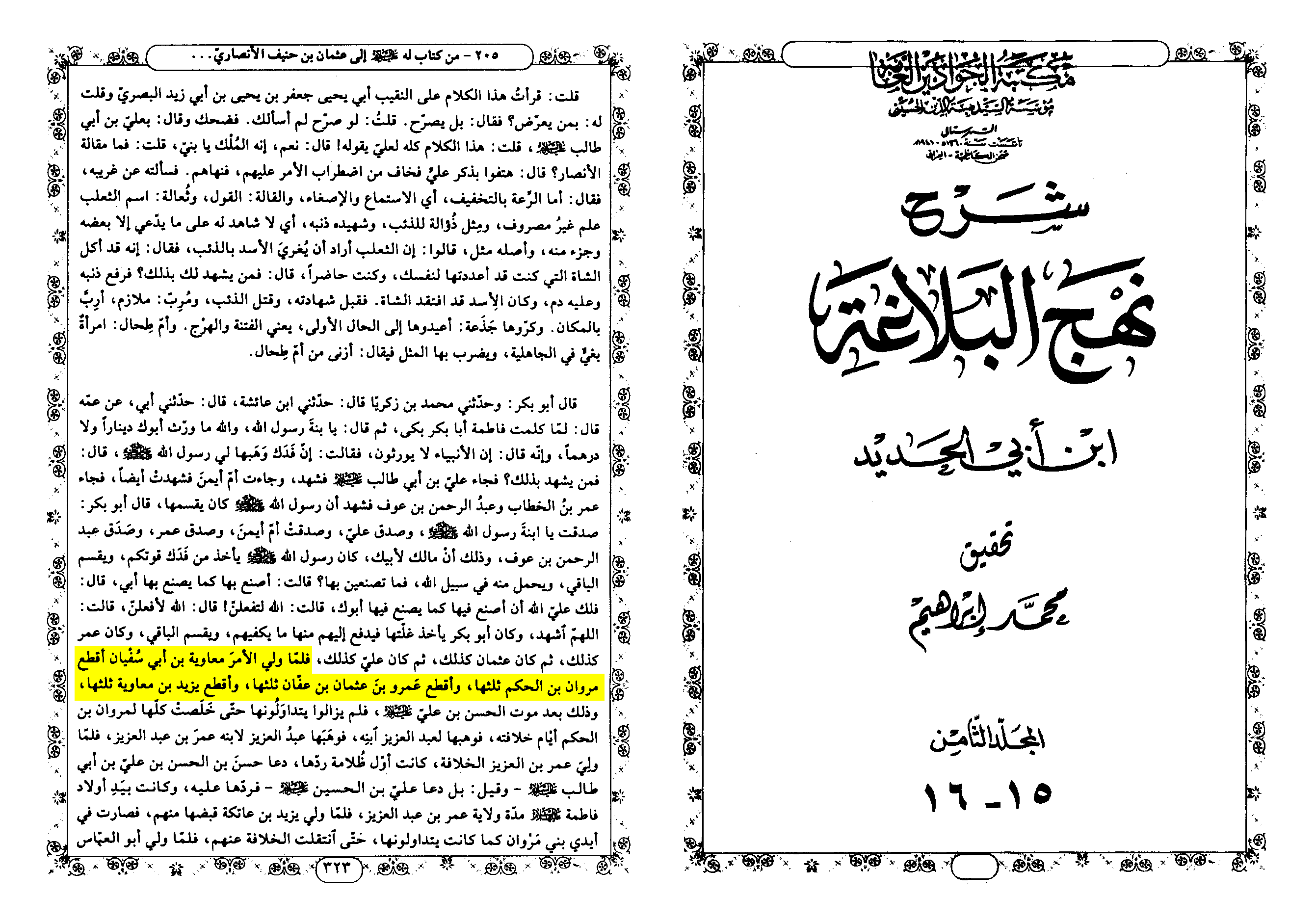
How could Fadak be insignificant, when three already very wealthy Emir’s financially benefited from portions of its land. For comparison, if we gave millionaires a sum of money that they would greatly benefit from, then it must be a sum large enough to be significant for them.


Comments