Fadak Series II: Abu Bakr Stole Fadak from Fatima!

Updated: Jun 12
The first matter we want to present related to Fadak is that Abu Bakr oppressed Fatima (AS) by stealing both Fadak and the Khumms. As for him stealing Fadak, it was already her property as the Prophet (SAW) gave it to her when he was alive by the command of Allah, as evidenced by the traditions of the Sahaba regarding the revelation of a verse of Sura al-Israa.
As for him stealing Khums, it is because the Prophet (SAW) used to give Khumms to Bani Hashim, but Abu Bakr did not. This blatant oppression towards the Ahl al-Bayt is clear and renders him totally unfit for the Caliphate.
Fadak in the Holy Qur'an
We shall now present the evidence that the Prophet (SAW) gave Fadak to Fatima (AS) during his lifetime, in turn proving Abu Bakr stole it. The evidence is found in the Quran as well as in numerous historical sources.
Allah says in Surat al-Israa’ verse 26:
وَآتِ ذَا الْقُرْبَى حَقَّهُ
Give the relatives their [due] right
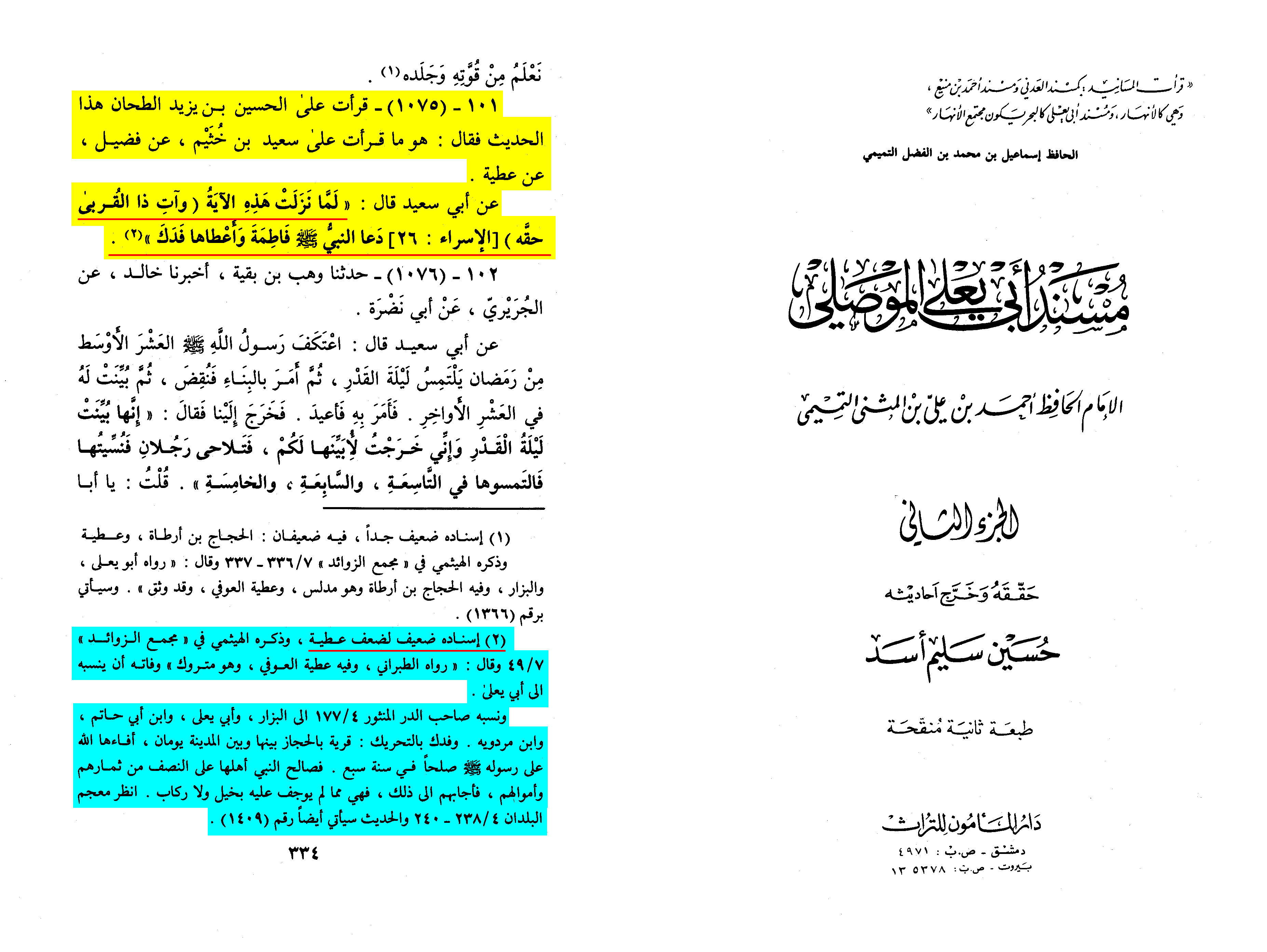
The Prophet (SAW) implemented the ruling of this verse by giving Fadak to Fatima (AS), as we read in Musnad Abu Yala Vol 2, pg. 234, Hadith # 1075 and on pg. 534, Hadith # 1409:
I read to al-Husayn b. Yazid al-Tahhan: Sa‘id b. Khuthaym narrated to us, from Fudayl, from ‘Atiyyah, from Abu Sa‘id al-Khudri, who said:
When this verse was revealed: {And give the near relative his right} [al-Isra’: 26], the Prophet (SAW) called Fatima and gave her Fadak.”
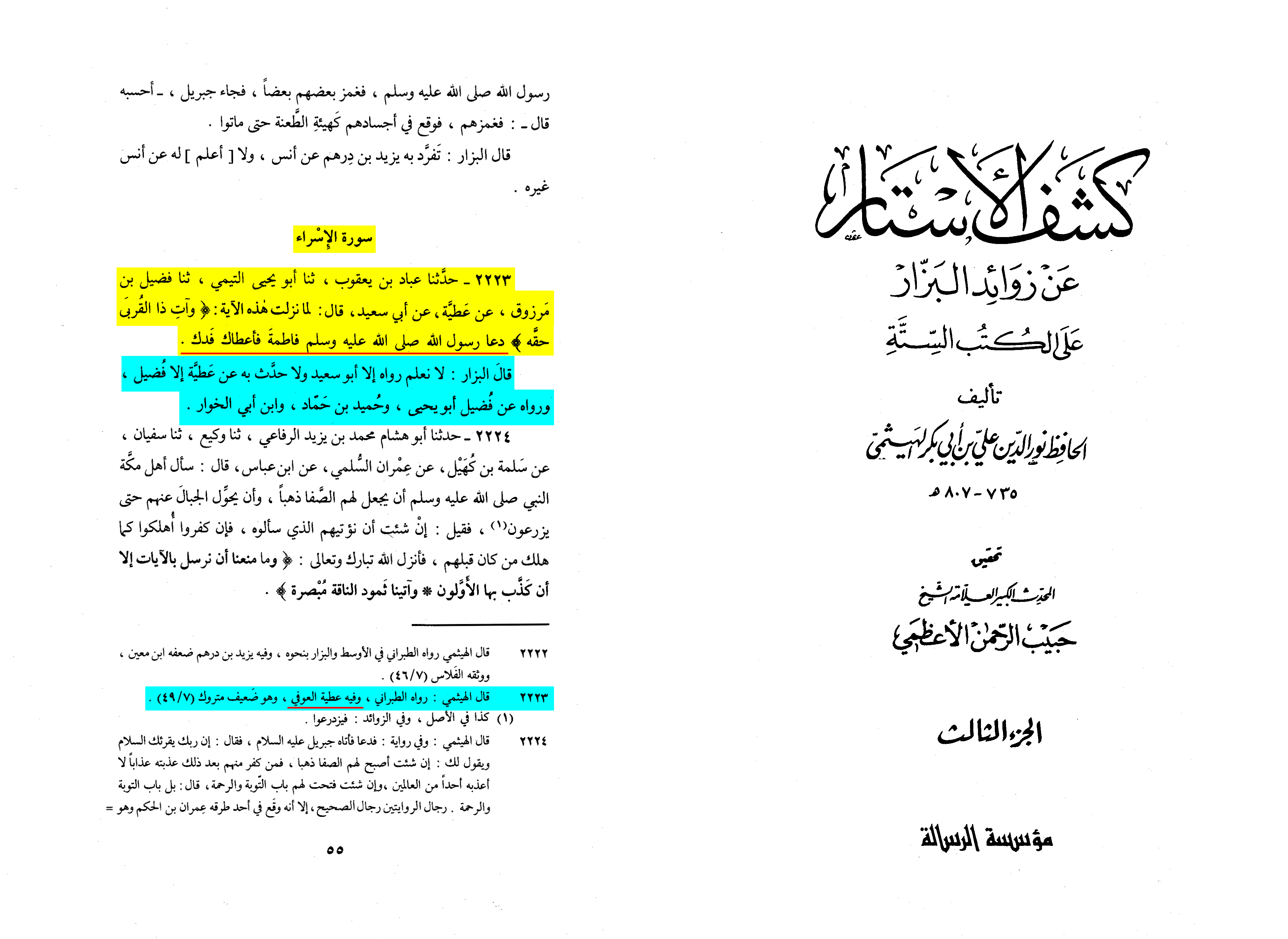
This tradition can also be found in Kashf al-Astar Vol 3, pg. 55, Hadith # 2223:
And al-Bazzar, Abu Ya‘la, Ibn Abi Hatim, and Ibn Mardawayh narrated from Abu Sa‘id al-Khudri (RA) who said:
When this verse was revealed: {And give the near relative his right}, the Messenger of Allah (SAW) called Fatima and gave her Fadak.
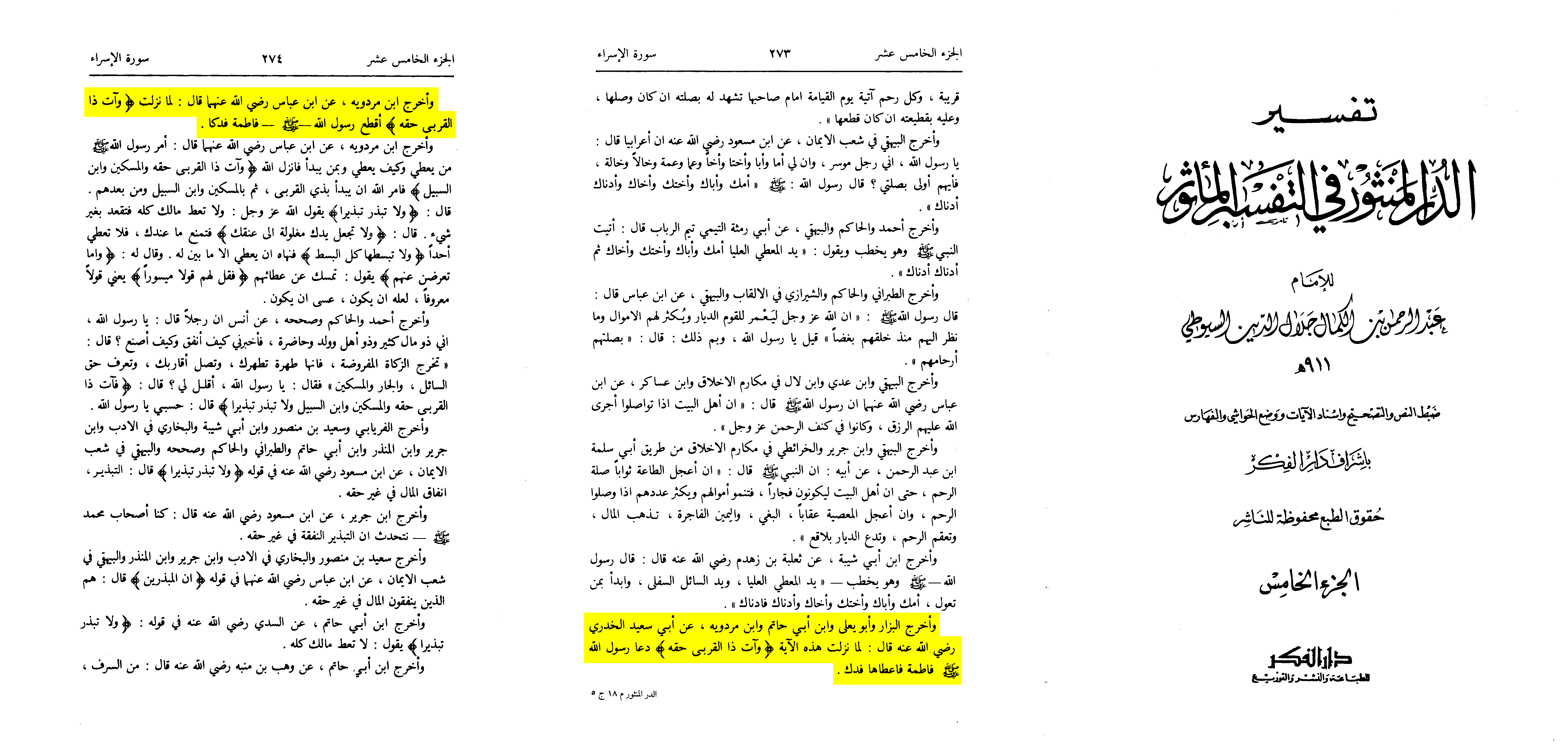
Al-Suyuti also listed other now lost sources for this report in Tafsir Durr al-Manthur, Vol. 5, pg. 273 - 274:
And Ibn Mardawayh narrated from Ibn ‘Abbas (RA), who said:
When {And give the near relative his right} was revealed, the Messenger of Allah (SAW) granted Fadak to Fatima.”
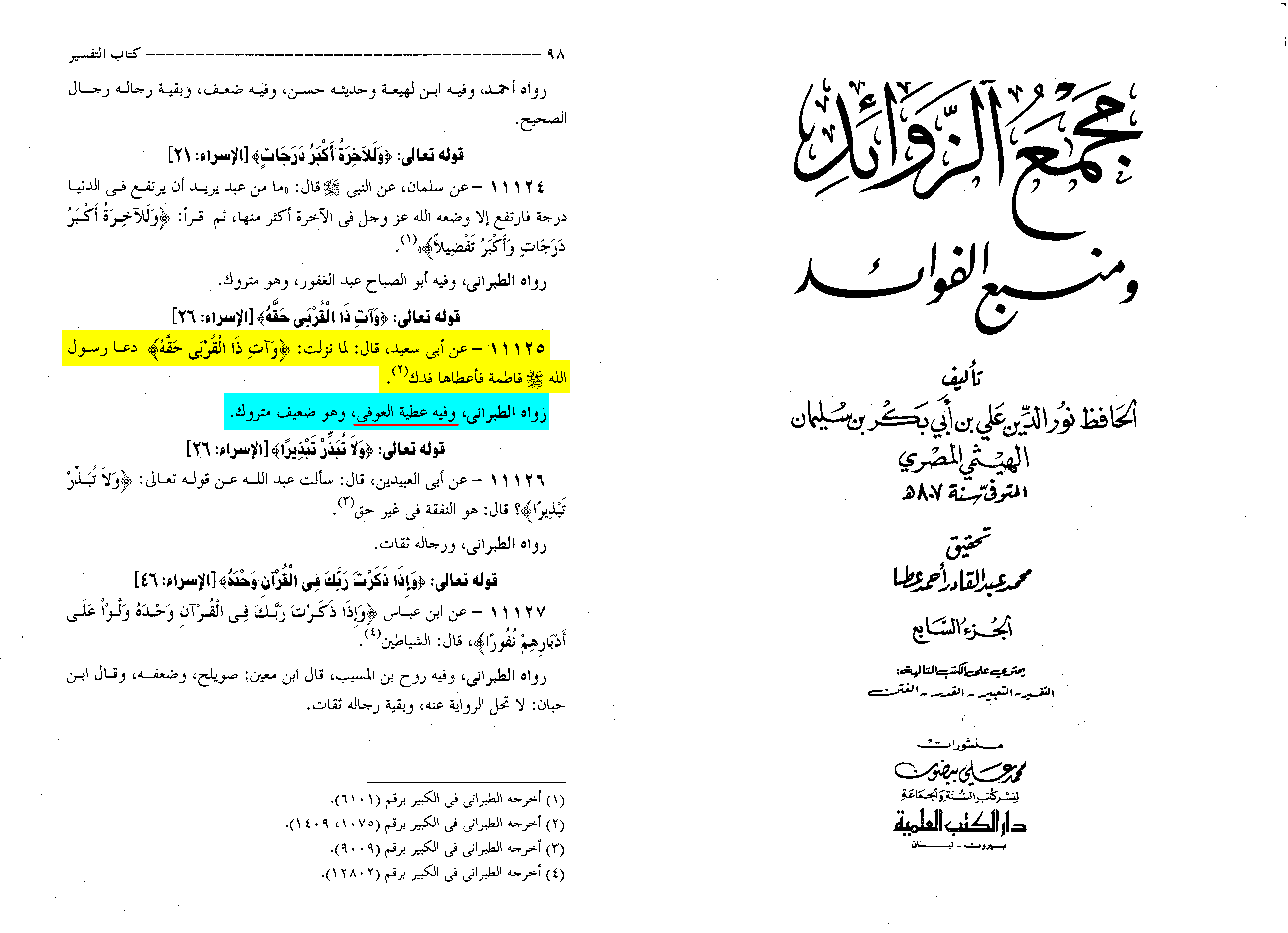
Al-Haythami also noted that this tradition was recorded by al-Tabarani in Majma’ al-Zawa’id Vol 7, pg. 98, Hadith # 11155, but weakened the tradition due to the presence of ‘Attiya al-’Awfi in the chain of transmission.
The reliability of ‘Attiya al-Awfi
When confronted with this hadith, our opponents try to weaken ‘Atiyya, as al-Haythami did. Yet al-Haythami contradicts himself in Majma’ al-Zawa’id Vol 7, pg. 432 Hadith # 12394, where he recorded that Attiya was authenticated by Yahya b. Ma’in.
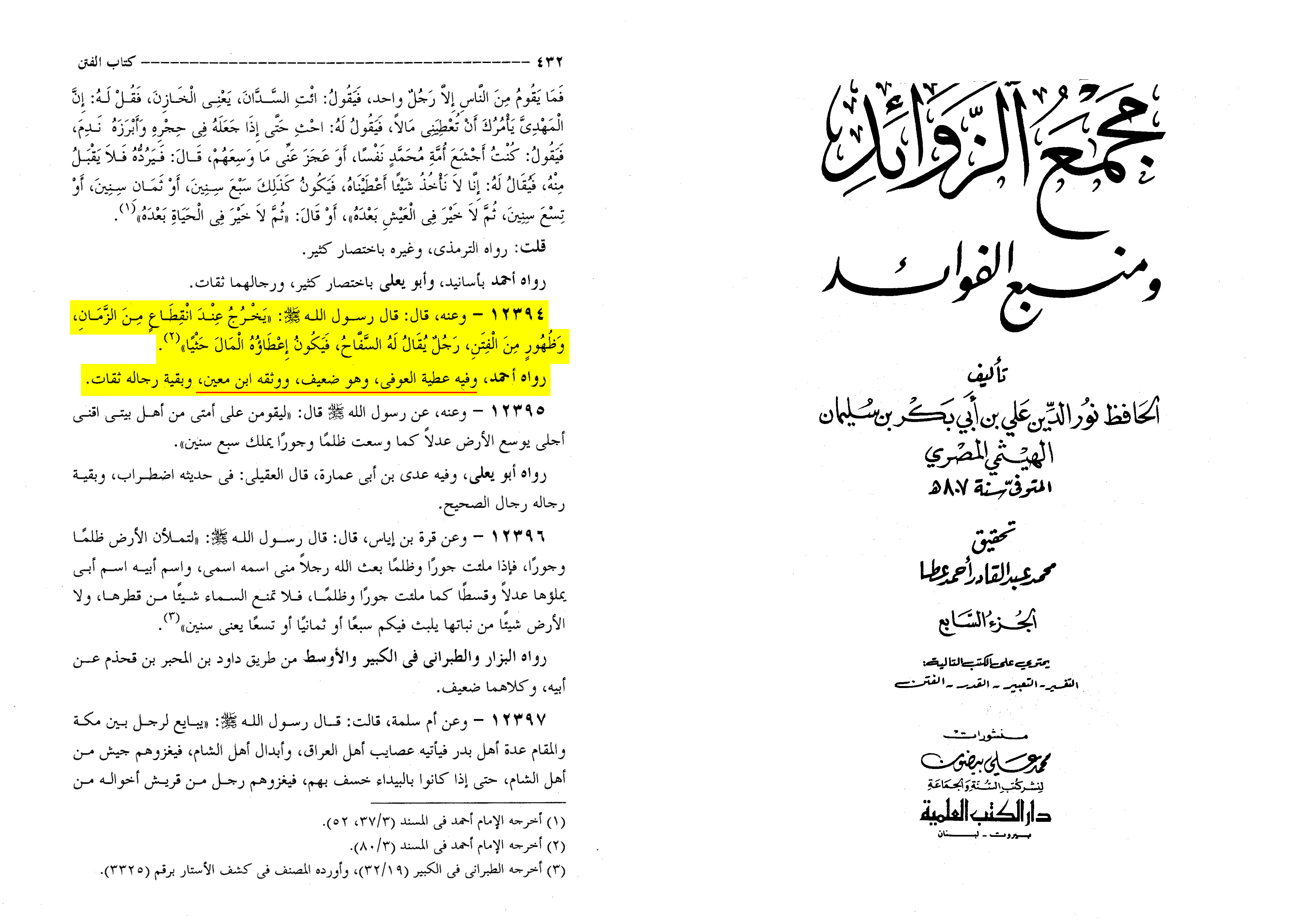
In ‘Ilm al-Rijal when there is both strengthening and weakening of the narrator we need explanation of the criticism, which in Arabic is known as Jarh Mufassar. If the Jarh, (weakening), is not justified or the reasons given are poor we should take the authentication.
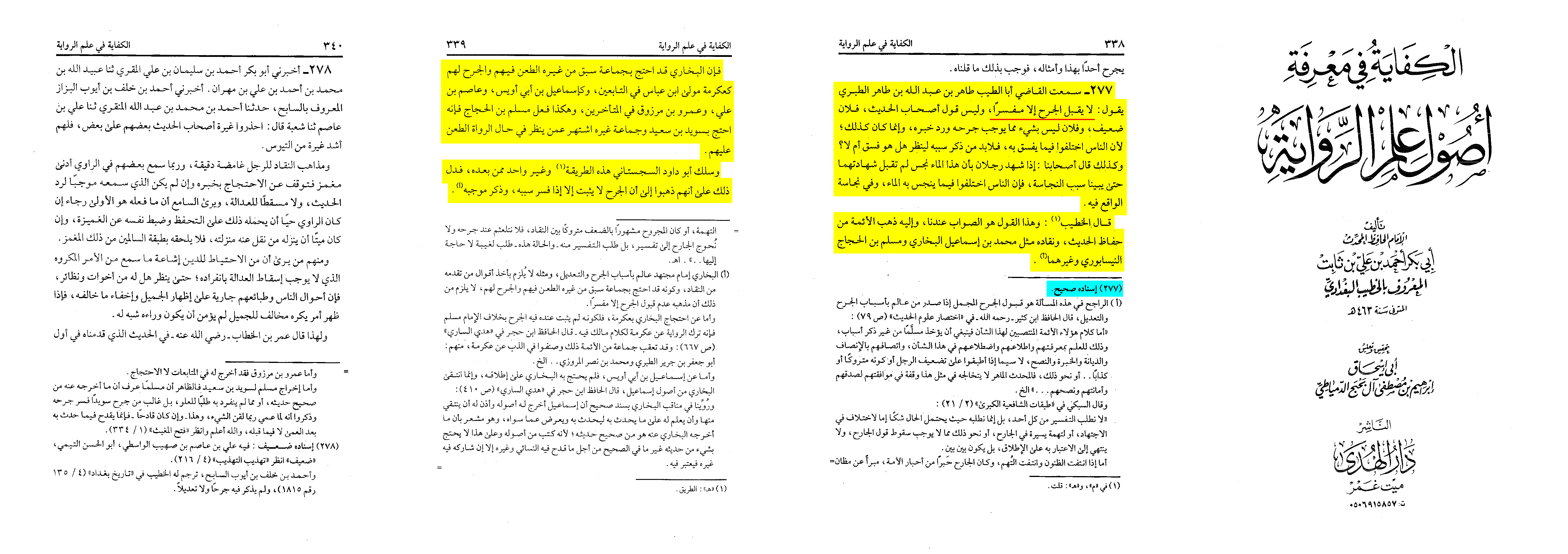
This was mentioned in al-Khatib al-Baghdadi’s al-Kifaya fi Usul Ilm al-Riwayah pg. 338 - 340, Report # 277:
The judge Abu al-Tayyib, Tahir b. Abd Allah b. Tahir al-Tabari, said: ‘Jarh is not accepted unless it is explained. The statement of the people of hadith, “So-and-so is weak,” and “So-and-so is nothing,” is not something that necessitates declaring him disparaged and rejecting his report. That is only because people differed regarding what causes fisq, so it is necessary to mention its reason, so that it may be examined whether it is fisq or not. [...]
Al-Khatib said: ‘This view is the correct one according to us, and to it went the imams from the hadith memorizers and its critics, such as al-Bukhari and Muslim and others besides them. For al-Bukhari relied upon a group of people against whom criticism and jarh had previously come from others, such as Ikrima, the mawla of Ibn Abbas, among the Tabiun, and such as Ismail b. Abi Uways, Asim b. Ali, and Amr b. Marzuq among the later ones.
Likewise Muslim b. al-Hajjaj did, for he relied upon Suwayd b. Said and a group besides him against whom criticism had become well known among those who examine the condition of narrators.
And Abu Dawud al-Sijistani followed this path, as did more than one after him. This indicates that they held that jarh is not established unless its reason is explained and its cause mentioned.’”
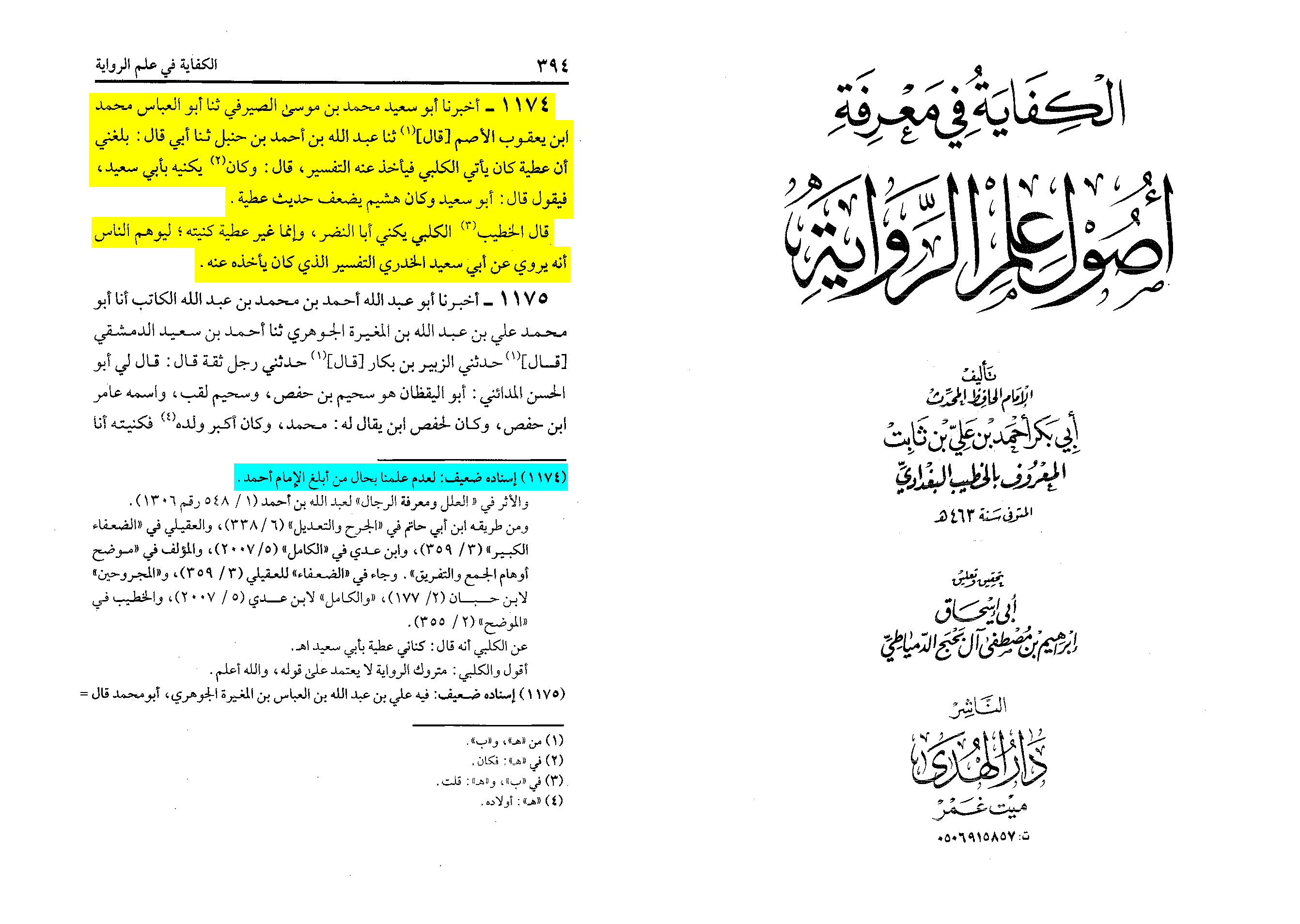
Now that we have established this principle, we now look into the reason for ‘Attiya’s weakening. The critics claimed he used to deceive about the source of his hadith. We read in al-Kifaya fi Usul Ilm al-Riwayah pg. 394, Report # 1174:
“Abu Sa‘id Muhammad b. Musa al-Sayrafi informed us: Abu al-‘Abbas Muhammad b. Ya‘qub al-Asamm narrated to us, saying: ‘Abd Allah b. Ahmad b. Hanbal narrated to us, saying: My father said:
‘It reached me that ‘Atiyya used to go to al-Kalbi and take tafsir from him. He would refer to him by the kunya Abu Sa‘id and say: “Abu Sa‘id said.” Hushaym used to weaken the hadith of ‘Atiyya.’
Al-Khatib said: ‘Al-Kalbi’s kunya was Abu al-Nadr. ‘Atiyya only changed his kunya in order to make people think that he was narrating the tafsir from Abu Sa‘id al-Khudri, whereas the tafsir was actually what he had taken from al-Kalbi.’”
The editor of the book commented:
“(1174) Its chain is weak because we do not know the condition of the person who conveyed it to Imam Ahmad.”
Ibn Hibban also recorded another reason for al-Kalbi’s weakening in Kitab al-Majruhin min al-Muhaddithin, Vol 2, pg. 168:
“I heard Makhul saying: I heard Ja’far b. Aban saying: I heard Ibn Numayr saying: Abu Khalid al-Ahmar said to me:
al-Kalbi said to me: Atiyya said to me: ‘Your kunya is Abu Said, so I say: “Abu Said narrated to us.”
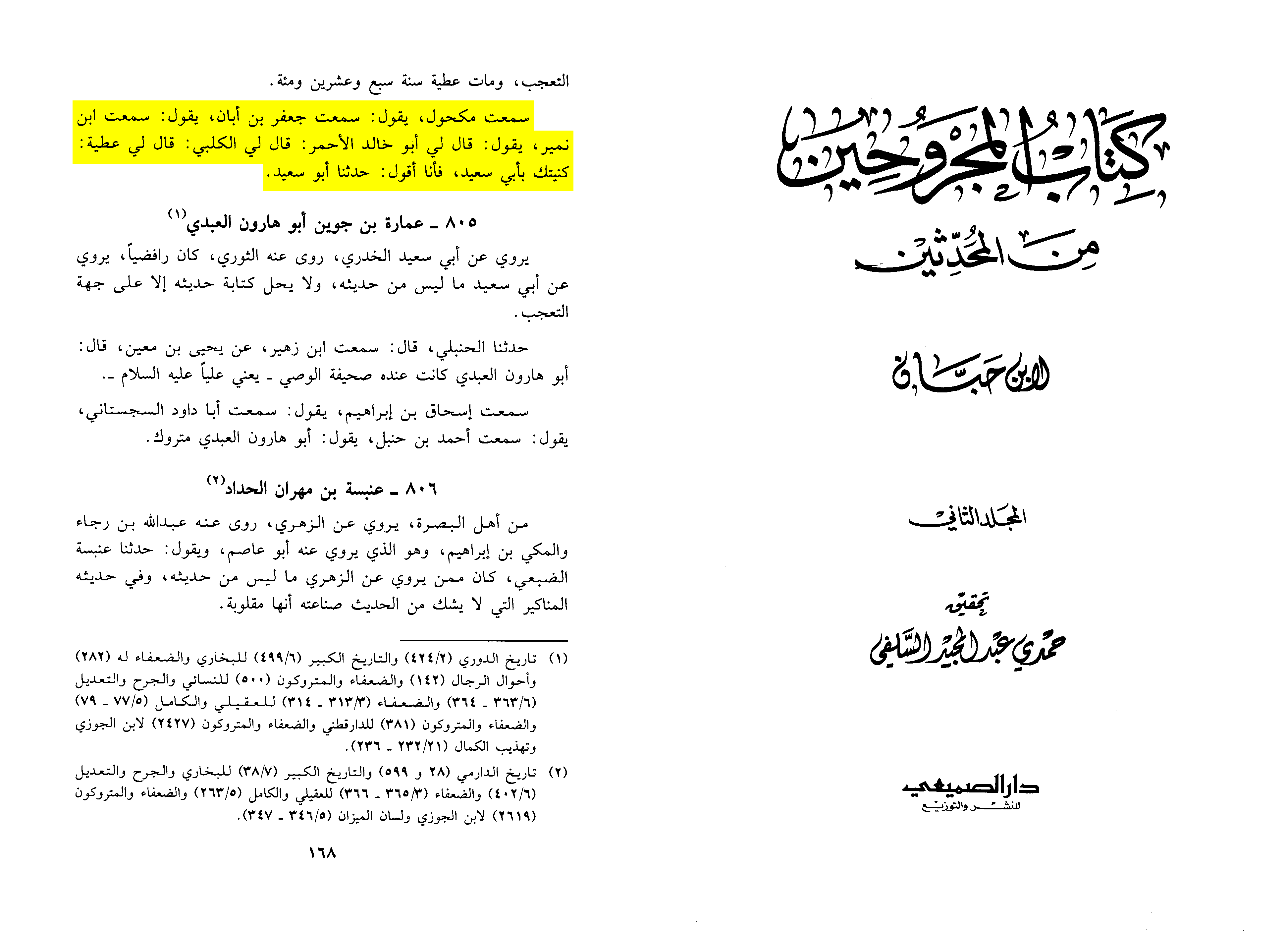
What is very interesting is the evidence that he did this comes from Muhammad b. al-Sa’ib al-Kalbi, who is considered a liar. So the weakening is based on the testimony of a liar, which is an invalid weakening and can not override the authentication of the other scholars such as:
Ibn Sa’ad: Thiqah with Salih hadiths in Tabaqat al-Kubra, Vol. 6, pg. 305.
Ibn Ma’in: Salih in Tarikh Ibn Ma’in by al-Dawri, Vol 1, pg. 259 & 280, Report # 2153 & 2446.
Al-Ijli included him in Marifat al-Thiqat Vol. 2, pg. 140 and said he is thiqah.
Al-Tirmidhi: Hasan al-Hadith per Ibn Hajar in Nataij al-Afkar, Vol. 1, pg. 267, and this is why al-Muhaqiq al-Nuhamisi concluded him to be ‘Saduq’ in the footnote of Emta al-Asma, Vol. 16, pg. 16 - 17.
Ibn Khuzayma also puts his narrations under his chapter of authentic ones in his Kitab al-Tawhid, pg. 852 - 853.
Allamah Ibn Shaheen included him in Asma al-Thiqat, pg. 172, and included another quote from Ibn Ma’in that there was no issue with him.
Ibn Hajar al-’Asqalani: Saduq in Taqrib al-Tahdhib, Vol. 1, pg. 680.
This is why Sheikh Mahmud Sa’id said in his book in Rafe al-Manara, pg. 215:
“And the summary of what has preceded is that Atiyyah al-Awfi was declared trustworthy by Yahya b. Sa’id al-Qattan, Ibn Sa’ad, Ibn Ma’in, al-Tirmidhi, al-Bazzar, and Ibn Shahin. Some of those who came after them followed them in this. Thus Ibn al-Qattan said (as found in Nasb al-Rayah 4/68): ‘Atiyyah al-Awfi has been weakened, but Ibn Main said regarding him: “Salih (acceptable/reliable).”
Therefore, the hadith is hasan (good).’ End quote.”
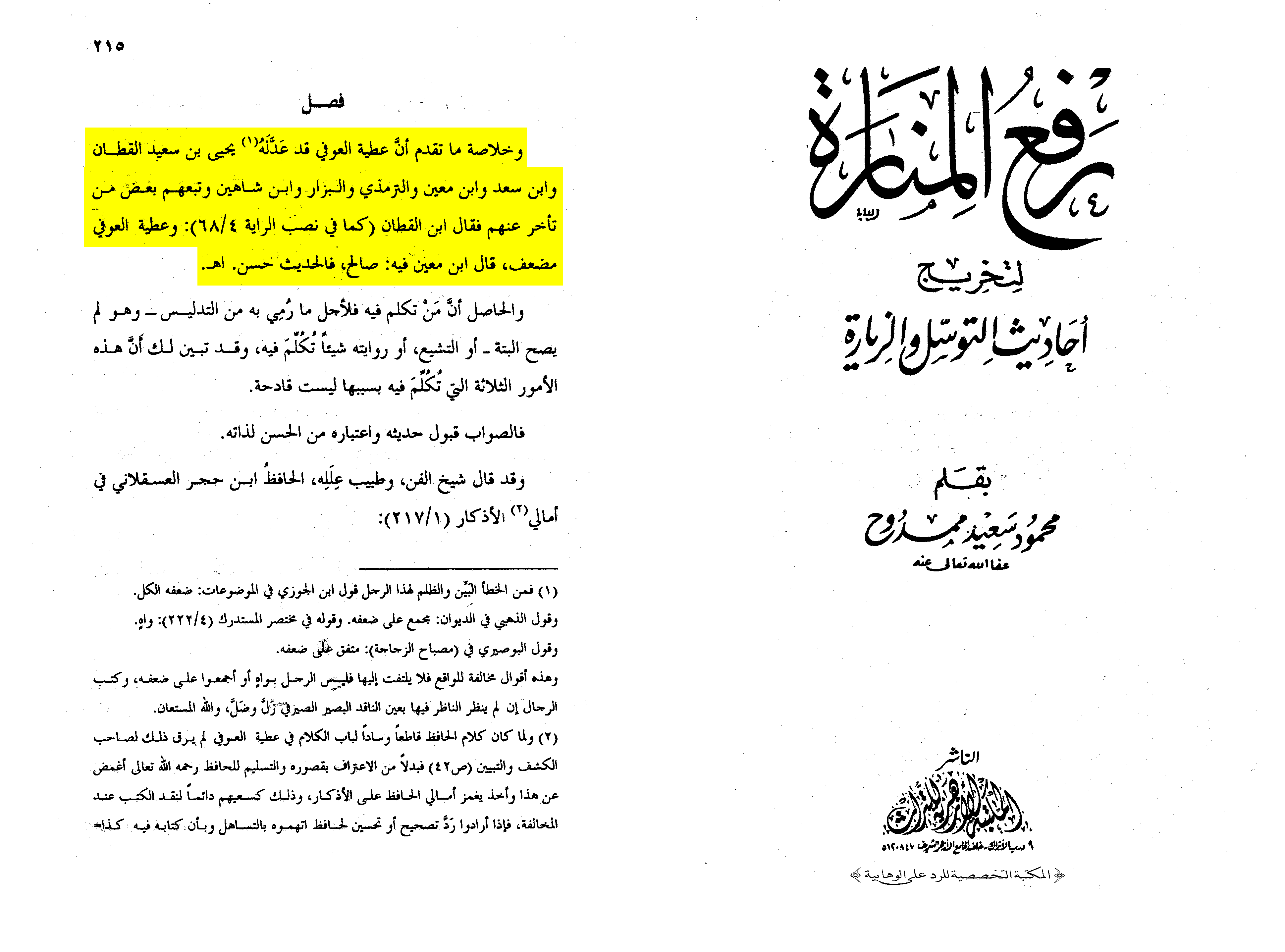
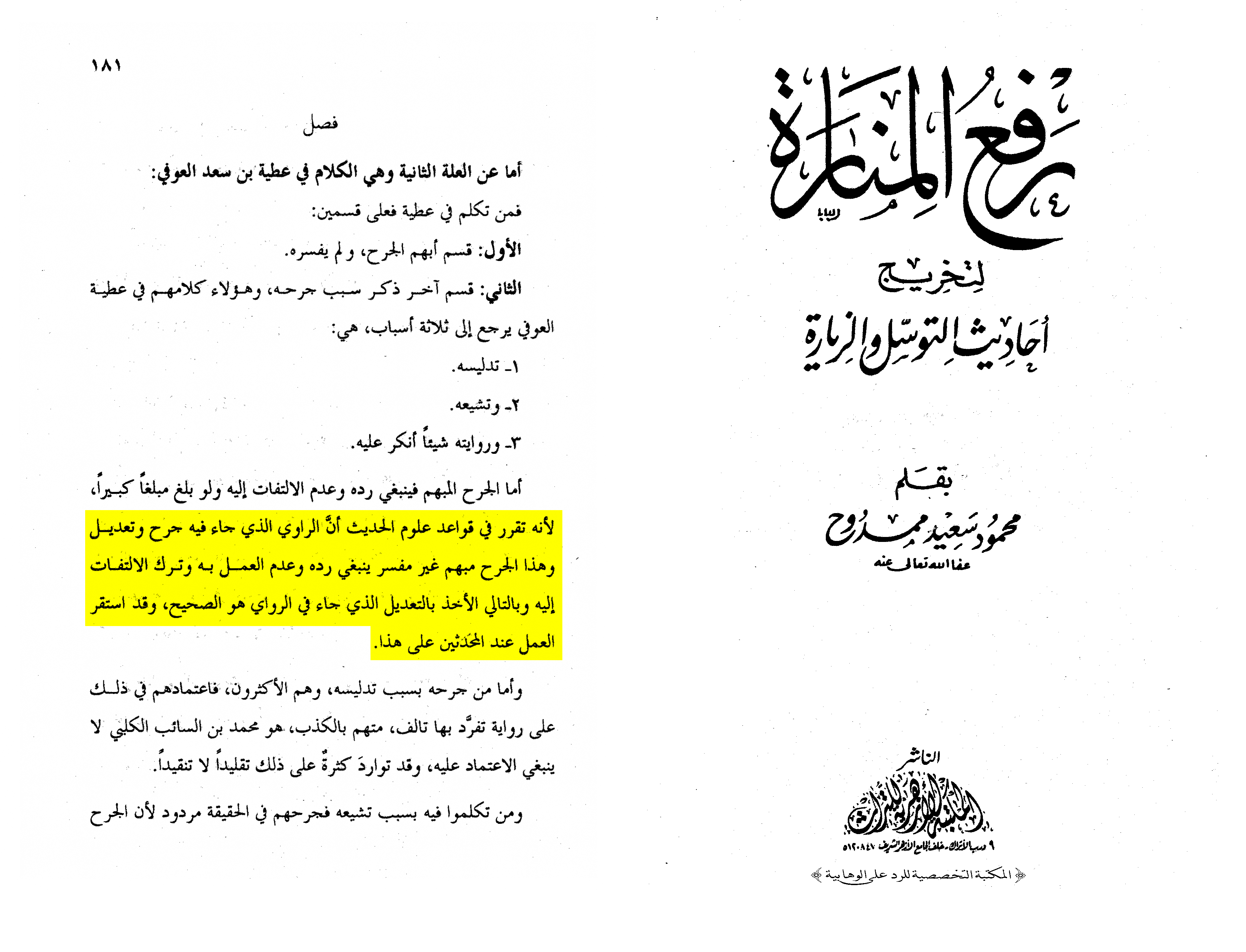
And most relevantly, on pg. 181 of the same book, we read:
“Because it has been established in the principles of the sciences of hadith that a narrator concerning whom both criticism and accreditation have been reported, and where the criticism is vague and unexplained, then that criticism should be rejected, not acted upon, and disregarded. Consequently, accepting the accreditation reported regarding the narrator is the correct position. This has become the established practice among the hadith scholars.”
Given ‘Attiya’s reliability, the hadith is authentic and it is established that Fadak was gifted during the lifetime of the Prophet (SAW), and therefore Abu Bakr stole it, regardless of whether or not Prophets (AS) leave behind inheritance.
The Witnesses who Testified for Fatima
The books of history preserve multiple reports where Fatima (AS) claimed Fadak was a gift from her father and brought forth witnesses to testify to this, namely her husband ‘Ali b. Abi Talib (AS), and Umm Ayman the servant of Rasulallah (SAW). Let us now review these reports.
The report of Musa b. ‘Uqba
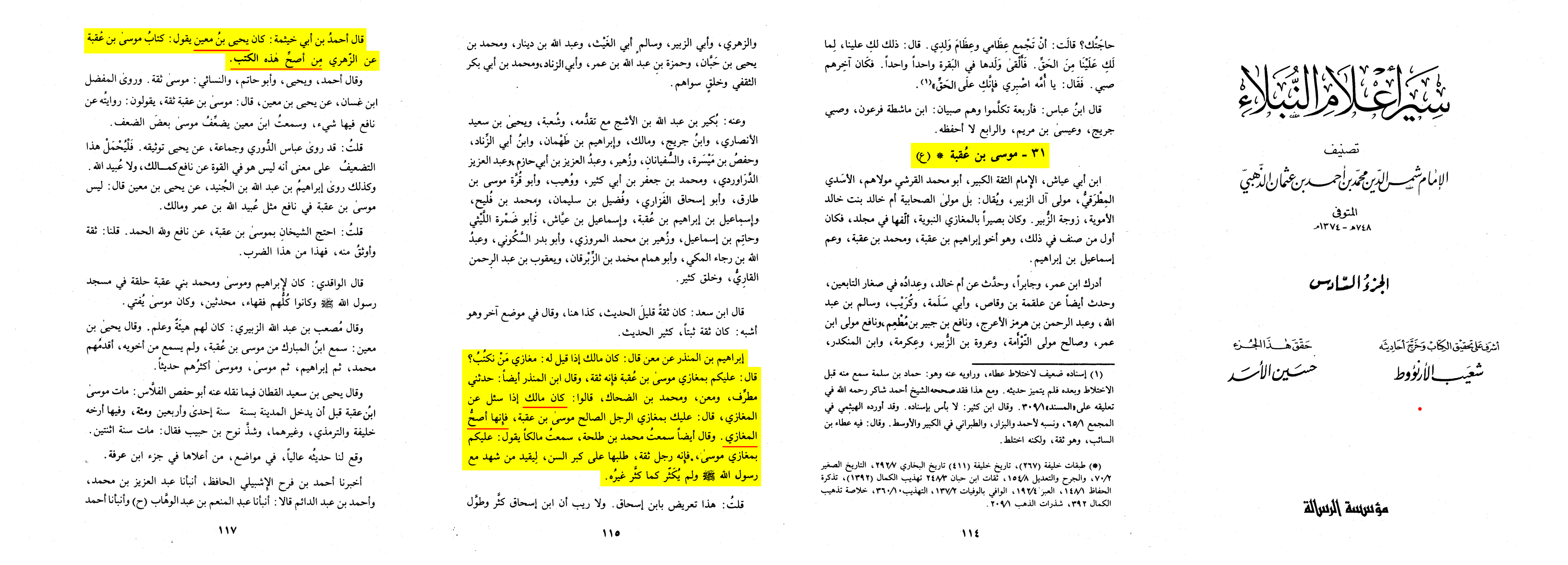
The first report comes to us by way of Musa b. Uqba, a prominent early historian held in high regard by the Sunnis. Musa b. ‘Uqba was the famous historian whose Kitab al-Maghazi was recently discovered. It was described by Malik and Ibn Ma’in as the most authentic book of Maghazi as reported by al-Dhahabi in Siyar A’lam al-Nubala, Vol. 6, pg. 114 - 115 & 117. This highlights that this report cannot be a Shi’a fabrication as Musa b. ‘Uqbah was absolutely not Shi'a leaning.
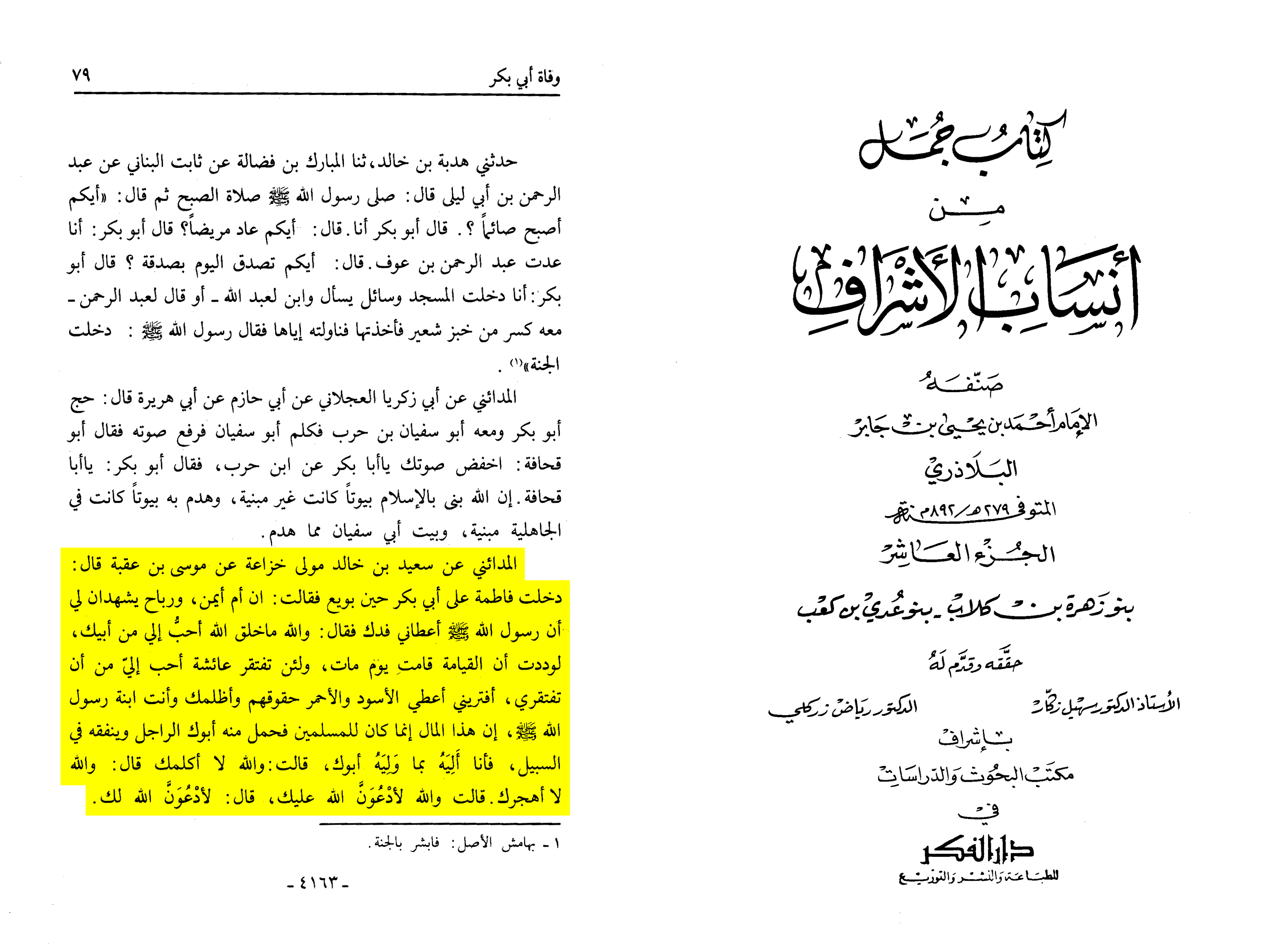
We read in Ansab al-Ashraf, Vol. 10, pg. 79:
Narrated Al-Mada'ini from Sa'eed ibn Khalid, servant of Khuza'a from Musa ibn Uqba who said:
Fatima (AS) entered upon Abu Bakr when he was paid allegiance, and she said: "Umm Ayman and Rabah bear witness for me that the Messenger of Allah (SAW) gave me the Fadak."
Abu Bakr said: “By Allah! There is no one more dear to me than your father, I wished the Judgment Day had happened in the day that he passed away, I prefer ‘Aisha to encounter poverty rather than your poverty, do you think I give every red and black their rights and I oppress you, while you are the daughter of the Messenger of Allah (SAW)? This wealth is for the Muslims. Your father used to appoint people over it and spent it for charity. I will do with it what your father did.”
Fatima (AS) replied: "By Allah! I will not speak to you!" He said: "By Allah! I will not leave speaking with you." She said: "By Allah! I will pray to Allah against you." He said: "But I will pray to Allah for you."
Fakhr al-Din al-Razi echoed this report in al-Tafsir al-Kabir Vol 15 pg. 247.
Here we see Fatima (AS) claim that this land was her property, not just inheritance, and brought witnesses yet Abu Bakr withheld it.
When confronted with this report, our opponents will argue that Musa b. ‘Uqba is not an eyewitness and that this report is disconnected. We remind them that according to Ibn Taymiyya, the disconnected reports of a prominent historian like Musa b. Uqba are more than acceptable.
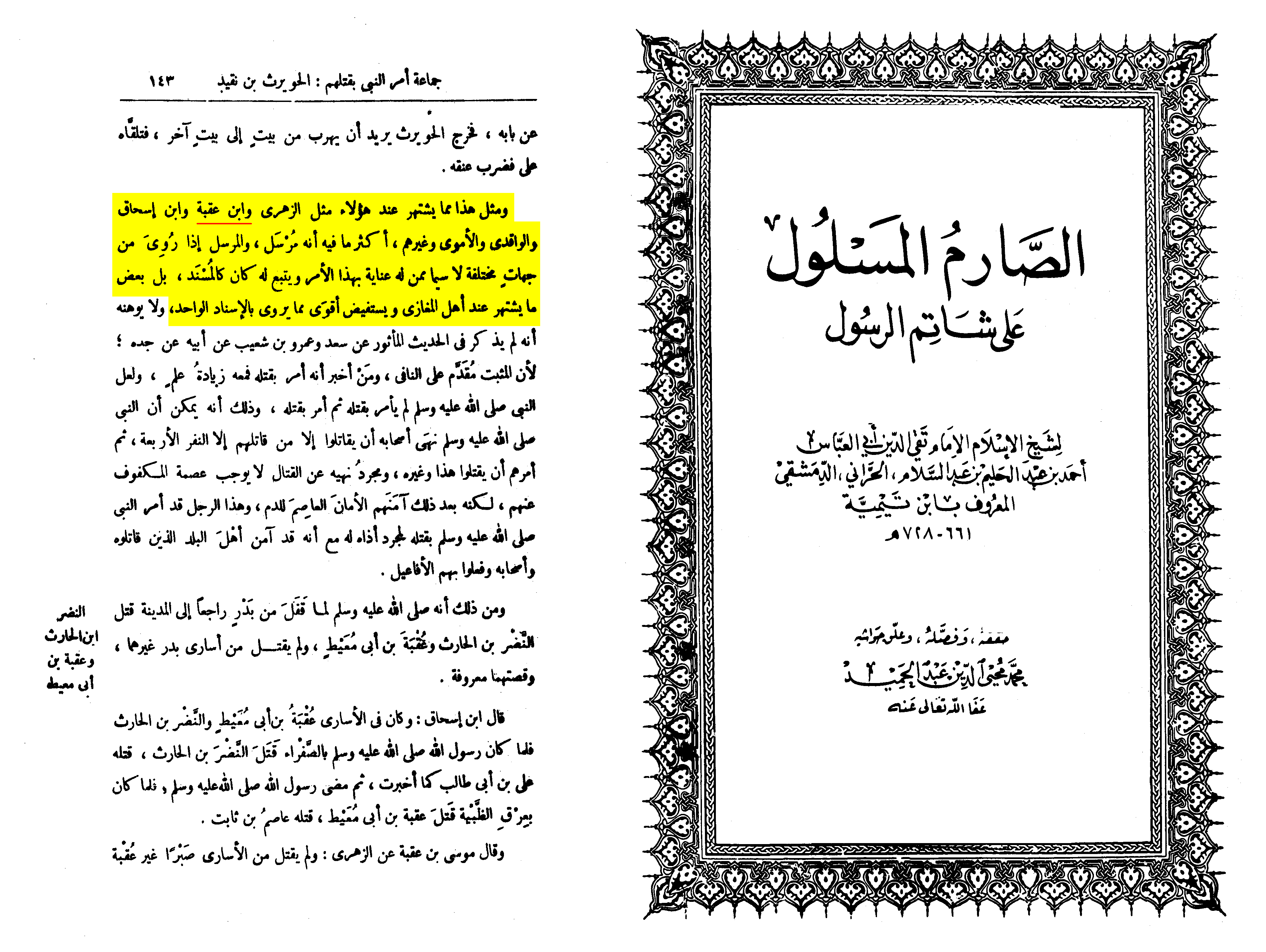
We read in al-Sarim al-Maslul pg. 143 by Ibn Taymiyyah:
And matters such as this, which are widely known among scholars like al-Zuhri, Musa b. ‘Uqba, Ibn Ishaq, al-Waqidi, al-Umawi, and others — the most that can be said about them is that they are mursal reports.
And when a mursal report is narrated through different routes, especially by those who are deeply concerned with and specialized in this field, it takes the status of a musnad report. In fact, some reports that become famous and widespread among the scholars of military expeditions are stronger than reports transmitted through a single chain.
The report of Zayd b. ‘Ali al-Shahid
Ibn ‘Uqbah’s report is at the very least corroborating evidence, especially when Fatima’s (AS) great grandson Zayd b. ‘Ali (AS) also transmitted the story as we shall present.
We see the following narrated authentically to him in the book of Tarikh al-Medina by Ibn Shabbah al-Numayri, a respectable high-ranking scholar. Al-Dhahabi recorded his biography in his Siyar A’lam al-Nubala. Vol 12, pg. 369. Bio # 158, and Ibn Hajar al-’Asqalani also affirmed his trustworthiness in his Taqrib al-Tahdhib, pg. 413. Bio # 4918.
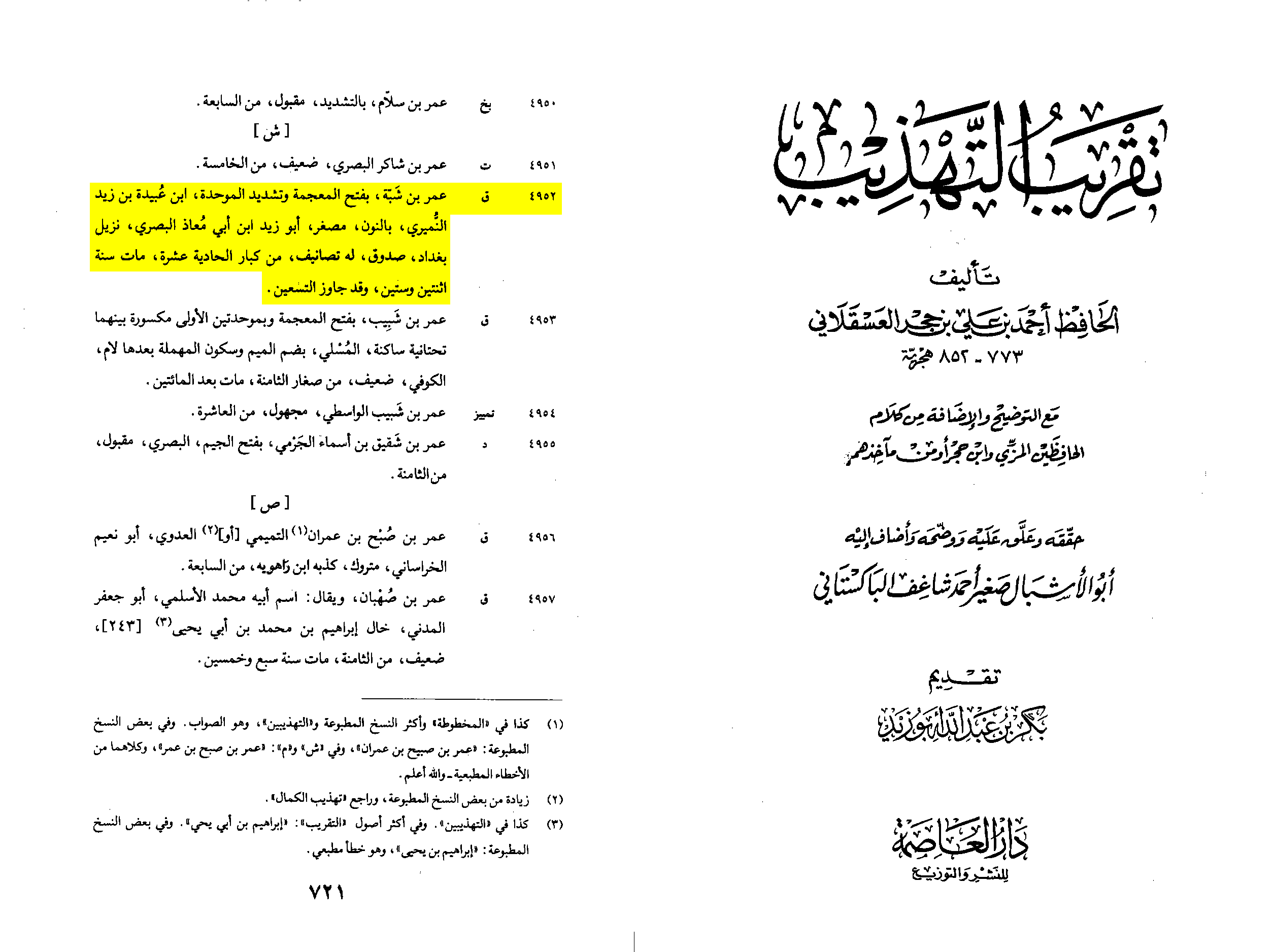
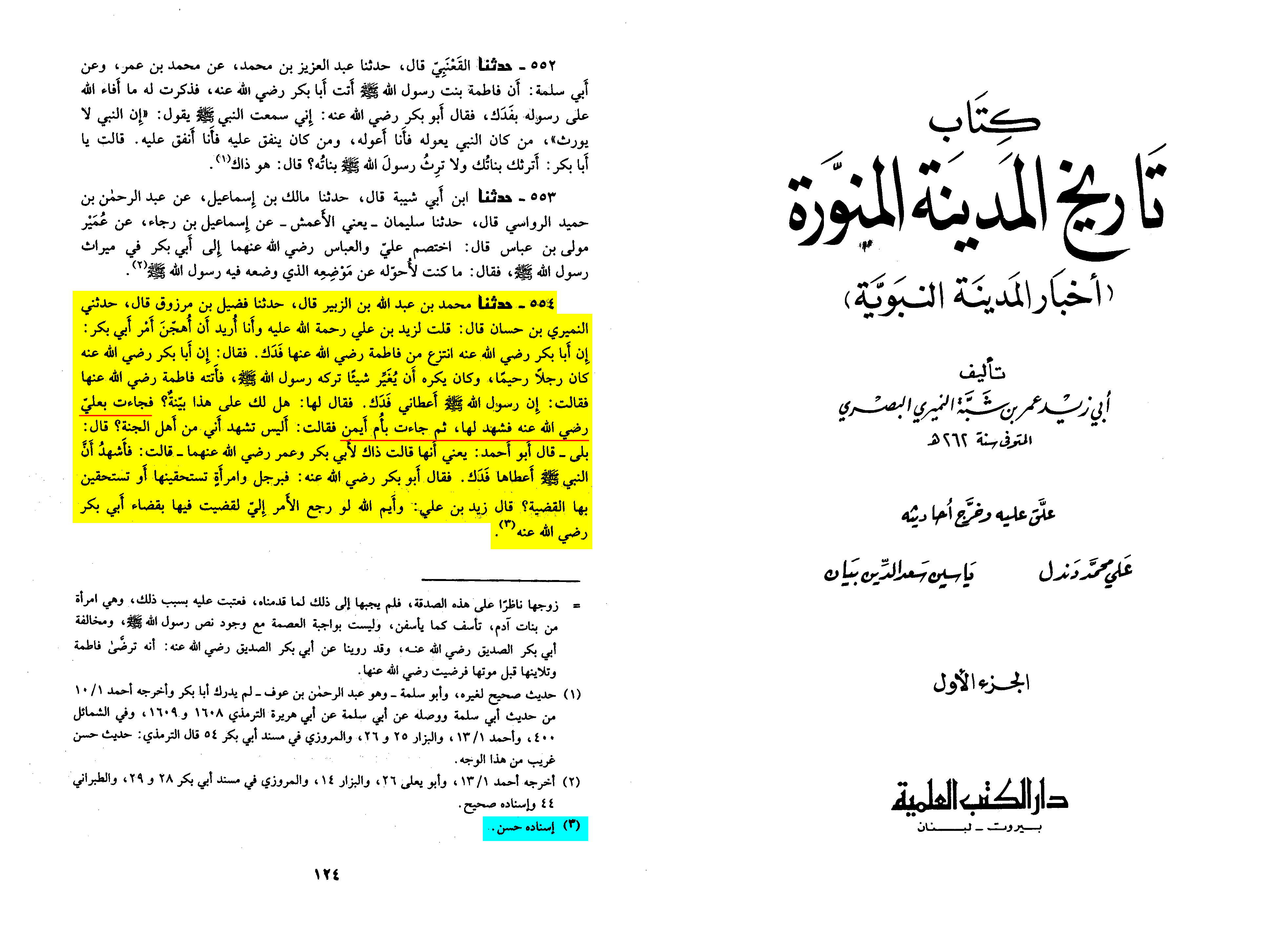
Ibn Shabbah reported in Tarikh al-Medina Vol. 1, pg. 124, Report # 554:
Muhammad b. Abdullah b. al-Zubayr from Fudhayl b. Marzuq from al-Numayri b. Hissan who said:
I said to Zayd b. ‘Ali and I wanted to know the truth about Abu Bakr, so I said: Abu Bakr took away Fadak, from Fatima (AS).
He said: Abu Bakr was a merciful man and he disliked to change the way the Prophet (saw) used to do things, then Fatima (AS) came to him and said: "The Messenger of Allah (SAW) gave me the Fadak."
So he said: "Do you have witnesses for this?" So she brought Ali (AS) and he bore witness for her. Then she brought Umm Ayman and she said: "Do you not bear witness that I am of the people of Paradise?" Abu Bakr said: "Yes."
(Abu Ahmad said: It means that she said it to Abi Bakr and Umar.) Then she (Umm Ayman) said: "So I bear witness that the Prophet (SAW) gave her Fadak.” Abu Bakr said: "With the testimony of a man and woman you cannot win this."
Zayd (AS) said: "By Allah (swt)! If the judgment returned to me I would have judged the same way Abu Bakr did."
The chain of transmission is reliable back to Zayd (AS). However, Sunnis would try to claim the report is disconnected as Zayd did not witness this report. This, however, is an invalid argument.
Is this report disconnected?
When our opponents are confronted with this tradition, they are now left to deal with the fact that three sahaba testified that the Prophet (SAW) gave Fatima the land of Fadak. Thus, they are forced to try to weaken this report, and the easiest defense they can bring forth is the issue of Zayd b. ‘Ali (AS) not being present when this incident occurred.
We appeal to reason, where would Zayd have gotten this information from if not from his blessed ancestors? When a man narrates to you about his great grandmother and he is known to be an honest man, the immediate assumption is that he is narrating from his ancestors, so why is the same assumption not applied to Zayd?
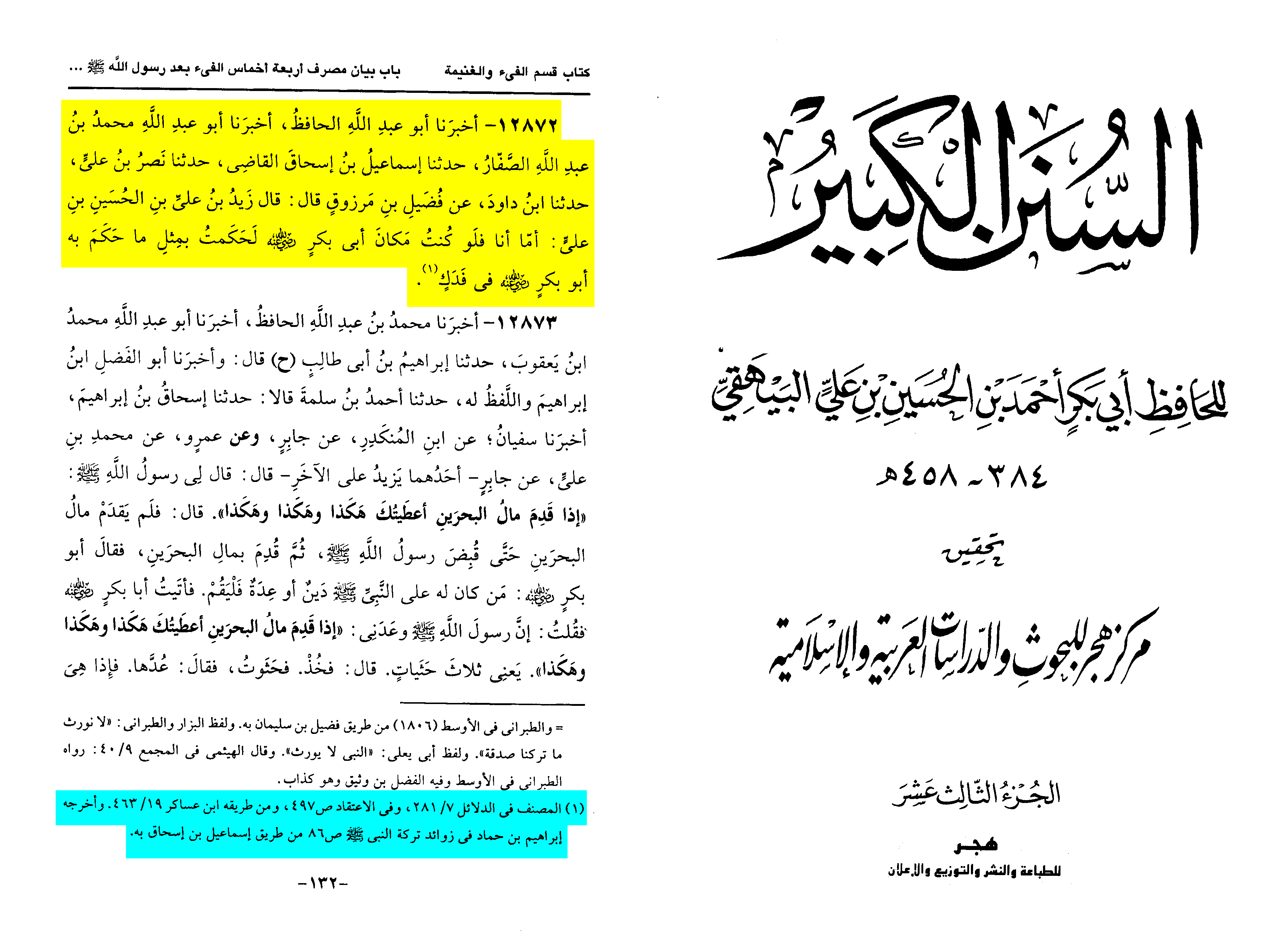
In fact, Sunni scholars have cited this same report to exonerate Abu Bakr! We read in Sunan al-Bayhaqi, Vol. 13, pg. 132, Hadith # 12872:
Abu Abd Allah al-Hafiz informed us: Abu Abd Allah Muhammad b. Abd Allah al-Saffar informed us: Ismail b. Ishaq al-Qadi narrated to us: Nasr b. ‘Ali narrated to us: Ibn Dawud narrated to us from Fudayl b. Marzuq, who said:
Zayd b. ‘Ali b. al-Husayn b. ‘Ali said: ‘As for me, had I been in the position of Abu Bakr, I would have judged regarding Fadak with the same judgment that Abu Bakr gave concerning it.’”
Ibn Kathir not only transmitted this tradition from al-Bayhaqi in al-Bidaya wa al-Nihaya Vol. 8, pg. 196, but he went so far as to use it as evidence to argue that the Ahl al-Bayt agreed with Abu Bakr’s position, as he prefaces the report with:
“And the scholars of the Ahl al-Bayt themselves acknowledged the correctness of what Abu Bakr ruled in that matter…”
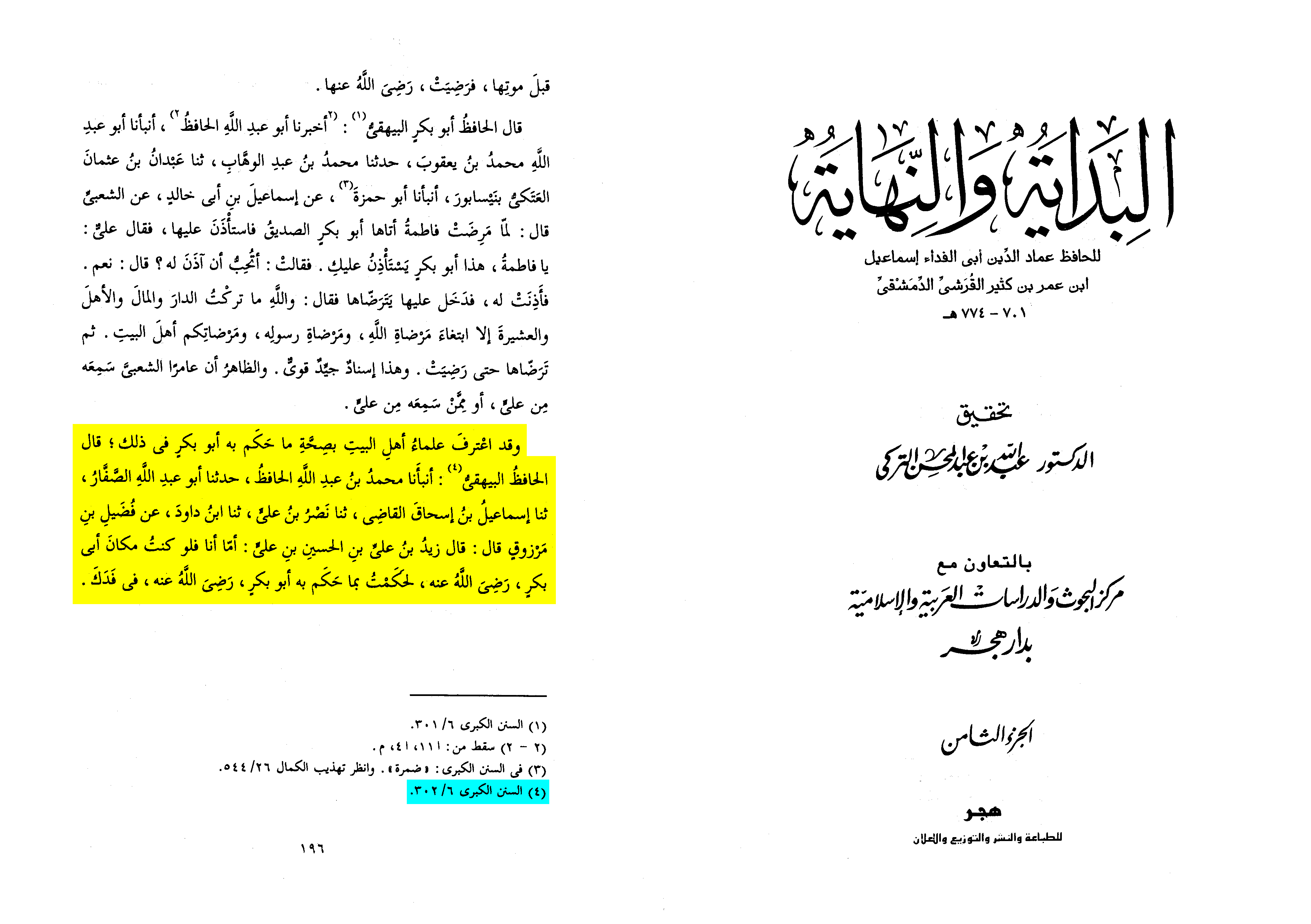
We note for our readers that we the Shia do not accept this attribution to Zayd al-Shahid. This is an example of our adversaries manipulating the words of Zayd (AS) to match their narrative, but in transmitting that Fatima (AS) brought forth witnesses they have shot themselves in the foot.
Thus we see that our opponents are more than willing to accept the “disconnected” traditions of Zayd al-Shahid (AS) when it backs their position.
The report of Ja’far al-Sadiq (AS)
We also read in Al-Baladhuri's Futuh al-Buldan pg. 26:
Rawh al-Karabisi narrated to me, he said: Zayd b. al-Habbab informed us, he said: Khaled b. Tahman informed us, from a man who deemed reliable by Rawh, (that) Ja'far b. Muhammad (AS) said:
Fatima said to Abu Bakr al-Siddiq, "Give me my share that the Messenger of Allah allocated for me."
He asked her for evidence, so she brought Umm Ayman and Rabaah, a freed slave of the Prophet, as witnesses. They testified to that.
Abu Bakr said, "In this matter, the testimony of a man and two women is not permissible."
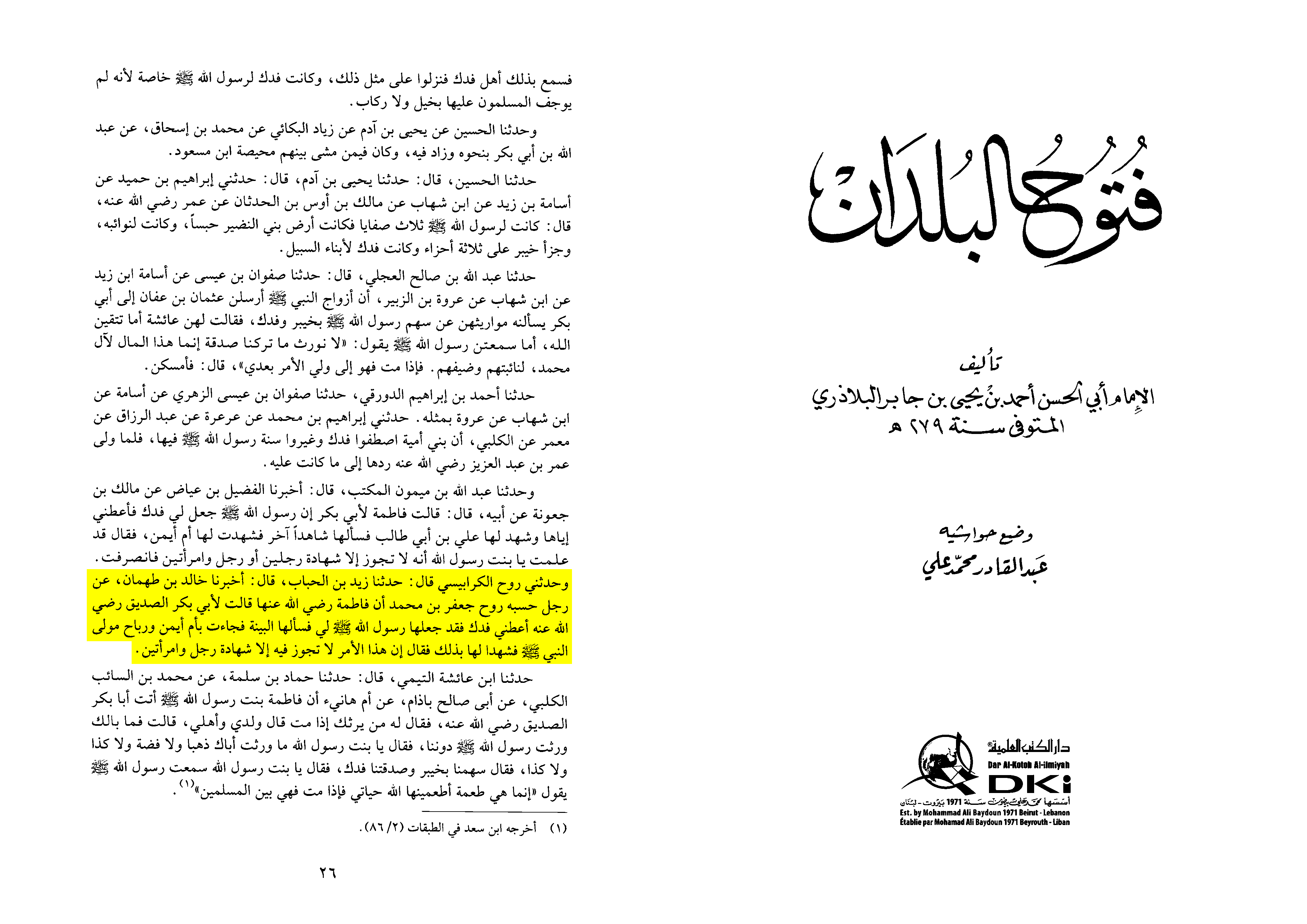
Yaqut al-Hamawi echoed this report in Mu’jam al-Buldan, Vol 4 pg. 270 - 272.
The chain of this report is reliable, and once again the chain of Imam al-Sadiq (AS) for this report is through his ancestors. For more information on this matter, refer to our article: Do Shia Hadiths come from the Prophet?
The report of ‘Umar b. al-Khattab
There is even a report from Abu Bakr’s right hand man ‘Umar testifying that Fatima (AS) brought witnesses to support her case, as narrated in Tabaqat Ibn Sa’ad, Vol 2, pg. 241:
Narrated by Muhammad b. ‘Umar, reported by Hisham b. Sa’ad from Zayd b. Aslam, from his father, he said: I heard ‘Umar saying,
"When the day the Messenger of Allah (SAW) passed away, Abu Bakr was appointed as the leader on that day. The next day, Fatimah came to Abu Bakr with ‘Ali, and she said, 'My inheritance from the Messenger of Allah!'
Abu Bakr asked, 'From the estate or from the necklace?'
She replied, 'The Fadak, Khaybar, and his charity in Medina, I inherit it as your daughters inherit from you when you die!'
Abu Bakr said, 'By Allah, your father is better than me, and you are better than my daughters. The Messenger of Allah said, 'We, the prophets, do not leave any inheritance, what we leave behind is charity.' Do you know that your father gave it to you?'
She replied, 'Umm Ayman informed me that he (the Prophet) gave me Fadak.' He asked, 'Did you hear him say it's for you?' She said, 'Yes.'
He said, 'If you have heard him say it's for you, then it's yours. I believe you and accept your words.' She said, 'I have informed you of what I have.'"
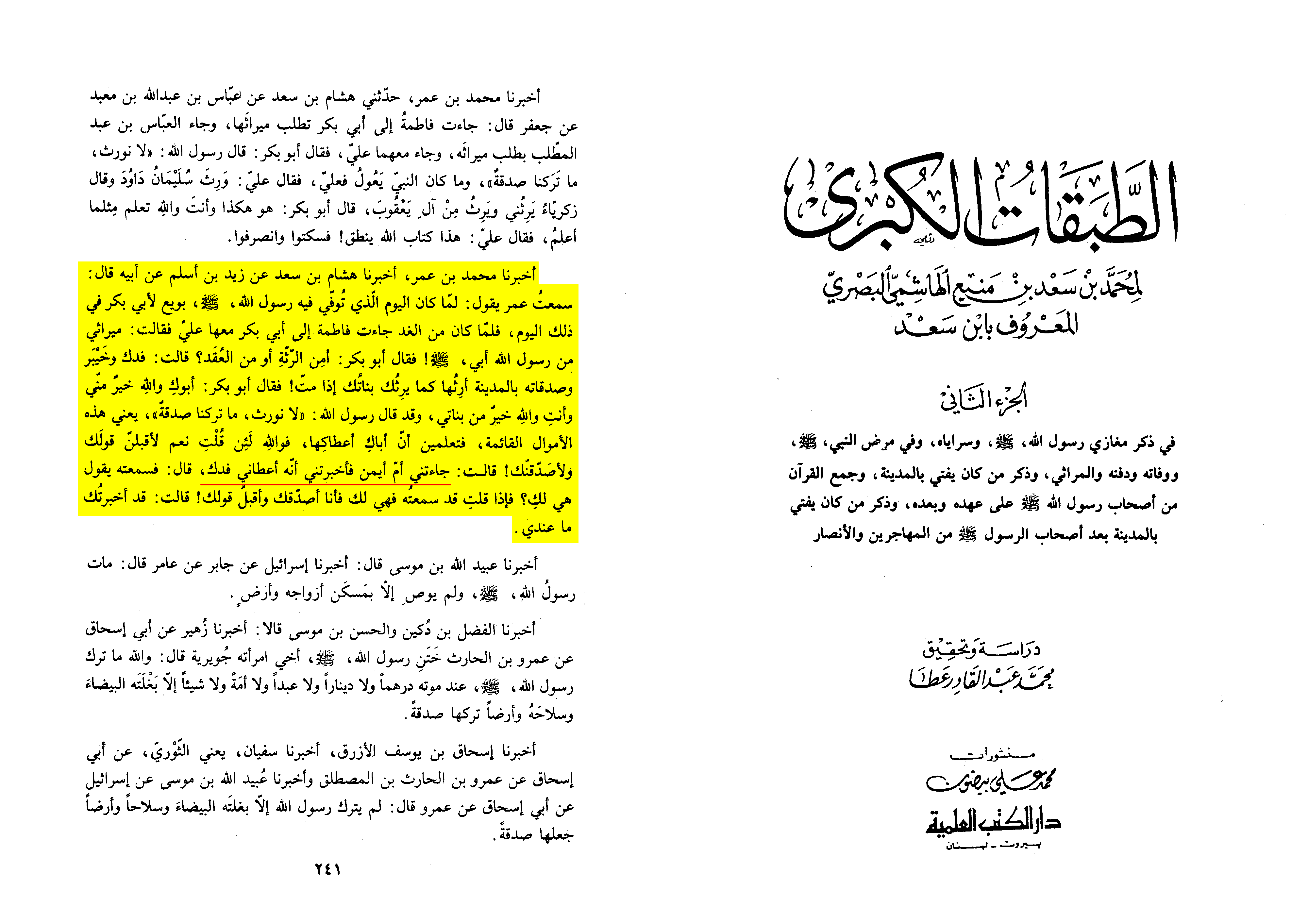
All the narrators are reliable except al-Waqidi, who is a controversial narrator. Nonetheless, his reports in history are valuable and can’t be dismissed. Read more about this in our article: The Historical Methodology
The report of ‘Ubayd Allah b. ‘Umar b. Musa al-Taymi
Abu Ahmad narrated from al-Jawhari from Muhammad b. Zakariya from Ibn A'isha, and from his father from his uncle, who said:
“Ali and Umm Ayman testified before Abu Bakr that the Prophet (SAW) had allocated a share for Fatima…”
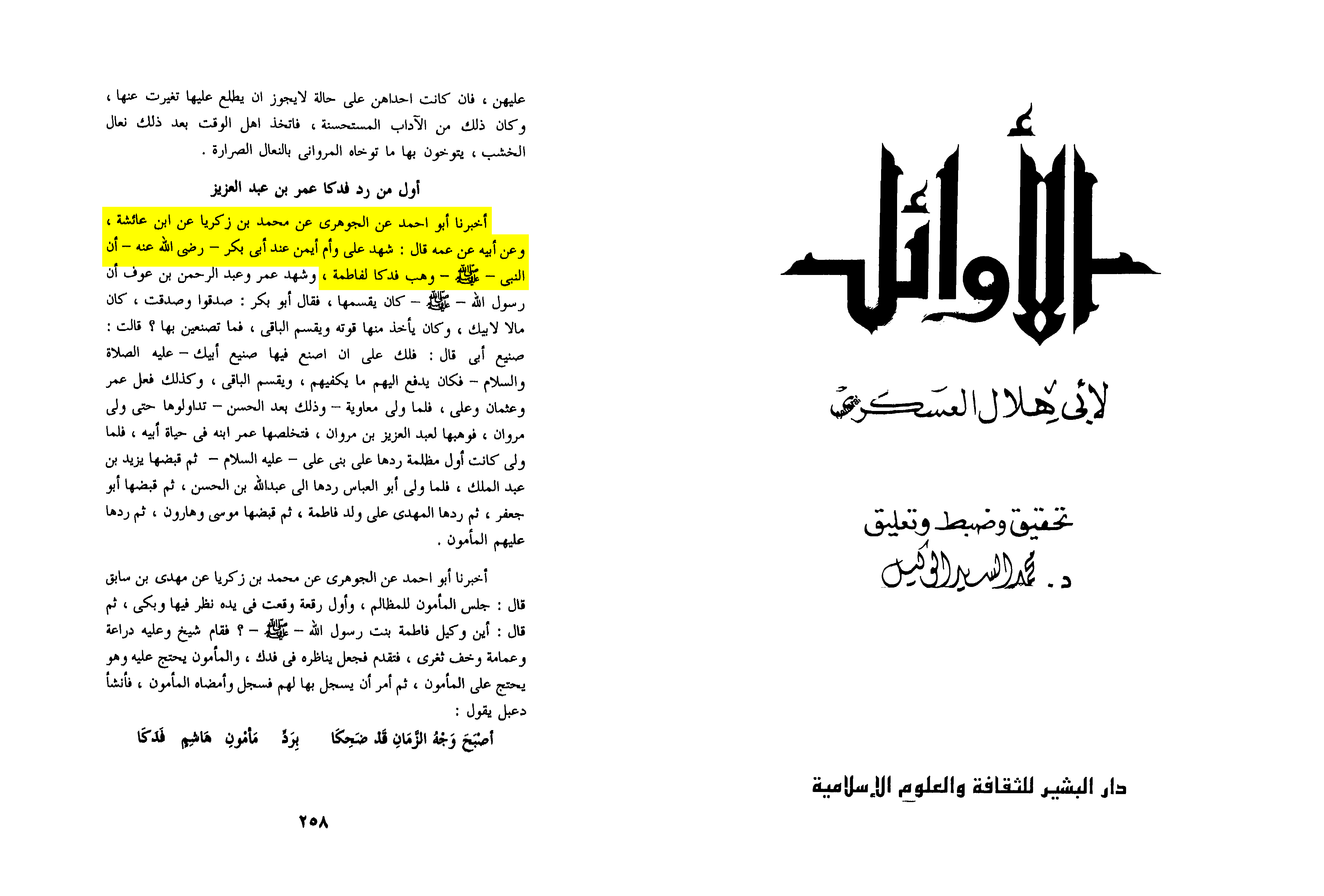
Ubayd Allah b. Umar al-Taymi has been mentioned in al-Jarh wal Ta‘dil by Ibn Abi Hatim al-Razi, Vol. 5, pg. 390, Bio # 8880 and in al-Tarikh al-Kabir by al-Bukhari, Vol. 6, pg. 518, Bio # 7282 without any criticism. It is famous that the silence of Bukhari & Ibn Abi Hatim on a narrator is proof for their ta’dil.
As for al-Jawhari, it suffices for his reliability that he is the sole transmitter of Umar b. Shabbah’s book, which was depended upon by all major scholars such as Ibn Hajar al-Asqalani, thereby proving his reliability.
The report of Malik b. Ja’unah’s father
Al-Baladhuri reported in Futuh al-Buldan pg. 26:
Abdullah b. Maymun al-Maktab narrated to us, saying: al-Fudhayl b. Iyad informed us, from Malik b. Ja'unah, from his father, who said:
Fatima said to Abu Bakr, "The Messenger of Allah ﷺ assigned Fadak to me, so give it to me."
‘Ali b. Abi Talib testified for her, but he [Abu Bakr] asked her for another witness. Umm Ayman then testified for her.
He replied, "I am aware, O daughter of the Messenger of Allah, that the testimony of only two men or one man and two women is valid."
So, she left.
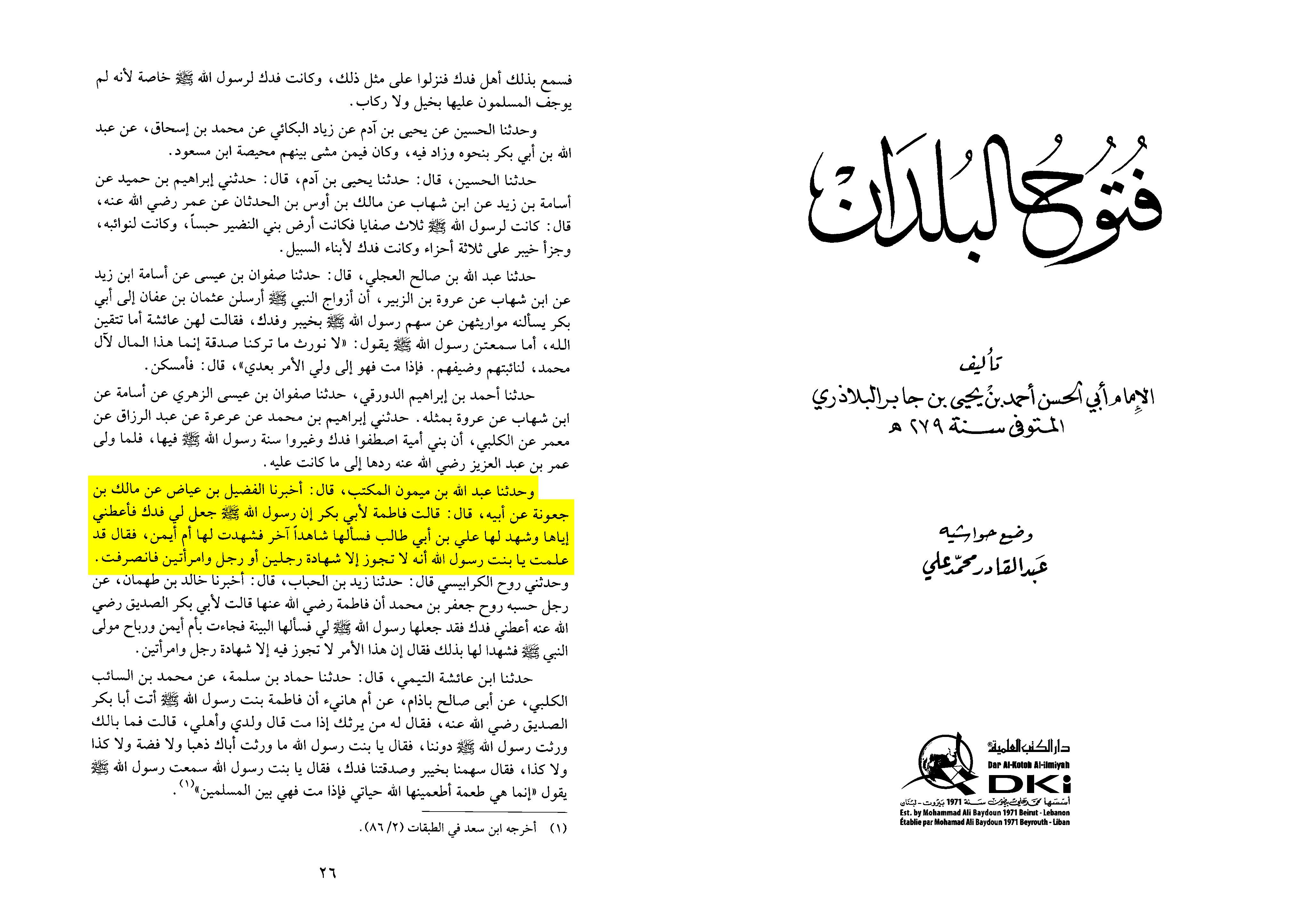
While this chain may not be reliable, it serves as historical corroboration to our other reports.
Al-Ma’mun al-Abbasi attests to the validity of Fatima’s claim
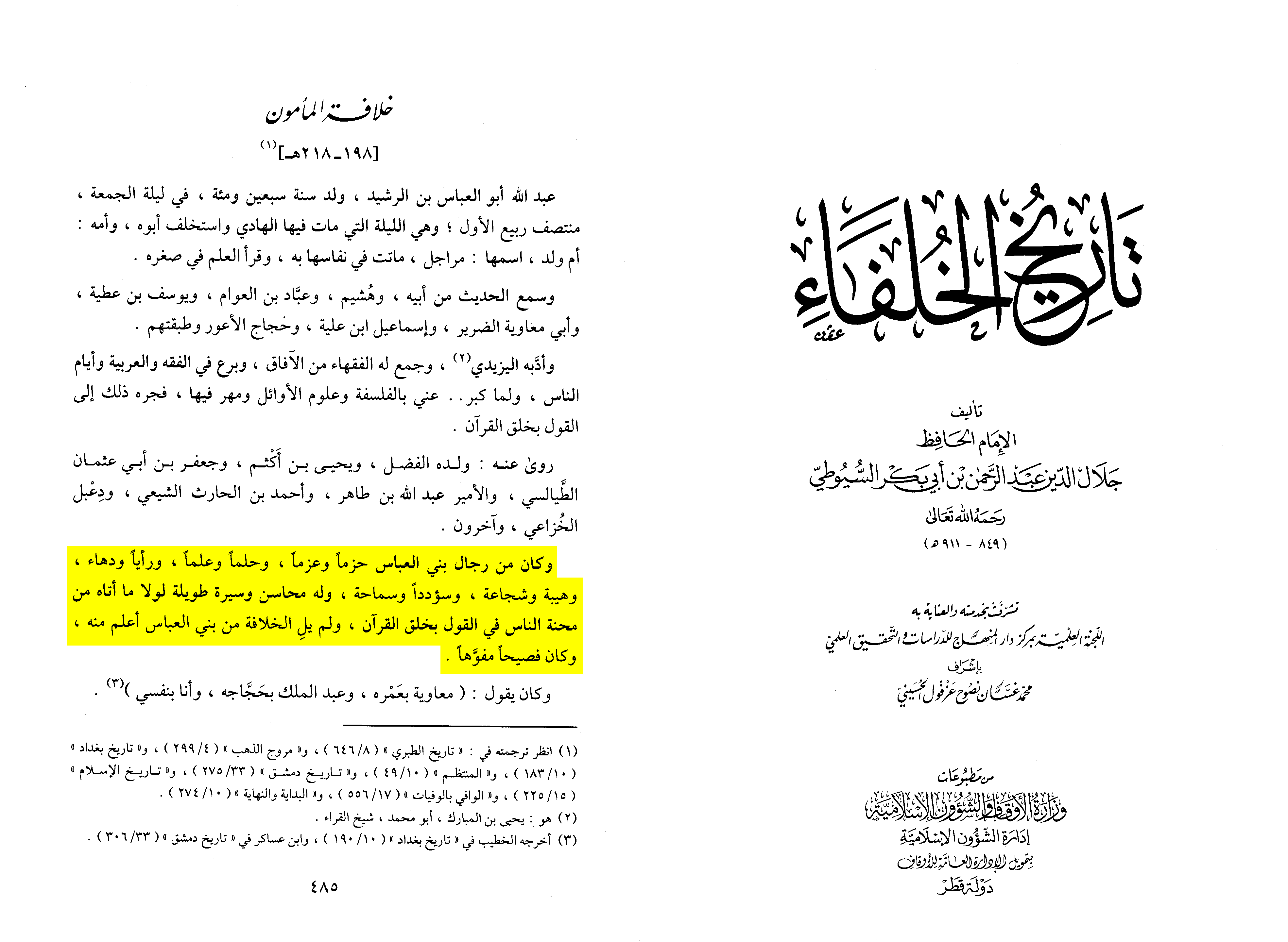
Before we present the next source, we would like to remind our readers that al-Ma’mun was no ordinary king like most of the Umayyad and Abbasid caliphs. He was an intellectual with profound knowledge of the Quran and Hadith as well as history as attested by al-Suyuti in Tarikh al-Khulafa, pg. 485:
“He (al-Ma’mun) was among the men of Banu al Abbas in firmness and determination, forbearance and knowledge, judgment and cunning, prestige and courage, leadership and generosity.
He possessed many virtues and a long record of conduct, were it not for what he brought upon the people through the ordeal regarding the doctrine of the createdness of the Quran. None among Banu al Abbas who assumed the caliphate was more knowledgeable than him, and he was eloquent and highly articulate.”
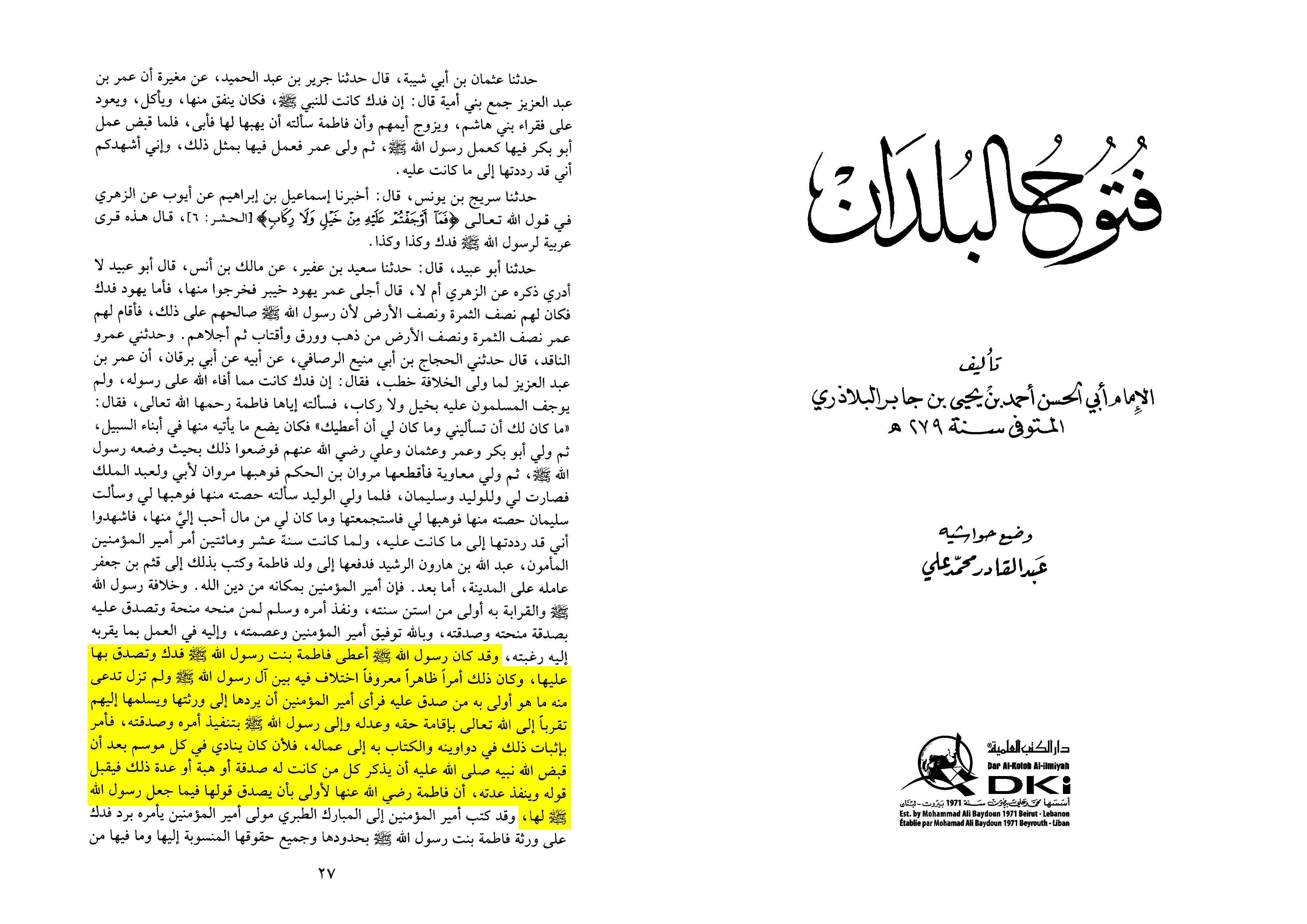
Al-Baladhuri also reported that al-Ma’mun acknowledged that the Ahl al-Bayt in his time were in agreement that the Prophet (SAW) had granted Fatima. We read in Futuh al-Buldan, pg. 27:
“And the Messenger of Allah (SAW) had granted Fadak to Fatimah, the daughter of the Messenger of Allah (SAW), and donated it to her. This was a manifest and well-known matter over which there was no disagreement among the family of the Messenger of Allah (SAW). She continually laid claim to what she had the greatest right to among that which had been granted to her.
So the Commander of the Faithful considered it proper to restore it to her heirs and hand it over to them, seeking nearness to Allah Most High through establishing His right and justice, and seeking nearness to the Messenger of Allah through carrying out his command and charity.
Thus he ordered this to be recorded in the official registers and letters to be sent regarding it to his governors. For if, after Allah took His Prophet (SAW), it would be proclaimed during every pilgrimage season that anyone who had been given a charity, gift, or promise should come forth and his statement would be accepted and his claim fulfilled, then surely Fatimah was even more deserving that her word be accepted concerning what the Messenger of Allah (SAW) had granted her.”
Was Abu Bakr correct in rejecting Fatima’s witnesses?
When Fatima (AS) produced her two witnesses, Abu Bakr rejected them, claiming that two women and one man are not enough to rule in her favor on this case.
To refute Abu Bakr here, let us examine this case. Firstly, Fatima (AS) is the plaintiff and Abu Bakr is not only the defendant, but he is also the judge. We ask our readers, is this just? How can Abu Bakr be the judge in the dispute when he is also one of the litigants?
There is a famous legal principle called nemo judex in causa sua (no one should be a judge in their own cause) and it prohibits anyone from adjudicating a dispute where they have a personal interest.
Abu Bakr contradicted the sunnah in rejecting the witnesses
One can act on the basis of a single truthful testimony, and this was from the Sunnah of Rasulullah (SAW).
Ibn Abbas records that the Prophet acted on a single witness in Sahih Muslim 1711b, Abu Hurayra also says that in Sunan Abi Dawud 3608 and so does Jabir b. ‘Abdullah al-Ansari in Sunan Ibn Majah 2369.
Imam al-Sadiq (AS) records that the Prophet (SAW) acted on a single witness in Imam Malik’s Muwatta, Hadith # 1409.
Jami` at-Tirmidhi 1345 and Musannaf Ibn Abi Shayba. Vol. 12, pg. 520 - 521, Hadith # 24498 likewise mention that the Prophet (SAW) acted on an oath and a witness, and that Imam ‘Ali (AS) did so as well in Kufa.
Al-Daraqutni affirmed the above in his Sunan al-Daraqutni, Vol. 5, pg. 378 - 379 and pg. 380.
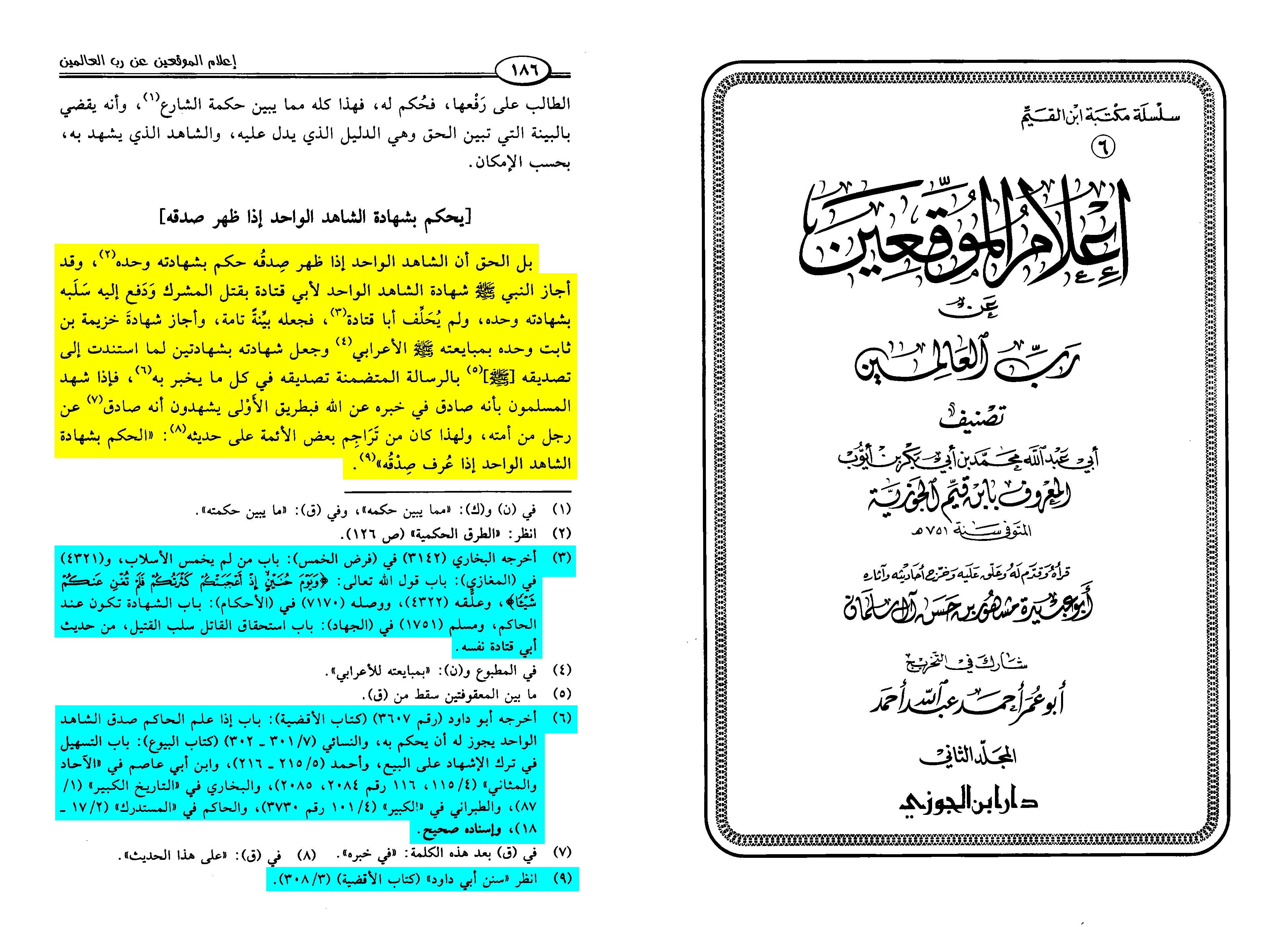
This is why the scholars of Ahl al-Sunnah have ruled as Ibn al-Qayyim al-Jawzi said in I'lam al-Muwqi’in, Vol 2. pg. 186:
“Rather, the truth is that if the truthfulness of a single witness becomes apparent, judgment may be made based on his testimony alone.
The Prophet (SAW) accepted the testimony of a single witness for Abu Qatadah regarding the killing of the polytheist and handed over to him the spoils taken from him on the basis of his testimony alone, and he did not require Abu Qatadah to swear an oath. Thus he treated it as complete proof.
And he accepted the testimony of Khuzaymah b. Thabit alone regarding the Prophet’s transaction with the Bedouin, and made his testimony equal to that of two men because it was founded upon his affirmation of the Messengerhood, which necessitated affirming him in everything he reported.
So if the Muslims testify that he is truthful in what he reports from Allah, then with even greater reason they testify that he is truthful regarding a man from his Ummah. For this reason, some of the chapter headings used by the Imams regarding this hadith were: ‘Judging by the testimony of a single witness when his truthfulness is known.’”
The famous story of Khuzayma b. Thabit (RA) has the Prophet (SAW) ruling his testimony to be as that of two because of his truthfulness; Sunan Abi Dawud 3607:
The Prophet (SAW) stopped when he heard the call of the Bedouin, and said: Have I not bought it from you? The Bedouin said: I swear by Allah, I have not sold it to you. The Prophet (SAW) said: Yes, I have bought it from you. The Bedouin began to say: Bring a witness. Khuzaymah b. Thabit then said: I bear witness that you have bought it. The Prophet (SAW) turned to Khuzaymah and said: On what (grounds) do you bear witness? He said: By considering you trustworthy, Apostle of Allah (SAW)! The Prophet (SAW) made the testimony of Khuzaymah equivalent to that of two people.
This tradition can also be found in al-Mustadrak ‘ala al-Sahihain. Vol. 2 pg. 21 - 22, Hadith # 2187 - 2188 graded Sahih by al-Dhahabi.
This is why Sunni fiqh actually allows single testimonials in matters of court cases.
In another report, Marwan b. al-Hakam ruled on the basis of the single testimony of Ibn ‘Umar; Sahih al-Bukhari 2624:
The sons of Suhaib, (Suhaib, who was the freed slave of Bani Jud'an) claimed that Allah's Messenger (ﷺ) had given two houses and one room to Suhaib. Marwan asked, "Who will testify to your claim?" They replied that Ibn 'Umar would do so. Marwan sent for Ibn 'Umar who testified that Allah's Messenger (ﷺ) had really given Suhaib two houses and a room. So, Marwan gave the verdict (in favour of Suhaib's sons), because of (Ibn 'Umar's) witness.
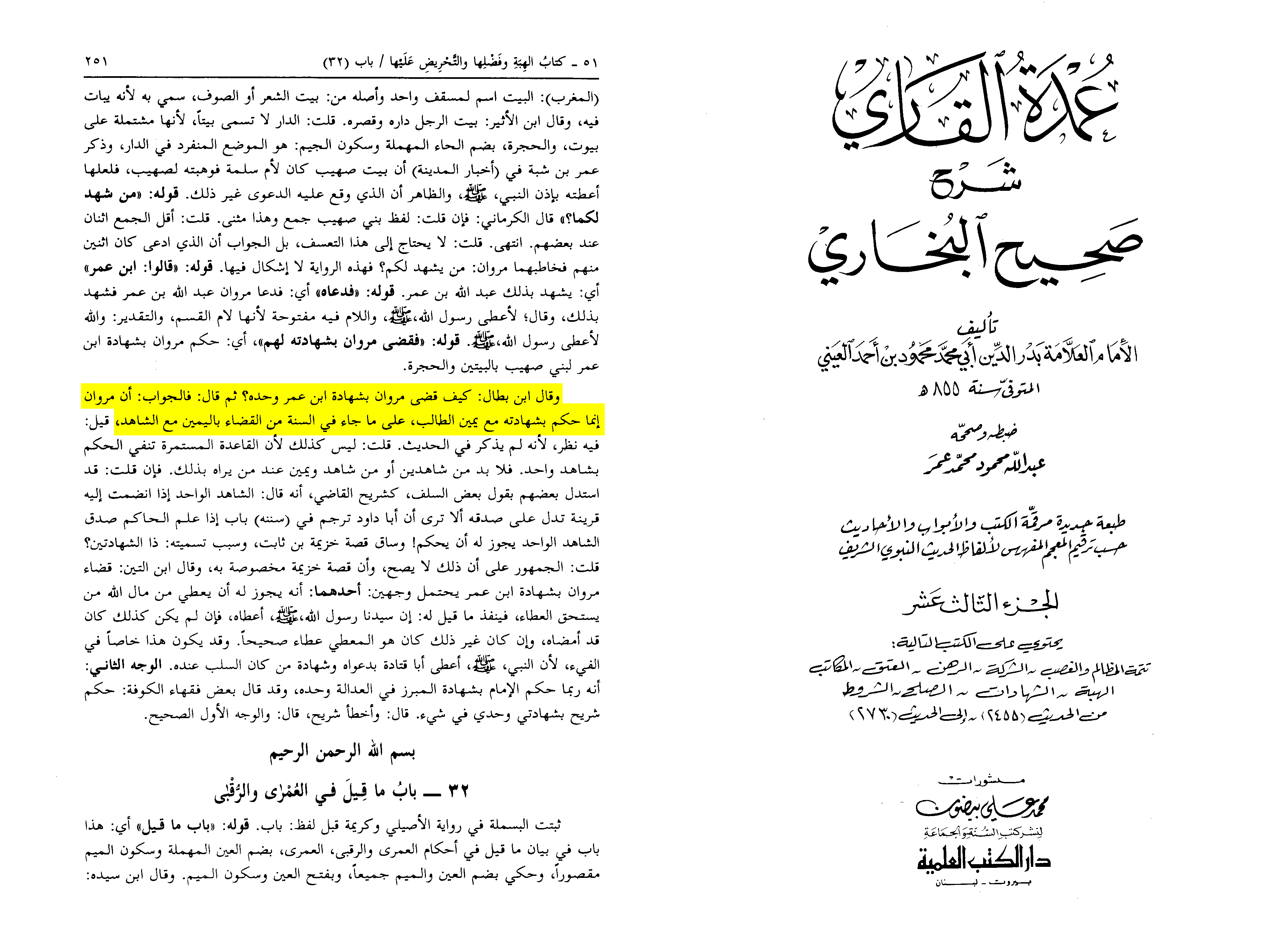
Al-’Ayni records in commentary of this hadith in his Umdat al-Qari, Vol. 13 pg. 251:
Ibn Batal said: ‘How did Marwan judge on the basis of Ibn Umar testimony only? The answer is that Marwan judged by his testimony accompanied by the oath of the claimant according to Sunnah in making judgment by a single witness and oath of claimant.
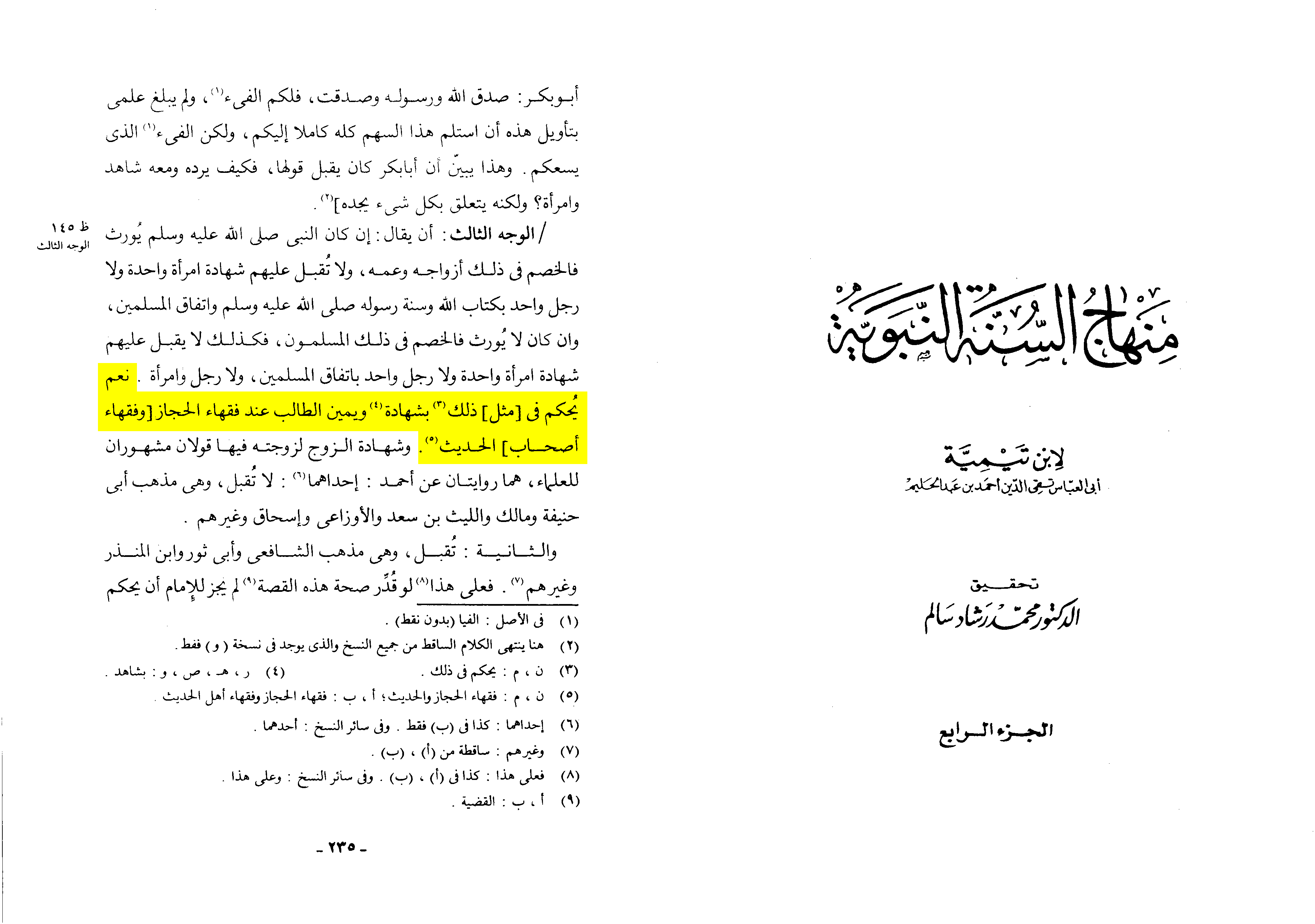
Ibn Taymiyya expressed the same view in Minhaj al-Sunnah, Vol. 4 pg. 235:
“Yes, in such a case judgment is given on the basis of one witness together with the oath of the claimant according to the jurists of the Hijaz and the jurists among the people of hadith.”
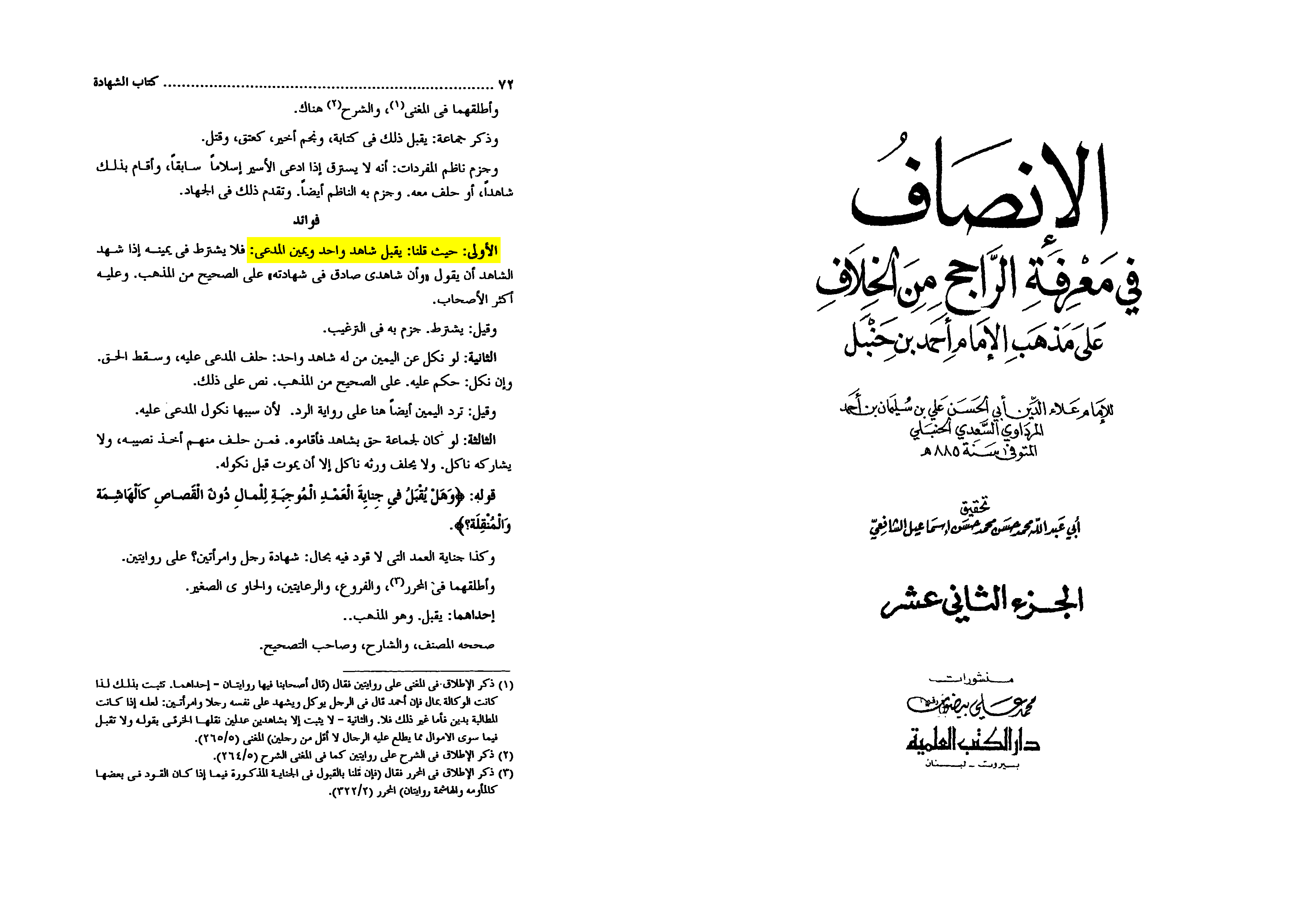
Al-Mawardi also says this in al-Ensaf, Vol. 12, pg. 72:
“The first: where we said that one witness and the oath of the claimant are accepted.”
So Fatima’s (AS) claim was enough and sufficient, so there was absolutely no reason to reject it along with two other testimonies.
The inconsistency of Abu Bakr
Furthermore, Abu Bakr had no right to reject Fatima (AS) and her witnesses, because we have seen multiple examples during his caliphate wherein he accepted the testimony of a single Sahabi in cases that benefitted them. Let us go over a few examples.
Abu Bakr did not demand witnesses from Jabir al-Ansari
A great example of his inconsistency is what we read in Sahih al-Bukhari 2296
Narrated Jabir b. `Abdullah:
Once the Prophet (ﷺ) said (to me), "If the money of Bahrain comes, I will give you a certain amount of it." The Prophet (ﷺ) had breathed his last before the money of Bahrain arrived. When the money of Bahrain reached, Abu Bakr announced, "Whoever was promised by the Prophet (ﷺ) should come to us." I went to Abu Bakr and said, "The Prophet (ﷺ) promised me so and so." Abu Bakr gave me a handful of coins and when I counted them, they were five-hundred in number. Abu Bakr then said, "Take twice the amount you have taken (besides).
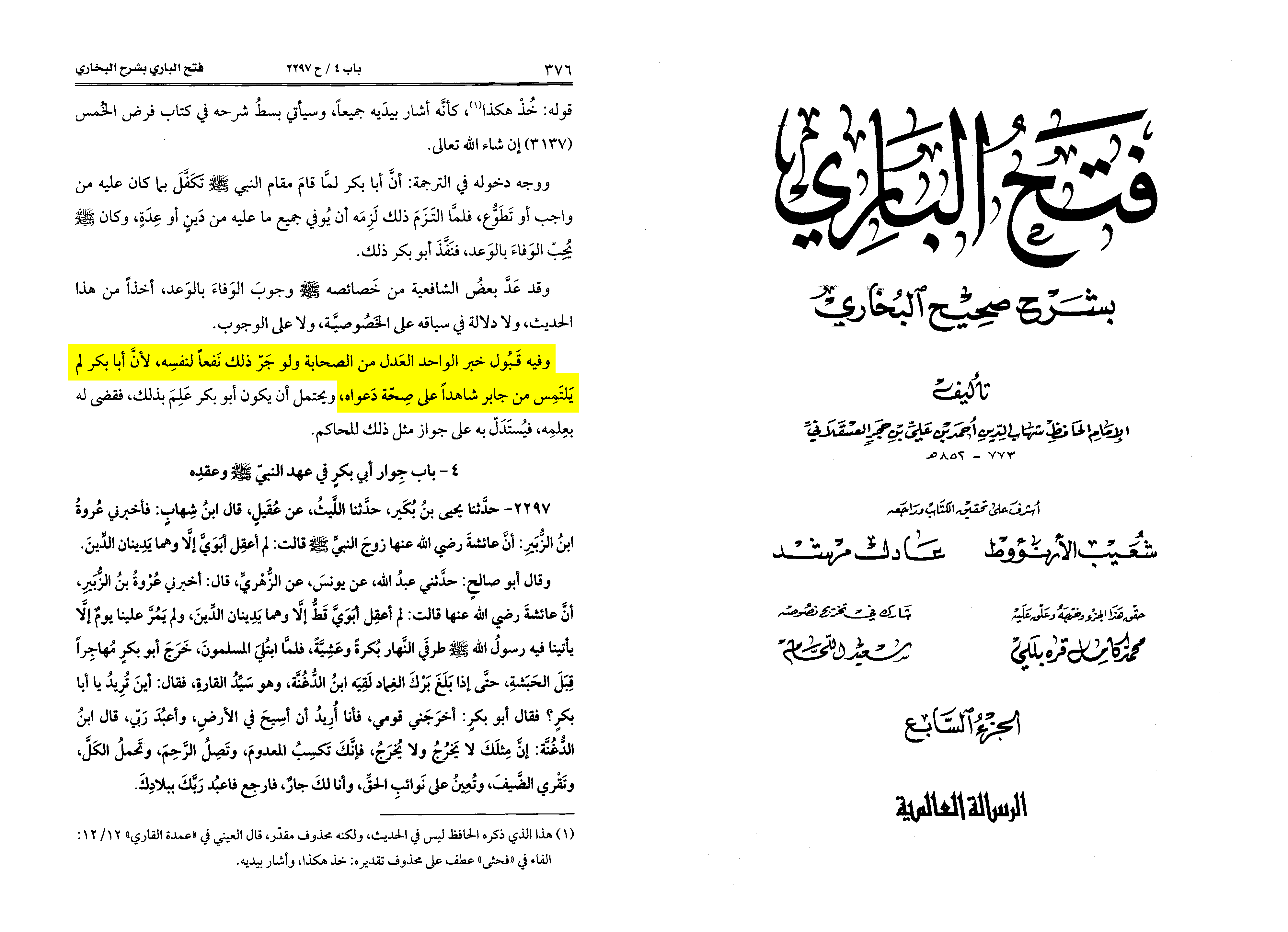
Furthermore, Ibn Hajar al-’Asqalani said regarding this tradition in his Fath al-Bari. Vol. 7, pg. 376:
“And in it is proof for the acceptance of the report of a single trustworthy individual from among the Companions, even if it brings some benefit to himself, because Abu Bakr did not ask Jabir b. Abd Allah for a witness to establish the truthfulness of his claim.”
And al-’Ayni similarly says in Umdat al-Qari. Vol. 12, pg. 171:
‘I say: The reason he did not ask him for a witness is because he was deemed trustworthy by the Book and the Sunnah.
As for the Book, it is the saying of Allah Most High: {You are the best nation brought forth for mankind} [Quran 3:110], and likewise His saying: {Thus We made you a middle nation} [Quran 2:143].
So if someone like Jabir b. Abd Allah is not among the best of the nation, then who would be?
And as for the Sunnah, it is the saying of the Prophet (SAW): “Whoever deliberately lies about me…” — the hadith.
And such a thing is not suspected of a Muslim, let alone a Companion.’”
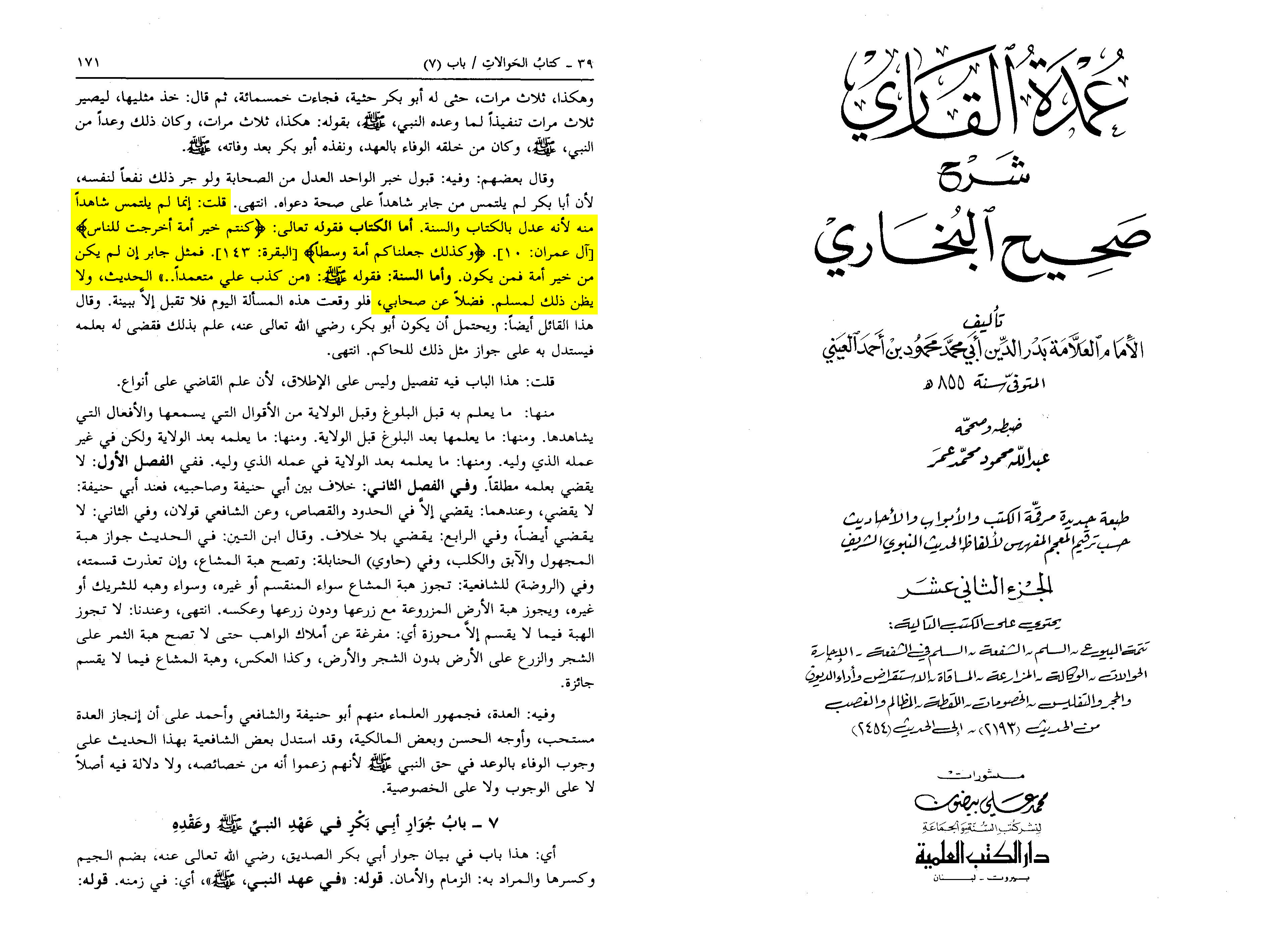
Subhanallah, we ask our opponents, was Fatima (AS) not among the best of the nation? If lying on the Prophet (SAW) is not suspected of a Muslim let alone a companion, how then can Fatima be accused of lying on the Prophet (SAW)? By what logic or justice is Fatima turned away while she had two witnesses to corroborate her claim while the claim of Jabir (RA) is accepted with only one?
Abu Bakr accepted a testimony of a dead man via a dream
What makes Abu Bakr’s inconsistency even more apparent is the case of Thabit b. Qays, a Sahabi who was killed in battle and then had his will carried out by Abu Bakr on the testimony of a man who saw him in a dream!
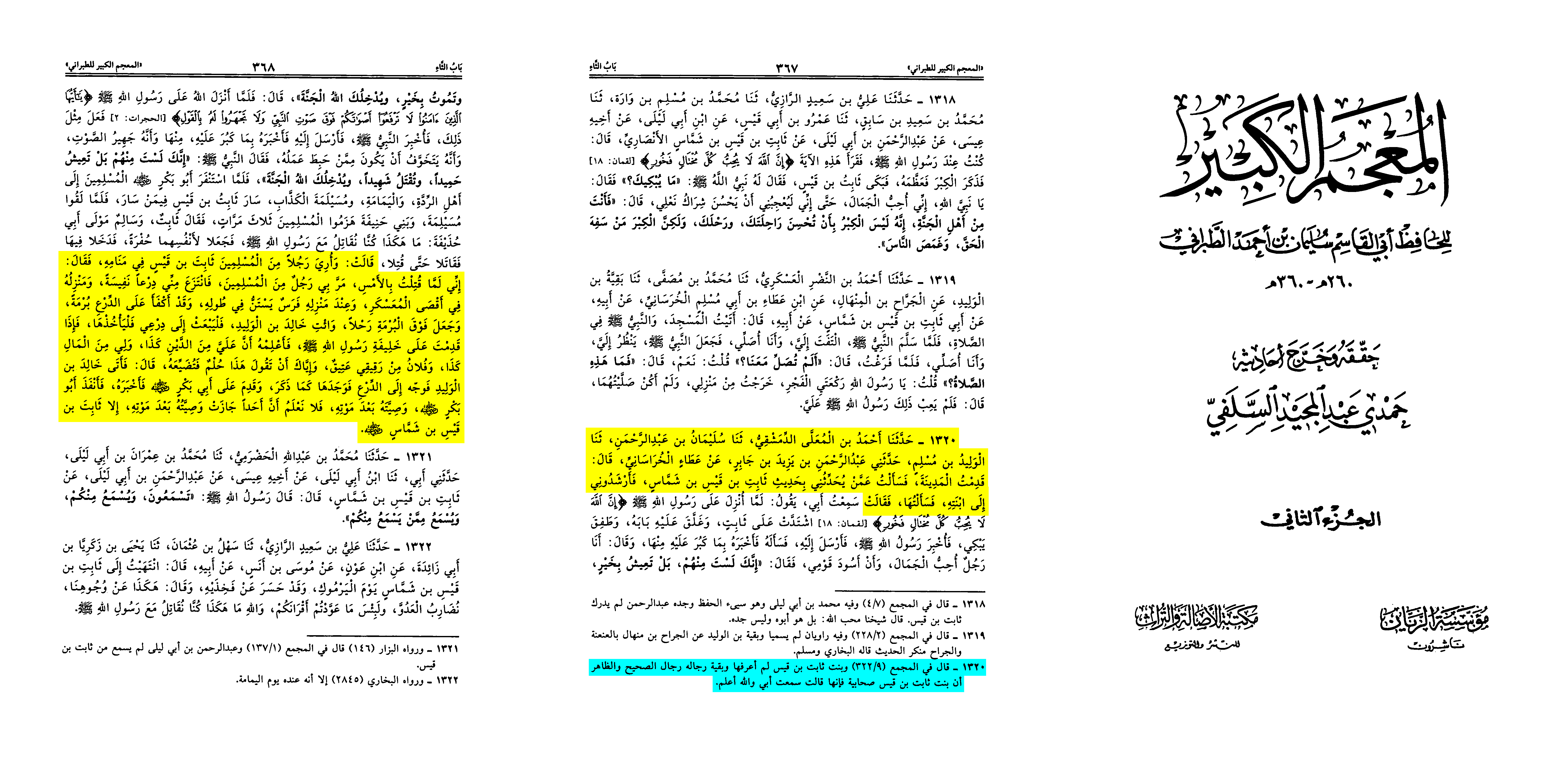
We read in al-Tabarani’s al-Mu’jam al-Kabir, Vol 2, pg. 367-368, Hadith # 1320:
Ahmad b. al-Mualla al-Dimashqi narrated to us: Sulayman b. Abd al-Rahman narrated to us: al-Walid b. Muslim narrated to us: Abd al-Rahman b. Yazid b. Jabir narrated to me from Ata al-Khurasani, who said:
I came to Medina and asked for someone who could narrate to me the hadith of Thabit b. Qays b. Shammas. They directed me to his daughter, so I asked her, and she said…
A Muslim man later saw Thabit b. Qays in a dream, and Thabit said to him:
“Yesterday, after I was killed, a Muslim man passed by me and took a valuable coat of armor from me. His tent is at the far edge of the camp. Near his tent is a horse tethered on a long rope. He has overturned a cooking pot over the armor and placed a saddle on top of the pot. Go to Khalid b. al-Walid and tell him to send for my armor and retrieve it.
And when you arrive before the successor of the Messenger of Allah (SAW), inform him that I owe such-and-such debt, that I possess such-and-such wealth, and that a certain slave of mine is free.
And beware lest you say, ‘This is only a dream,’ and neglect it.”
The man went to Khalid b. al-Walid, who sent men for the armor, and they found it exactly as Thabit had described.
Then the man came to Abu Bakr and informed him, so Abu Bakr carried out his will after his death.
And we do not know of anyone whose will was executed after his death except Thabit b. Qays b. Shammas, may Allah be pleased with him.”
Al-Haythami commented on this in his Majma’ al-Zawa’id, Vol. 9, pg. 395 - 396, Hadith # 15784:.
This narration was reported by al-Tabarani, and the daughter of Thabit b. Qays, whom I am not familiar with, and the rest of the narrators in the chain are reliable narrators. It appears that the daughter of Thabit b. Qays was a companion (Sahabiyyah). She said, "I heard from my father, and Allah knows best."
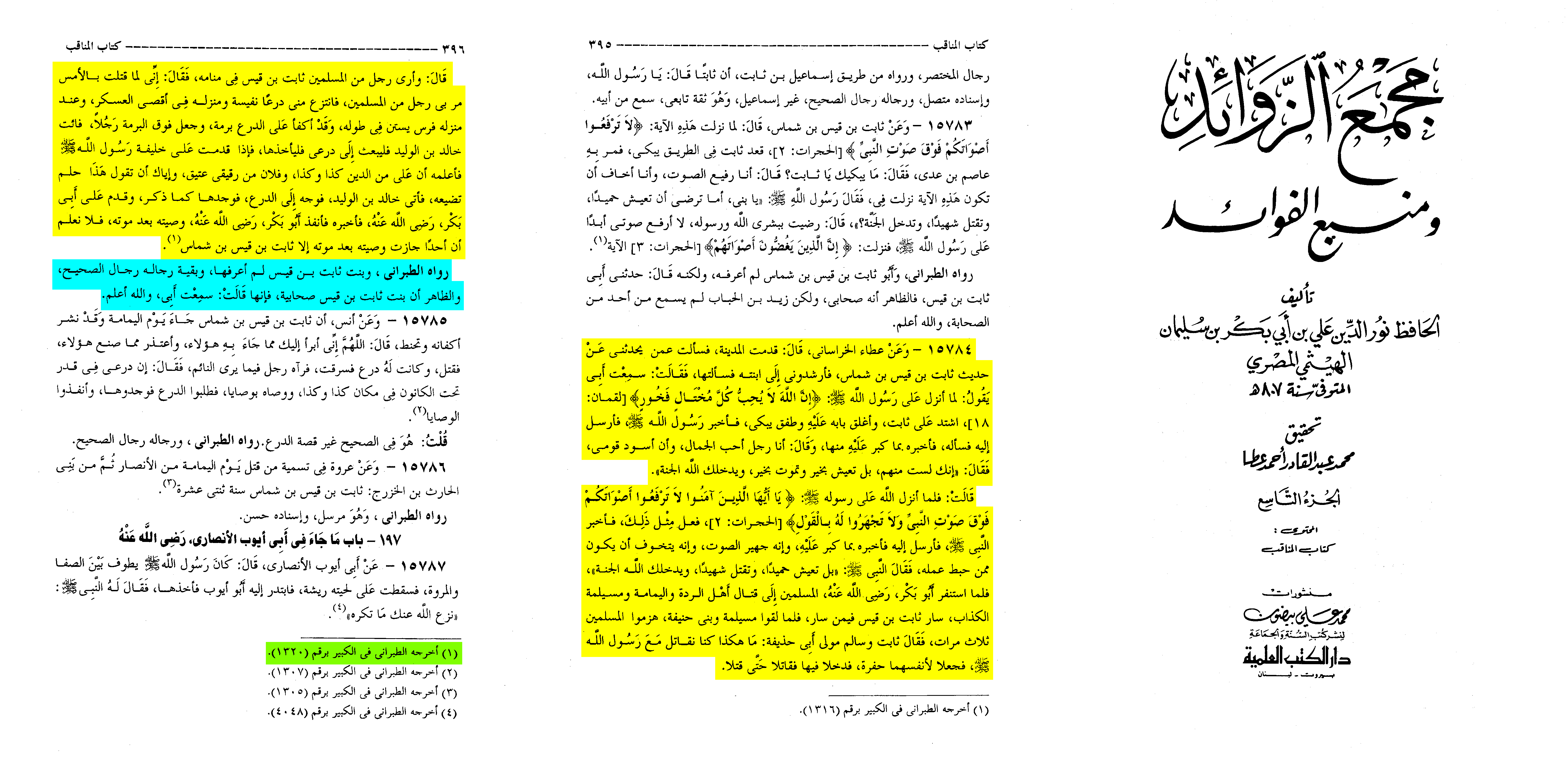
This report can also be found in the following sources:
This shows that Abu Bakr considered even the dead man’s testimony as having legal authority yet somehow the testimonies of Fatima (AS) and her witnesses were not enough in the case of Fadak. We ask our readers, who was more worthy of having their testimony accepted, Fatima (AS) and her witnesses, or a sahabi who appeared to someone in a dream?
Is a spouse's testimony acceptable?
Some of our opponents would try to argue that Abu Bakr was correct in rejecting Fatima’s claim to Fadak, as Fatima (AS) brought forth her own husband as a witness, and the testimony of a husband for his wife is biased and thus unacceptable.
We reply to this in two ways. Firstly, we ask our readers to ponder:
If we accused any of the Sahaba of lying on the Prophet (SAW) for their own benefit, how would our opponents react? If we were to accuse any of their Imams of lying on the Prophet (SAW) for their own benefit, would they accept this?
To put forth this objection is to imply that ‘Ali (AS) would lie on the Prophet (SAW) for his own gain, which is humorous when one considers that the opponents of the Shia constantly flaunt themselves as the true lovers of the Ahl al-Bayt (AS) and constantly try to paint the Shia as charlatans.
Secondly, we remind our opponents that according to some of their own jurists, the testimony of a husband for his wife is acceptable. Ibn Taymiyya states in Minhaj al-Sunnah, Vol. 4 pg 235:
“And regarding the testimony of a husband for his wife, there are two well-known opinions among the scholars, and they are two narrations from Ahmad b. Hanbal:
The first: that it is not accepted. This is the school of Abu Hanifa, Malik b. Anas, al-Layth b. Sa’ad, al-Awzai, Ishaq b. Rahawayh, and others.
The second: that it is accepted. This is the school of al-Shafii, Abu Thawr, Ibn al-Mundhir, and others.”
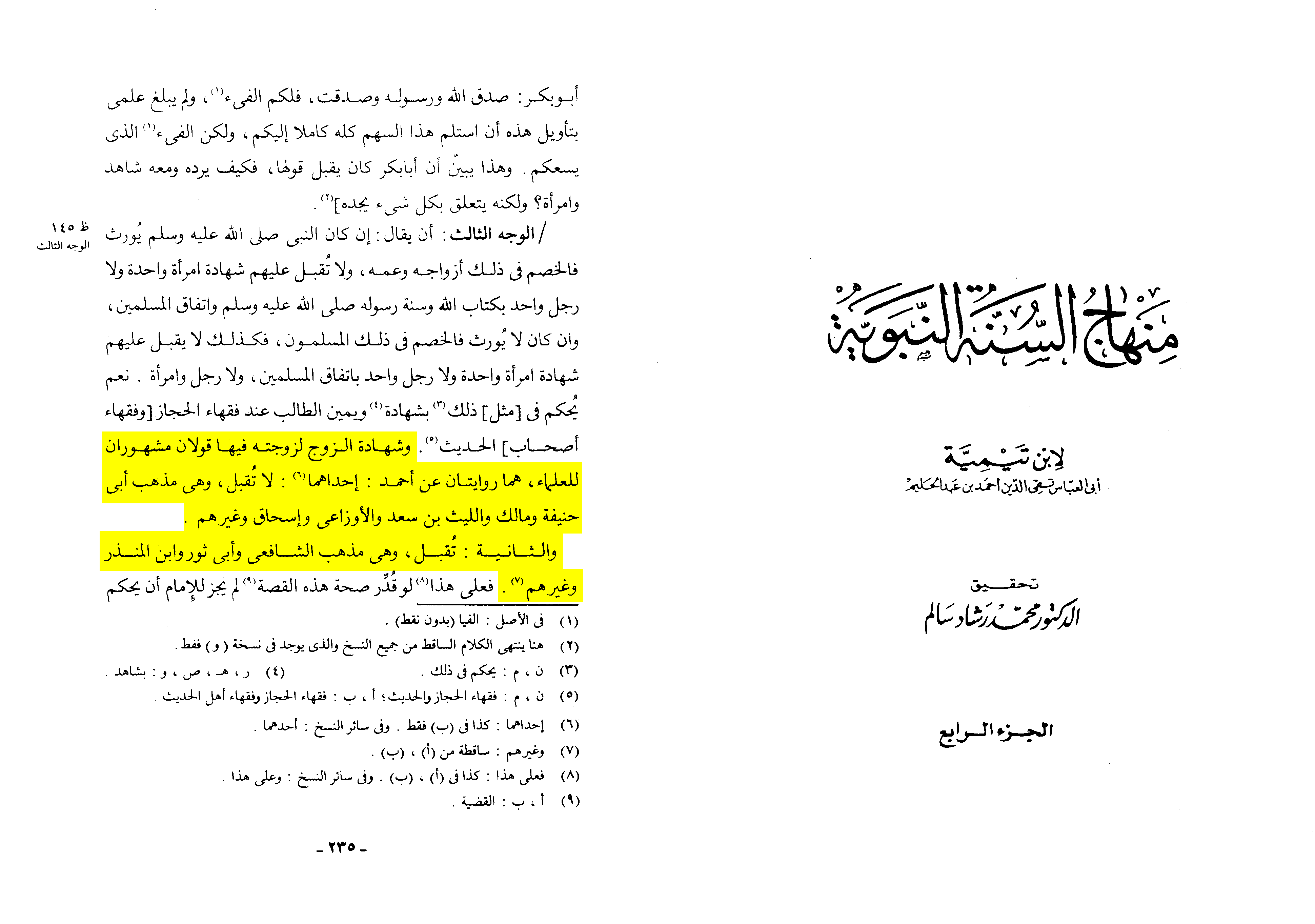
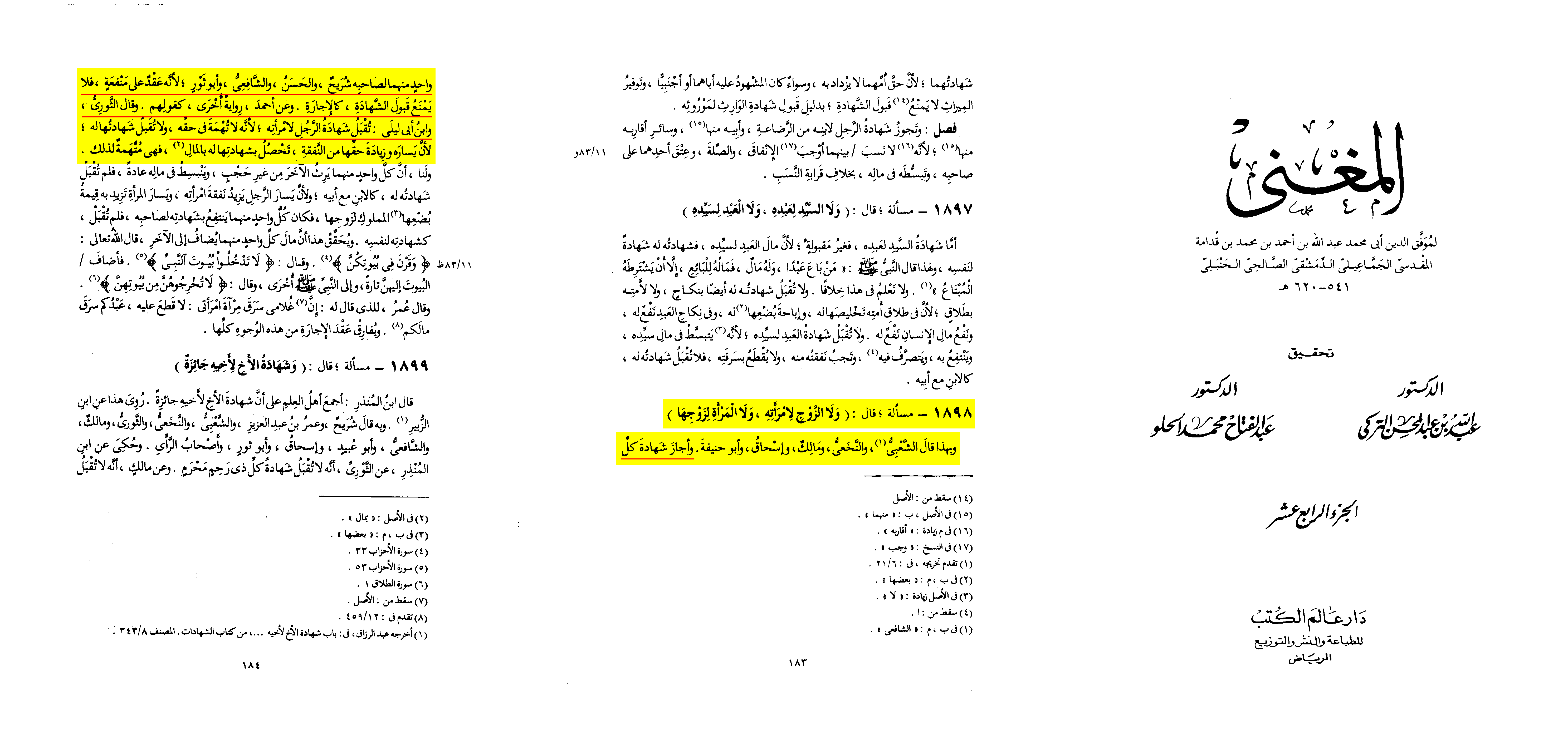
Similarly, we read in al-Mughni by Ibn Qudamah Vol 14, pg. 183 - 184, Issue 1898:
‘Nor is the husband’s testimony accepted for his wife, nor the wife’s testimony for her husband.’
This was also the view of al-Sha’abi, al-Nakhai, Malik b. Anas, Ishaq b. Rahawayh, and Abu Hanifah.
But Shurayh al-Qadi, al-Hasan al-Basri, al-Shafii, and Abu Thawr permitted the testimony of each spouse for the other, because marriage is a contract based on benefit, so it does not prevent acceptance of testimony, just like leasing.
And from Ahmad b. Hanbal, there is another narration agreeing with them.
And Sufyan al-Thawri and Ibn Abi Layla said:
‘A man’s testimony for his wife is accepted, because there is no suspicion concerning him. But her testimony for him is not accepted, because his wealth and the increase of her financial rights through maintenance are achieved through her testimony in his favor regarding wealth, so she is suspected because of that.’”
The Status of Fatima’s witnesses
Fatima bt. Muhammad al-Zahraa (AS) brought witnesses of the highest caliber. Herself, the best of the women of this Ummah, rather of all women, her husband- Amir al-Mu’minin (AS)- and Umm Ayman!
Witness 1: Umm Ayman (RA)
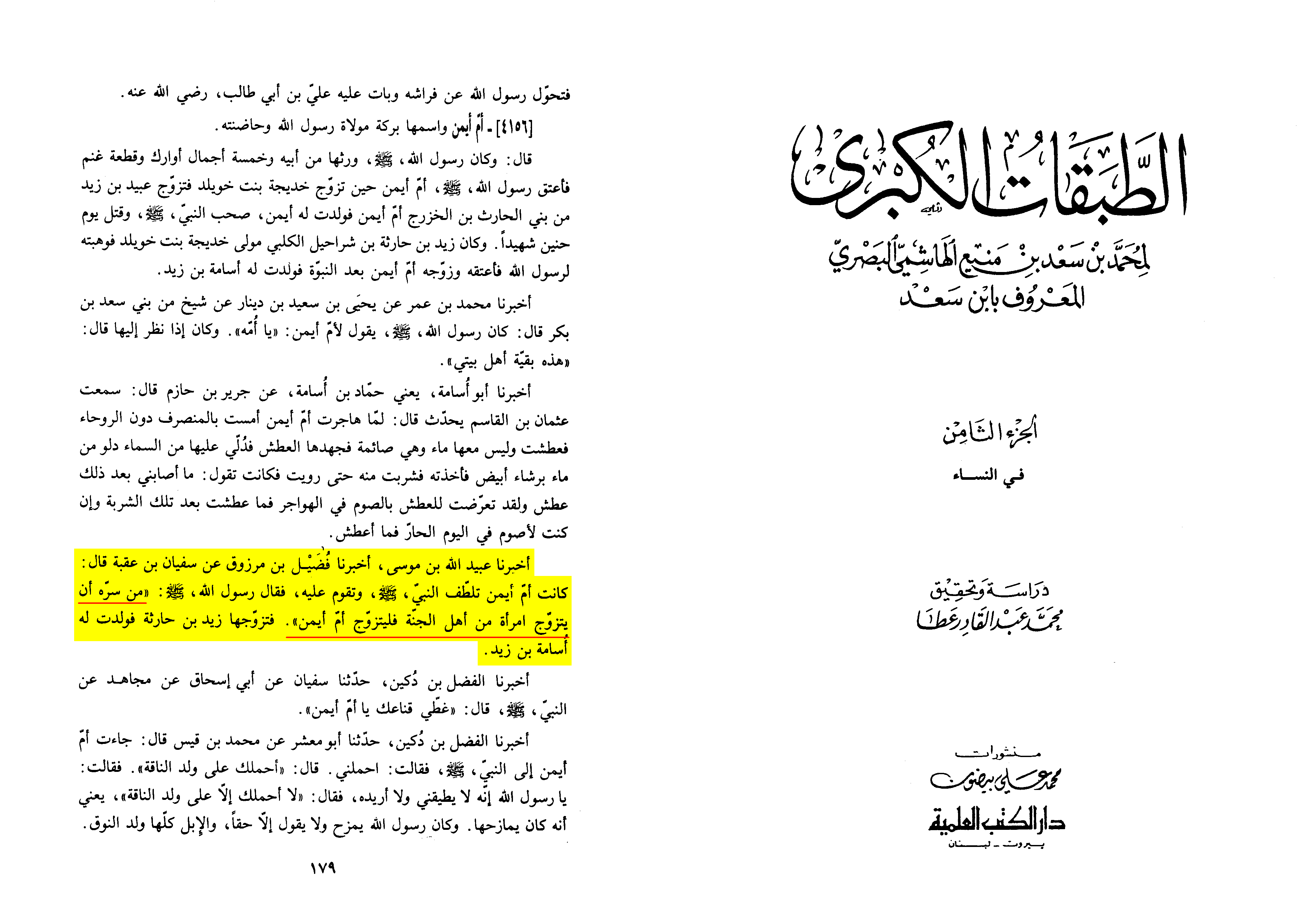
Umm Ayman (RA) was the servant of Rasulullah (SAW) as stated by al-Dhahabi in his Siyar A'lam al-ِNubala, Vol. 2, pg. 223. She had a status so lofty and high, the Prophet (SAW) used to say she’s a woman of paradise as recorded in Ibn Sa’ad’s Tabaqat al-Kubra, Vol 8, pg. 179:
Ubayd Allah b. Musa informed us: Fudayl b. Marzuq informed us from Sufyan b. Uqbah, who said:
Umm Ayman used to care tenderly for the Prophet (SAW) and look after him.
So the Messenger of Allah (SAW) said:
‘Whoever wishes to marry a woman from the people of Paradise, let him marry Umm Ayman.’
Then Zayd b. Harithah married her, and she gave birth to Usamah b. Zayd for him.”
Witness 2: ‘Ali b. Abi Talib
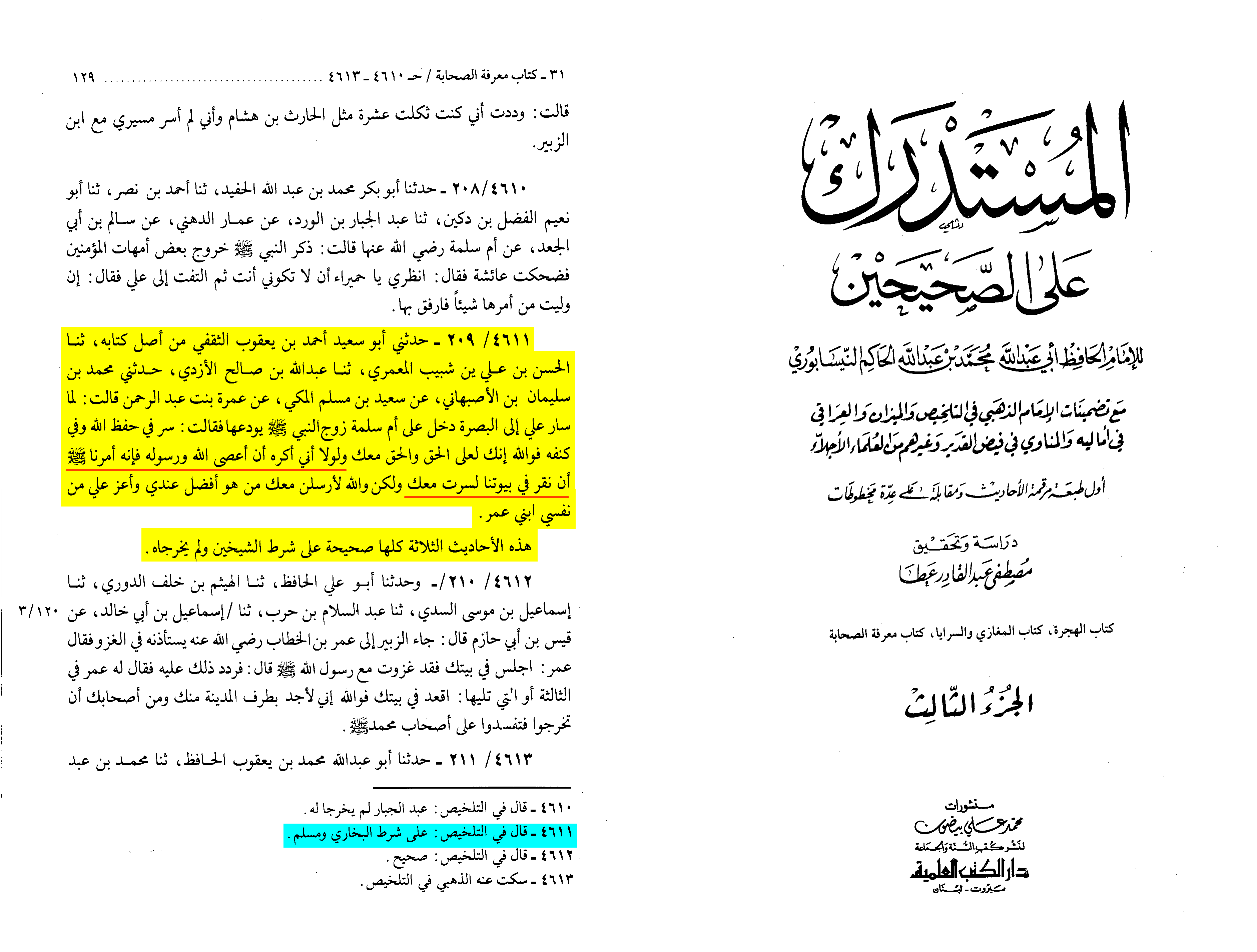
As for Ali (AS), it has been said about him that the truth is with him, and he is with the truth unconditionally. However, we will highlight the narration certified by al-Dhahabi in al-Mustadrak ala al-Sahihain, Vol 3 pg. 129 Hadith # 4611:
Abu Said Ahmad b. Yaqub al-Thaqafi narrated to me from the original of his book: al-Hasan b. Ali b. Shabib al-Mamari narrated to us: Abd Allah b. Salih al-Azdi narrated to us: Muhammad b. Sulayman b. al-Asbahani narrated to me from Said b. Muslim al-Makki, from Amrah daughter of Abd al-Rahman, who said:
When ‘Ali b. Abi Talib set out for Basra, he entered upon Umm Salamah, the wife of the Prophet (SAW), to bid her farewell. She said:
‘Go under the protection of Allah and in His care. By Allah, you are certainly upon the truth, and the truth is with you. Were it not that I dislike disobeying Allah and His Messenger — for the Messenger of Allah (SAW) commanded us to remain in our homes — I would have gone out with you. But by Allah, I shall certainly send with you one who is dearer and more precious to me than my own self: my son Umar.’
Furthermore, it is well attested that ‘Ali was an outstanding judge, as he had been miraculously granted the wisdom required to be a judge through a supplication from the Prophet (SAW).
We read in Sunan Abi Dawud 3582:
Narrated Ali ibn AbuTalib:
The Messenger of Allah (ﷺ) sent me to the Yemen as judge, and I asked: Messenger of Allah, are you sending me when I am young and have no knowledge of the duties of a judge?
He replied: Allah will guide your heart and keep your tongue true. When two litigants sit in front of you, do not decide till you hear what the other has to say as you heard what the first had to say; for it is best that you should have a clear idea of the best decision.
He said: I had been a judge (for long); or he said (the narrator is doubtful): I have no doubts about a decision afterwards.
This hadith can also be found in the following sources:
Should our opponents have problems with this, let them refer to the words of ‘Umar as recorded in Sahih al-Bukhari 4481:
`Umar said, "Our best Qur'an reciter is Ubai and our best judge is `Ali; and in spite of this, we leave some of the statements of Ubai because Ubai says, 'I do not leave anything that I have heard from Allah's Messenger (ﷺ) while Allah: "Whatever verse (Revelations) do We abrogate or cause to be forgotten but We bring a better one or similar to it." (2.106)
Furthermore we have the testimony of Ibn Mas’ud who said the same:
Abdullah (b. Masud) said:
‘We used to say that no one is the best Judge in Medina other than ‘Ali’
Fatima bt. Muhammad (AS)
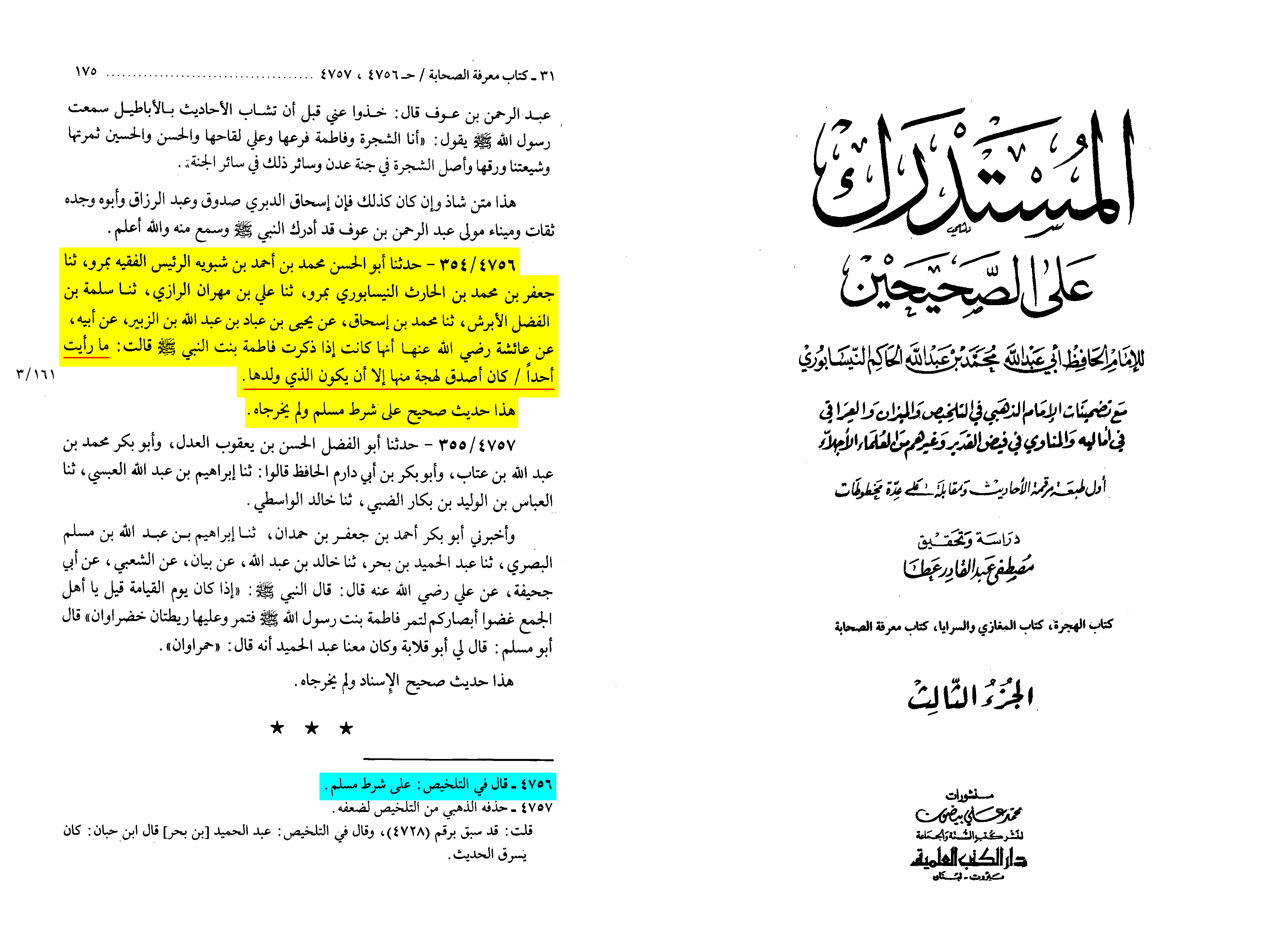
As for Fatima herself, she was the greatest daughter of the greatest man who ever walked this earth, and her honesty is testified to even by our opponents’ most revered figures. We read in al-Mustadrak ‘ala al-Sahihain, Vol. 3, pg. 175, Hadith # 4756:
Abu al-Hasan Muhammad b. Ahmad b. Shabbuyah, the chief jurist in Marw, narrated to us: Jafar b. Muhammad b. al-Harith al-Naysaburi in Marw narrated to us: Ali b. Mihran al-Razi narrated to us: Salamah b. al-Fadl al-Abrash narrated to us: Muhammad b. Ishaq narrated from Yahya b. Abbad b. Abd Allah b. al-Zubayr, from his father,
From Aisha: Whenever Fatima, the daughter of the Prophet (SAW), was mentioned, she would say: ‘I never saw anyone more truthful in speech than her, except for the one who fathered her.’
Should anyone be foolish or Nasibi enough to doubt the honesty of Fatima (AS), we would remind them that the Prophet (SAW), who never lied from the day he was born until Allah took him unto himself declared that she was the mistress of the women of paradise.
We read in Jami` at-Tirmidhi 3781:
Narrated Hudhaifah:
"My mother asked me: 'When is your planned time - meaning with the Prophet (ﷺ)?'
So I said: 'I have not had a planned time to see him since such and such time.'
She rebuked me, so I said to her: 'Let me go to the Prophet (ﷺ) so that I may perform Maghrib (prayer) with him, and ask him to seek forgiveness for you and I.'
So I came to the Prophet (ﷺ), and I prayed Maghrib with him, then he prayed until he prayed Al-'Isha. Then he turned, and I followed him, and he heard my voice, and said: 'Who is this? Hudhaifah?'
I said: 'Yes.'
He said: 'What is your need, may Allah forgive you and your mother?'
He said: 'Indeed, this is an angel that never descended to the earth ever before tonight. He sought permission from his Lord to greet me with peace and to give me the glad tidings that Fatimah is the chief of the women of Paradise, and that Al-Hasan and Al-Husain are the chiefs of the youths of the people of Paradise.'"
It is unbefitting of a believer to lie, let alone the mistress of the believing women of paradise. By what right then, does Abu Bakr reject her testimony and rob her of her right? By what right does he revive the tradition of Jahiliyya wherein a woman would lose her father and be left with nothing?
We see that in the case of Fadak there are double standards against the family of the Prophet (SAWW). Abu Bakr requires witnesses for the chief of the women of Paradise, while for others he accepted their claims without requesting any additional evidence.
Abu Bakr stole the Khumms of the Ahl al-Bayt
We would also inform our readers that Abu Bakr not only denied Fatima (AS) her inheritance, but he also oppressed the rest of Ahl al-Bayt (AS) by withholding the Khumms, which the Prophet (SAW) had granted them during his lifetime. We now present the evidence for this.
The verse of Khumms
To prove that the Prophet (SAW) gave Bani Hashim Khumms we look no further than the Quran itself in Surah al-Anfal verse 41:
وَاعلَموا أَنَّما غَنِمتُم مِن شَيءٍ فَأَنَّ لِلَّهِ خُمُسَهُ وَلِلرَّسولِ وَلِذِي القُربىٰ وَاليَتامىٰ وَالمَساكينِ وَابنِ السَّبيلِ
{And know that anything you obtain of war booty - then indeed, for Allah is one fifth of it and for the Messenger and for [his] near relatives and the orphans, the needy, and the [stranded] traveler.}
This verse proves that Khumms is the right of Bani Hashim. Al-Tabari says in Tafsir al-Tabari. Vol. 11, pg. 193 - 194 that Mujahid, Ibn Abbas, and Ibn Jurayj held this opinion as well as Imam ‘Ali b. al-Husayn (AS):
From Abu al-Daylam, who said:
Ali b. al-Husayn (AS) said to a man from the people of al-Sham: “Have you not read in ‘al-Anfal’: ‘And know that whatever you acquire of spoils, then indeed for Allah is one-fifth of it and for the Messenger…’ (the verse)?”
He said: “Yes.” He then asked: “Then are you indeed those (meant by it)?” He said: “Yes.”
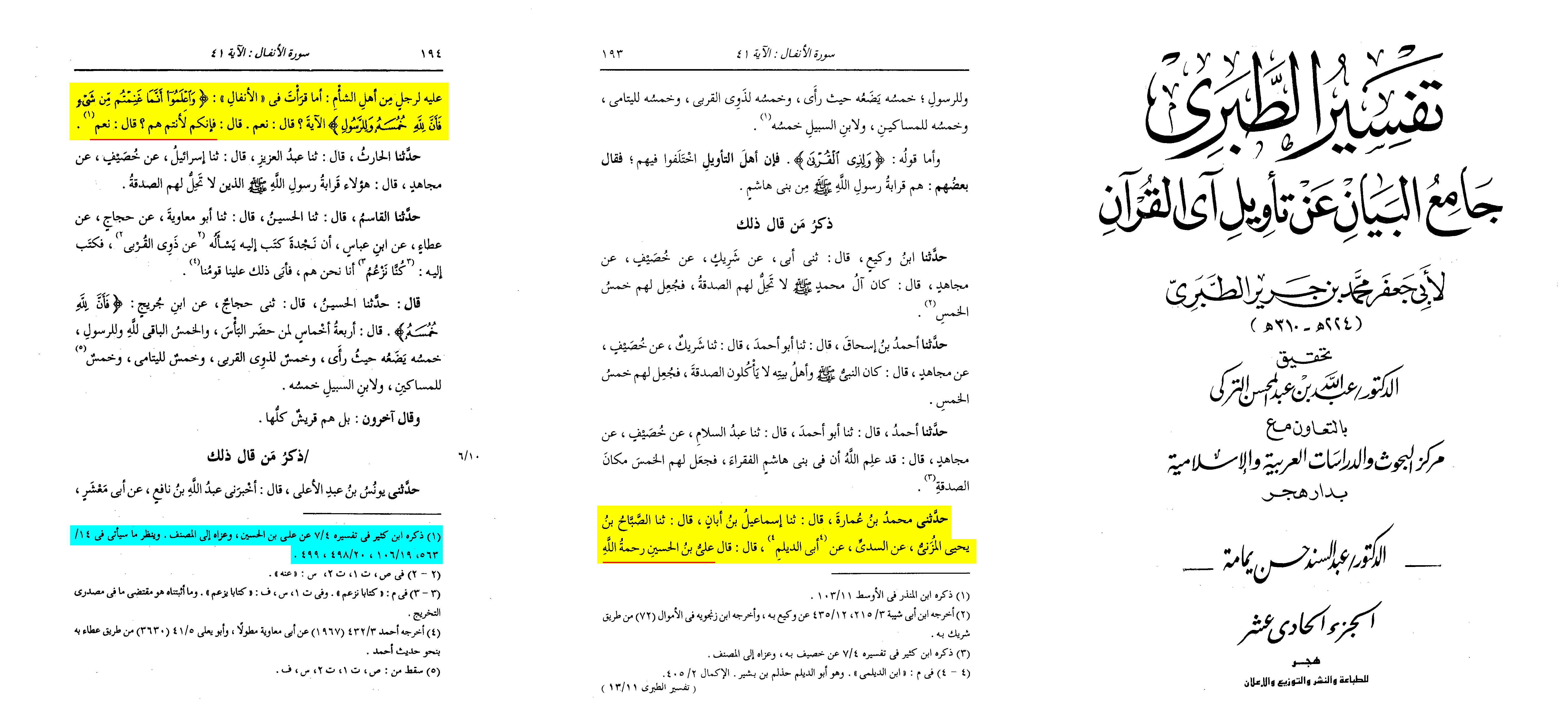
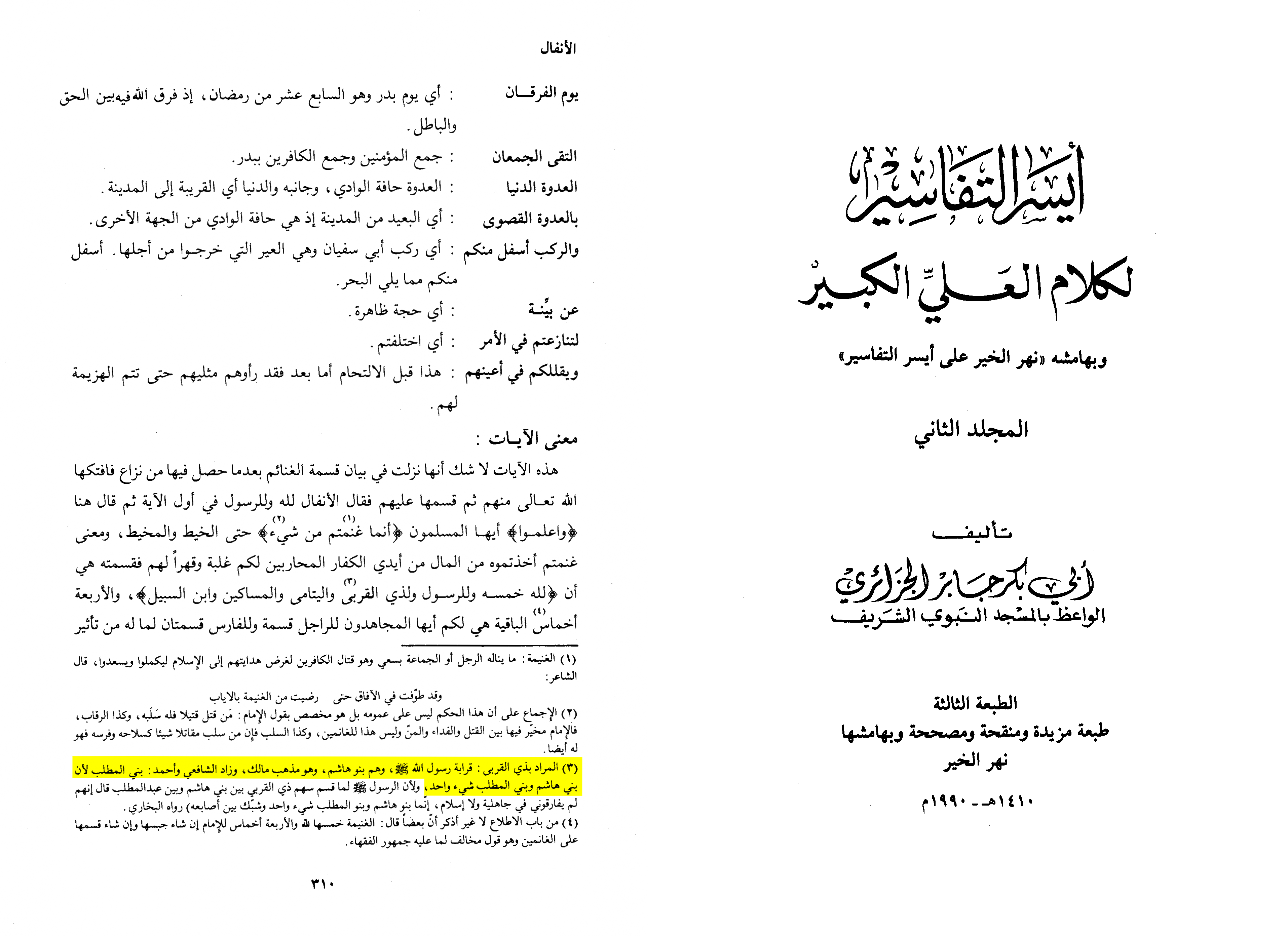
In fact, al-Tabari, (the greatest commentator of the Quran according to Ibn Taymiyyah,) concludes the correct opinion about this verse is that it’s about those clans in Tafsir al-Tabari. Vol. 11, pg. 196. Similarly in al-Jazaeri’s Aysar al-Tafasir, Vol. 2, pg. 310 we read:
The meaning of ‘al-Qurba’ is: The relatives of Rasulullah (SAW), and they are Banu Hashim per Malik’s opinion. Al-Shafi’i and Ahmad added Banu Muttalib because Bani Hashim and Banu Muttalib are one thing.
Now, it is evident that the Qur’anic command is that the relatives get their share of war booty - the khumms. However, Abu Bakr did not adhere to this rule and kept this away from them.
The Khumms was stolen
As we have shown, Rasulallah (SAW) would distribute the khumms ONLY to his relatives of Banu Hashim and Muttalib, as this was their exclusive right that Allah (swt) had granted them in the Qur’an. This is why Ibn Abbas wrote as recorded in Sunan an-Nasa'i 4133:
It was narrated from Yazid bin Hurmuz that:
when Najdah Al-Haruriyyah rebelled during the Fitnah of Ibn Zubayr, he sent word to Ibn 'Abbas asking him about the share of the relatives (of the Messenger of Allah) -to whom did he think it should be given? He replied: "It is for us, because of our blood ties to the Messenger of Allah allocated it to them, but 'Umar offered us something we thought was less than what was our due, and we refused to accept it. What he offered to them who wanted to get married, and to help the debtors pay off their debts, and he gave to their indigent. But he refused to give them more than that."
Despite this right being established in the Quran and Sunnah, Abu Bakr withheld it, as is narrated authentically in Sunan Abi Dawud 2978:
Narrated Jubair b. Mut'im:
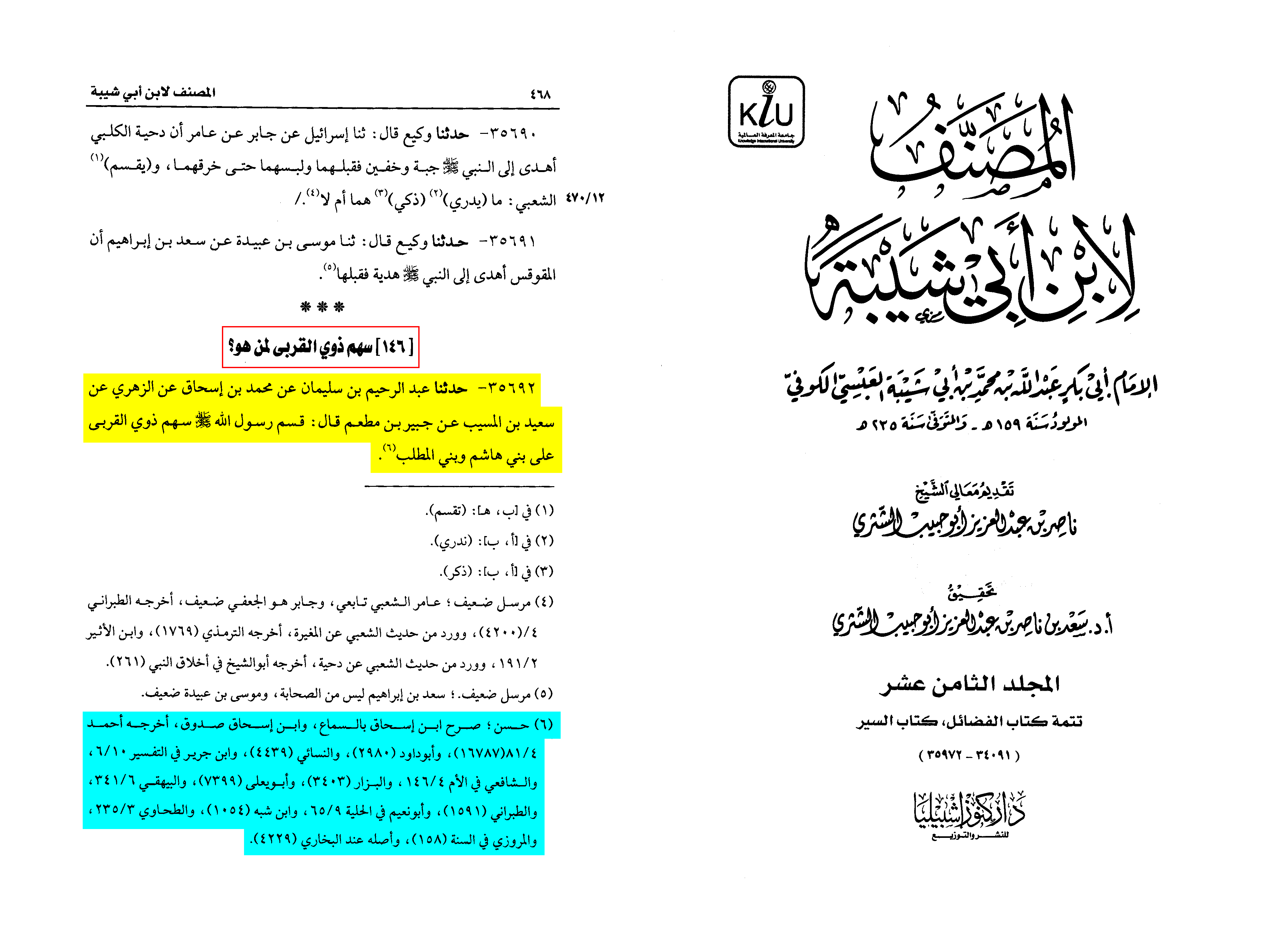
That he and 'Uthman b. 'Affan went to the Messenger of Allah (ﷺ) talking to him about the fifth which he divided among the Banu Hisham and Abu 'Abd al-Muttalib. I said: Messenger of Allah, you have divided (the fifth) among our brethren Banu 'Abd al-Muttalib, but you have not given us anything, though our relationship to you is the same as theirs. The Prophet (ﷺ) said: The Banu Hisham and the Banu 'Abd al-Muttalib are one. Jubair said: He did not divide the fifth among the Banu 'Abd Shams and the Banu Nawfal as he divided among the Banu Hashim and the Banu 'Abd al-Muttalib. He said: Abu Bakr used to divide the fifth like the division of Messenger of Allah (ﷺ) except that he did not give the relatives of the Messenger of Allah (ﷺ), as he gave them. 'Umar b. al-Khattab and 'Uthman after him used to give them (a portion) from it.
This report was also transmitted in Musannaf Ibn Abi Shayba Vol 18, pg. 468, Hadith # 35692 with a hasan (reliable) chain.
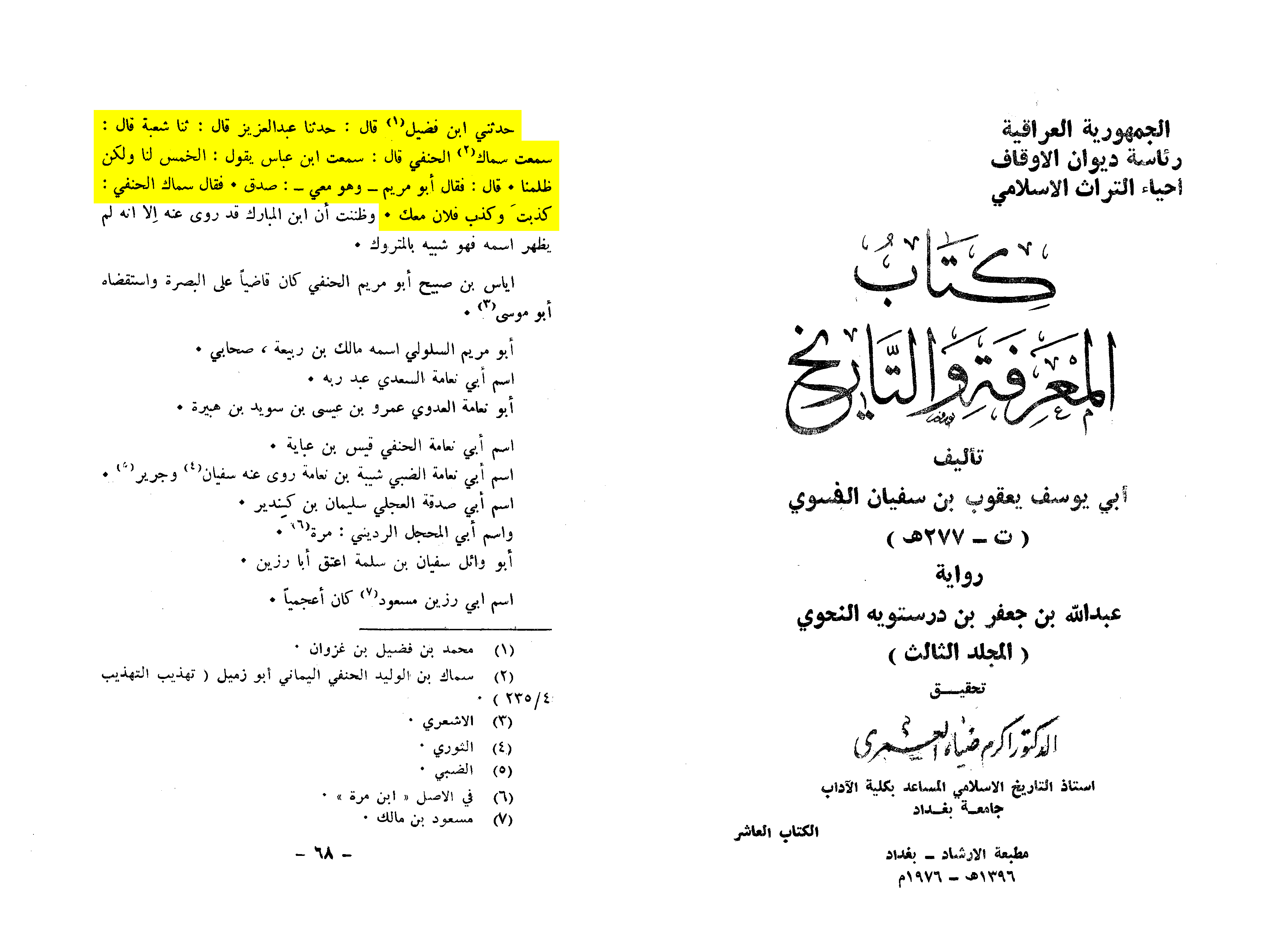
We also read in al-Ma'rifa wal Tarikh, Vol 3, pg. 68:
Ibn Fudayl narrated to me, he said: ‘Abd al-‘Aziz narrated to us, he said: Shu‘bah narrated, he said: I heard Simak al-Hanafi say:
I heard Ibn ‘Abbas say: “The khumms belongs to us, but we have been wronged.”
Our opponents are left to explain this. Either Abu Bakr knew that the Khumms was the right of Bani Hashim, or he was ignorant of this. If he did know, then he intentionally oppressed Ahl al-Bayt (AS), making him unworthy of the caliphate. If he did not know, then he is also unworthy of the Caliphate due to his ignorance of the financial rights of the Prophet’s (SAW) own family. Either way he oppressed them, and either way he is unworthy of the caliphate.
Conclusion
To understand the absurdity of our opponents, we need not look further than Abu Bakr himself. He says himself in Sahih al-Bukhari 3713:
Abu Bakr: Look at Muhammad through his family (i.e. if you are no good to his family you are not good to him).
His very words indict him, a man who stole Fadak and the Khumms from the family of the Prophet (SAW). In the next chapter, we shall examine how Fatima (AS) continued to press her claim by claiming Fadak as an inheritance.


Salaam alaikum brothers, you mentioned the hadith from Tarikh al-Madina, isn’t it a mursal? Since it was transmitted by Zeyd Ibn Ali, it is unlikely that Sunnis will accept the hadith from him, please explain, as well as Said Ibn Khalid is a weak transmitter according to Sunnis